Top places to stay in Rome, Italy.
Rome established a legacy of hospitality through its position at the center of the ancient Roman Empire, the enduring influence of the papacy, and the cultural pilgrimage of the Grand Tour, bringing imperial grandeur, Renaissance patronage, and centuries of international travel into the fabric of the Italian capital. The Roman road network brought merchants, officials, and pilgrims into the imperial capital, where inns and lodging houses served travelers near commercial thoroughfares and public gathering places. Following the decline of the Western Roman Empire, the papacy became central to the city's institutions, sustaining a culture of religious hospitality through monasteries, hospices, and accommodation for pilgrims visiting the tombs of Saints Peter and Paul. The medieval pilgrimage routes connecting northern Europe with Rome supported an extensive network of religious guesthouses, establishing hospitality as an enduring part of the city's economy. During the Renaissance, papal patronage transformed Rome through ambitious architectural commissions and the construction of grand residences, attracting artists, diplomats, scholars, and aristocratic visitors. The reigns of Julius II and Leo X strengthened the city's position as a center of European artistic production, bringing international attention to the work of Bramante, Raphael, and Michelangelo. The completion of major Baroque projects during the seventeenth century further enhanced Rome's appeal, with grand churches, fountains, and public squares establishing the ceremonial landscape encountered by generations of travelers. During the eighteenth century, the Grand Tour brought wealthy European visitors to Rome for extended periods of classical study, artistic education, and social engagement. The city's lodging establishments developed alongside this international culture, serving aristocratic travelers, collectors, and artists whose visits often lasted several months. The opening of the Hotel d'Inghilterra in 1845 near the Spanish Steps reflected the growing sophistication of accommodation associated with Rome's international artistic community. Italian unification introduced another decisive period of change when Rome became the capital of the Kingdom of Italy in 1871, encouraging the construction of government institutions, commercial infrastructure, and substantial metropolitan hotels. The opening of the Grand Hotel in 1894, subsequently known as The St. Regis Rome, established a distinguished expression of luxury hospitality near the developing administrative center. The Excelsior opened on Via Veneto in 1906, strengthening the boulevard's association with prestigious accommodation and international society. During the twentieth century, Rome's expanding film industry introduced a new dimension to its hospitality culture, particularly following the establishment of Cinecittà in 1937. The international success of Italian cinema and the presence of American productions during the postwar decades brought actors, directors, and prominent cultural figures into the city's luxury hotels. Federico Fellini's La Dolce Vita, released in 1960, immortalized the social atmosphere of Via Veneto and reinforced Rome's association with glamorous metropolitan life. The expansion of commercial aviation and international tourism subsequently encouraged investment in contemporary accommodation near the historic center and principal transportation corridors. The restoration of aristocratic palazzi and former institutional buildings introduced a complementary tradition of intimate luxury hotels, preserving historic architecture within an increasingly sophisticated hospitality market. Rome's hotel industry today draws its exceptional character from the continuity between ancient travel, papal ceremony, aristocratic patronage, and the international cultural influence of modern Italy.
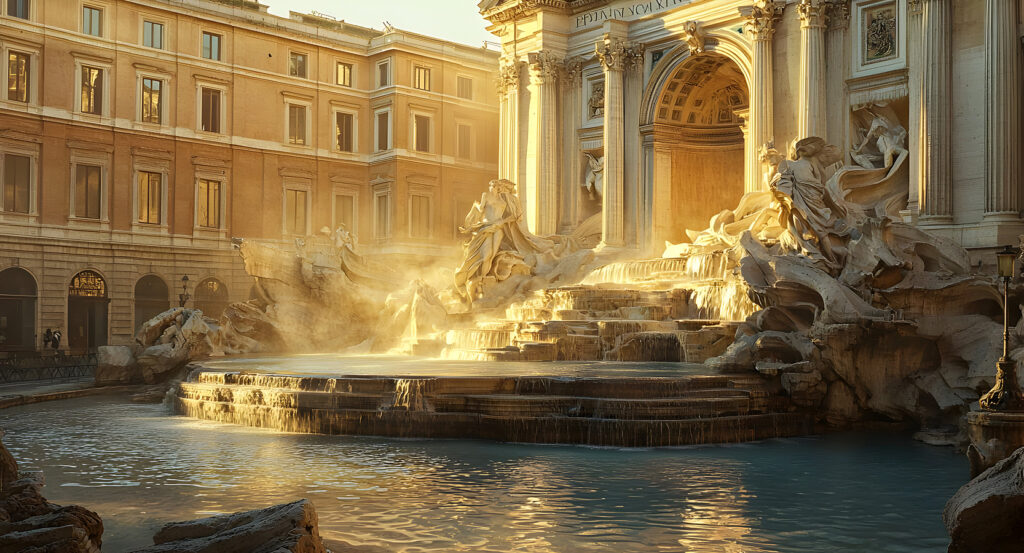
Rome's most distinguished places to stay occupy a remarkable architectural landscape shaped by ancient streets, Renaissance palaces, Baroque squares, and the grand avenues of the Italian capital. The historic center forms the principal setting for intimate luxury accommodation, where converted palazzi and substantial residential buildings occupy streets connecting the Pantheon, Piazza Navona, and Campo de' Fiori. This district preserves the irregular street pattern of medieval and Renaissance Rome, with enclosed courtyards, grand stone entrances, and upper-floor terraces overlooking a dense succession of churches and historic residences. Around the Pantheon, hotels occupy former aristocratic properties and commercial buildings within walking distance of the city's principal classical monuments. Piazza Navona introduces a more ceremonial environment through its elongated Baroque square and surrounding palazzi, whose elaborate façades reflect the architectural ambitions of papal Rome. Northeast of the historic center, the streets surrounding the Spanish Steps contain one of the city's most prestigious concentrations of luxury hotels, with substantial historic buildings overlooking elegant shopping avenues and intimate residential streets. Via dei Condotti connects this district with the international fashion houses occupying Rome's principal luxury retail corridor, establishing a refined metropolitan environment closely associated with Italian design. The neighboring streets around Piazza del Popolo preserve a complementary architectural character through grand gateways, historic residences, and landscaped approaches to the Pincian Hill. Along Via Veneto, grand hotels occupy substantial early twentieth-century buildings distinguished by elaborate façades, grand entrances, and sophisticated public interiors. The boulevard rises toward the gardens of Villa Borghese, offering accommodation near one of Rome's most important landscaped public spaces and the distinguished collections of the Galleria Borghese. Southward, the Quirinale district occupies elevated ground near the presidential palace, with substantial historic buildings and prestigious hotels overlooking the ceremonial avenues of Central Rome. The adjoining Monti neighborhood preserves a contrasting urban environment through narrow streets, intimate squares, and historic residential properties situated between the Colosseum and the major commercial corridors of the city center. Boutique hotels within this district provide access to ancient monuments alongside established neighborhood restaurants and independent shops. West across the Tiber, Trastevere retains a distinctive residential character through medieval streets, ochre-colored façades, and intimate courtyards surrounding the Basilica of Santa Maria in Trastevere. Its small hotels and guesthouses occupy historic properties within a neighborhood celebrated for its restaurants and traditional Roman street life. Farther north, Prati developed through the planned expansion of Rome following Italian unification, with broad avenues, substantial apartment buildings, and orderly residential blocks extending toward the Vatican. The district's hotels offer a more spacious metropolitan setting near St. Peter's Basilica and the Vatican Museums, supported by established shopping streets and transportation connections. The neighboring Borgo district preserves a more intimate relationship with the Vatican through its historic streets and substantial religious institutions, accommodating visitors drawn to the ceremonial and artistic center of Catholicism. South of the historic core, the Aventine Hill introduces a quieter residential environment through landscaped gardens, historic villas, and elevated views across the city. The surrounding streets support intimate accommodation within one of Rome's most distinguished residential settings. Beyond the central districts, Parioli occupies an affluent northern neighborhood characterized by substantial twentieth-century residences, landscaped avenues, and proximity to Villa Ada. These contrasting environments create a distinctive hospitality geography extending from intimate Renaissance palazzi and grand grand hotels to historic neighborhood guesthouses and secluded residential retreats, each shaped by Rome's extraordinary architectural inheritance. Foresyte may earn a commission when you book.
Foresyte Travel's top five choices.
5. Hotel de la Ville, a Rocco Forte hotel
Hotel de la Ville occupies an eighteenth-century palazzo on Via Sistina above the Spanish Steps, placing the property within the urban expansion that reshaped this part of Rome as a destination for aristocrats and Grand Tour travelers. The building operated as a hotel for generations before Rocco Forte Hotels undertook an extensive transformation led by architect Tommaso Ziffer with interiors by Olga Polizzi. Their 2019 reconstruction drew upon the Grand Tour itself, incorporating classical references, archaeological motifs, historic maps and objects conceived around the collecting traditions of European travelers in Rome. The project connects a historic hospitality address with the cultural phenomenon that made the Eternal City an essential destination for generations of artists, scholars and aristocrats.
4. Rome Cavalieri, A Waldorf Astoria Hotel
Rome Cavalieri, A Waldorf Astoria Hotel opened in 1963 on Monte Mario, establishing a resort-scale property above Central Rome during the extraordinary economic and cultural expansion that followed Italy's postwar reconstruction. Founder Ugo Cattani developed the hotel around an ambitious art program that grew to include Old Master paintings, French period furniture, tapestries and works by artists including Giovanni Battista Tiepolo and Andy Warhol. The collection transformed corridors, salons and public rooms into exhibition spaces, making fine art integral to the property's conception decades before art programs became widespread within international luxury hospitality. Its hilltop estate and institutional collection give Rome Cavalieri an unusual position in the city, joining postwar Italian hotel development with a privately assembled body of European decorative and fine art.
3. Hotel Hassler Roma
Hotel Hassler Roma crowns the Spanish Steps beside Trinità dei Monti, occupying a site that has housed a hotel since the late nineteenth century and commands one of Rome's defining Baroque urban compositions. Swiss hotelier Alberto Hassler established the property before Oscar Wirth assumed control, beginning the family stewardship that subsequently carried the hotel through reconstruction and successive generations. The existing building opened in 1947 after the earlier hotel had been demolished, and the Wirth family rebuilt its reputation during Rome's postwar emergence as a center of international cinema, diplomacy and society. Audrey Hepburn, Dwight D. Eisenhower and other major twentieth-century figures became part of its history, giving the independently controlled hotel an enduring connection with the period when Rome became a global capital of film, politics and high society.
2. Hotel Eden – Dorchester Collection
Hotel Eden opened in 1889 under Francesco Nistelweck near Via Veneto, entering Rome's hospitality culture during the decades when the newly established national capital was undergoing rapid physical and social transformation. Its elevated position near the Villa Borghese attracted international political, artistic and royal figures, with Sigmund Freud becoming a recurring guest during visits to Rome and recording his attachment to the hotel in correspondence. The property later became closely associated with Rome's twentieth-century film culture as Via Veneto developed into the social territory immortalized by Federico Fellini's La Dolce Vita. Dorchester Collection acquired Hotel Eden in 2013 and completed an extensive restoration in 2017, carrying a nineteenth-century Roman hotel through the same district's evolution from Grand Tour destination to a center of twentieth-century international society.
1. Hotel de Russie, a Rocco Forte hotel
Hotel de Russie occupies a nineteenth-century palazzo on Via del Babuino between Piazza del Popolo and the Spanish Steps, where architect Giuseppe Valadier shaped much of the surrounding urban landscape during Rome's neoclassical transformation. The property became the Hotel de Russie because of its popularity with Russian aristocrats and later attracted cultural figures including Pablo Picasso, Jean Cocteau and Igor Stravinsky during Rome's rise as an international artistic center. Its defining terraced garden climbs toward the Pincian Hill through mature planting, fountains and architectural elements associated with Valadier, extending the hotel into the landscaped geography linking Piazza del Popolo with Villa Borghese. Rocco Forte Hotels restored and reopened the property in 2000, reviving a historic hotel whose architecture, artistic associations and garden connect directly with one of Rome's most consequential nineteenth-century urban interventions.
Where your story begins.
Foresyte Travel reveals places that feel extraordinary long before you arrive.
Enjoy editorial crafted for luxury travelers.
Foresyte may earn a commission when you book.