Why Piazza Navona matters.
Piazza Navona is a theater of light, water, and life, where Rome's Baroque soul performs daily under the open sky.
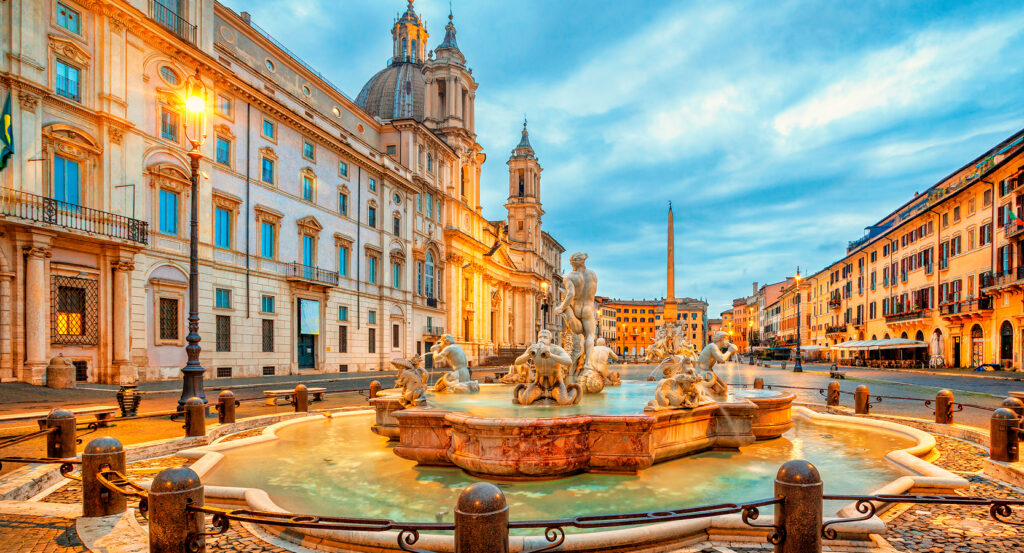
Built on the ancient footprint of Emperor Domitian's 1st-century stadium, the piazza preserves the oval shape of its athletic past while pulsing with the exuberance of a living masterpiece. Here, marble and motion blend effortlessly: Bernini's Fountain of the Four Rivers bursts to life at the center, its gods personifying the world's great waterways beneath the towering Egyptian obelisk. To the north, Giacomo della Porta's Fountain of Neptune brims with mythic energy; to the south, the Fountain of the Moor ripples in lively symmetry. Around them, cafés spill onto cobblestones, artists line the arcades with paintings, and street performers fill the air with laughter and violin song. The façades of Sant'Agnese in Agone rise in radiant white stone opposite the fountains, Borromini's masterpiece of curves and light, framing one of the most exquisite public spaces ever conceived. To stand in Piazza Navona is to feel Rome's eternal rhythm, theatrical, sensuous, and alive with centuries of applause.
What defines Piazza Navona.
Beneath its beauty lies a layered story, one that spans from imperial glory to papal power and the heartbeat of the modern city.
Piazza Navona's origins trace to AD 86, when Emperor Domitian built his grand stadium here for athletic games. Over time, the arena's structure was buried and built over, yet its distinctive shape defined the square we see today. During the Baroque era, it became a canvas for papal ambition: Pope Innocent X, whose family palace still faces the square, commissioned Bernini and Borromini to create an urban symphony of art and architecture. Bernini's Fountain of the Four Rivers (1651) became an allegory of papal dominion, its four river gods representing the Nile, Ganges, Danube, and Rio de la Plata, symbolizing the Church's reach across the world. In summer, the square was once deliberately flooded to cool the city, transforming it into a temporary lake for lively spectacles. Even now, the remnants of Domitian's stadium can be explored below ground, where ancient arches whisper of Rome's first cheering crowds. Piazza Navona has witnessed everything, triumphs, processions, revolutions, and revelry, yet its magic remains constant. It's not just a place to see; it's a place that sees you, inviting you into Rome's living story.
How Piazza Navona fits.
To experience Piazza Navona is to immerse yourself in Rome's artistry, to taste, listen, and linger.
Begin your visit in the early morning, when the piazza is still hushed and the fountains shimmer in solitude. Walk its length slowly, tracing the curve of Domitian's ancient stadium beneath your feet, and admire the play of light on marble and stucco. Stop inside Sant'Agnese in Agone to admire Borromini's delicate geometry and the quiet power of its domed interior. Return at midday for espresso or gelato at one of the surrounding cafés, the hum of conversation rising like a chorus. As evening approaches, the square transforms: lights flicker on, artists display portraits under canopies, and musicians fill the air with soft serenades. Dine al fresco under the stars as Bernini's sculptures glow gold against the night sky. Visit in December for the annual Christmas market, when stalls brim with ornaments, sweets, and nativity scenes. Piazza Navona in Rome isn't just one of the world's great squares, it's the city's stage, forever performing the timeless play of beauty, motion, and joy.
Where your story begins.
Foresyte Travel reveals places that feel extraordinary long before you arrive.
Enjoy editorial crafted for luxury travelers.
Foresyte may earn a commission when you book.