Top places to stay in Monaco.
Monaco's transformation into one of Europe's most celebrated luxury destinations began with a financial gamble by Monaco's ruling family, whose ambitions turned an isolated Mediterranean hillside into an international capital of grand hotels and high society. During the nineteenth century, the Principality of Monaco faced severe economic pressures following the loss of Menton and Roquebrune, territories that had provided much of its agricultural revenue. Prince Charles III pursued tourism and gaming as foundations for a new economy, supported by his mother, Princess Caroline Gibert de Lametz. Early attempts to establish a casino struggled with difficult access and limited accommodation. The arrival of François Blanc, an experienced casino entrepreneur from Homburg, transformed the undertaking. In 1863, Blanc assumed control of the gaming concession and established the Société des Bains de Mer, creating an enterprise that would shape Monaco's hospitality industry for generations. The Hôtel de Paris opened in 1864 beside the developing casino, introducing an extraordinary standard of luxury to the principality. Its grand reception rooms, prestigious dining facilities, and elaborate accommodations attracted European aristocrats and wealthy international travelers. The surrounding district received the name Monte Carlo in 1866 in honor of Charles III. Railway connections along the French Riviera brought increasing numbers of visitors from Paris and other European capitals, strengthening the resort's winter social season. The completion of Charles Garnier's Casino de Monte-Carlo complex in 1878-1879 established an architectural centerpiece for the district, uniting gaming with theatrical performance and ceremonial public spaces. The Hôtel Hermitage followed in 1896, extending the resort's distinguished accommodation through Belle Époque architecture and an atmosphere of residential elegance. During the early twentieth century, Monaco became synonymous with international wealth, fashionable society, and Mediterranean leisure. The inauguration of the Monaco Grand Prix in 1929 introduced a sporting performance that brought an entirely different form of international attention to its streets. Following the Second World War, Prince Rainier III encouraged modernization and economic diversification. His marriage to Grace Kelly in 1956 intensified worldwide fascination with Monaco's royal household. The opening of the Fairmont Monte Carlo's predecessor in 1975 introduced substantial contemporary accommodation above the Mediterranean. Later investment brought restored historic interiors, sophisticated wellness facilities, and ambitious waterfront development. Monaco's hospitality character emerged from the deliberate creation of a luxury resort whose grand hotels became essential institutions in Monaco's economic and social life.
Monaco occupies a compact but dramatically varied landscape of steep Mediterranean slopes, terraced gardens, expansive buildings, and waterfront developments overlooking the Ligurian Sea. The Carré d'Or forms its most prestigious hotel district, centered on the Place du Casino and its surrounding ensemble of Belle Époque architecture. Ornamental façades, formal gardens, and carefully maintained public spaces establish an atmosphere of exceptional architectural refinement. Accommodation here places guests within immediate reach of luxury boutiques, celebrated restaurants, and the district's principal cultural institutions. Avenue des Beaux-Arts and the adjoining streets contain elegant residential buildings and commercial properties whose restrained façades complement the expansive scale of the central square. Eastward, the streets approaching Avenue Princesse Grace descend toward the shoreline through substantial apartment towers and prestigious residences. Larvotto occupies Monaco's principal beachfront setting, where a broad pedestrian promenade follows the sheltered Mediterranean coast. Contemporary hotels and residential properties overlook the sand, with landscaped terraces and waterfront restaurants creating an atmosphere of relaxed coastal luxury. The district's modern architecture emphasizes balconies, pale stone, and extensive glazing that captures the changing light across the water. Above the beach, the slopes of Saint-Roman rise toward the French border through densely arranged residential towers and secluded private properties. Elevated accommodation commands expansive coastal views, particularly toward the headlands and bays of the eastern Riviera. West of the casino district, the streets surrounding the Grimaldi Forum introduce a substantial cultural and convention environment, with contemporary architecture integrated into the steep waterfront terrain. The adjoining Japanese Garden provides a carefully composed landscape of water, stone, and ornamental planting amid the surrounding high-rise development. Farther west, the Port Hercule waterfront forms one of Monaco's most recognizable urban settings, with luxury yachts occupying a protected harbor beneath the surrounding hillsides. Hotels and serviced residences along the harbor enjoy views of the marina and the dramatic architecture rising above its quays. The neighboring La Condamine district offers a more traditional urban atmosphere through established commercial streets, residential buildings, and intimate restaurants surrounding the port. Its market square and pedestrian routes provide a contrasting sense of everyday Monégasque life. Above the harbor, Monaco-Ville occupies the fortified promontory known as Le Rocher, where narrow lanes and historic stone buildings surround the Prince's Palace and the cathedral. Accommodation here is limited, but the district's elevated position and historic character make it an important part of the wider visitor experience. Westward, Fontvieille presents a more contemporary waterfront environment developed on reclaimed land, with substantial residential properties, landscaped gardens, and a marina beneath the rocky cliffs. Across the principality, accommodation ranges from ceremonial grand hotels and sophisticated beachfront properties to contemporary harbor residences, each shaped by Monaco's exceptional density, dramatic topography, and uninterrupted relationship with the Mediterranean. Foresyte may earn a commission when you book.
Foresyte Travel's top five choices.
5. Fairmont Monte Carlo
Fairmont Monte Carlo occupies a vast waterfront structure built into the Mediterranean edge of the principality beside the celebrated hairpin of the Monaco Grand Prix circuit. Architect Victor Gruen designed the property, which opened in 1975 as the Loews Monte-Carlo on land created through major engineering works along the coast. Its construction placed much of the building directly over the sea, creating an unusually horizontal architectural mass within Monaco's steep and intensely developed territory. The hotel later operated under the Monte Carlo Grand Hotel name before becoming Fairmont Monte Carlo in 2004. Its physical integration with the Formula 1 circuit and reclaimed shoreline connects the property directly with two forces that have shaped modern Monaco: international performance and engineering-driven expansion into the Mediterranean.
4. Hotel Metropole, Monte Carlo
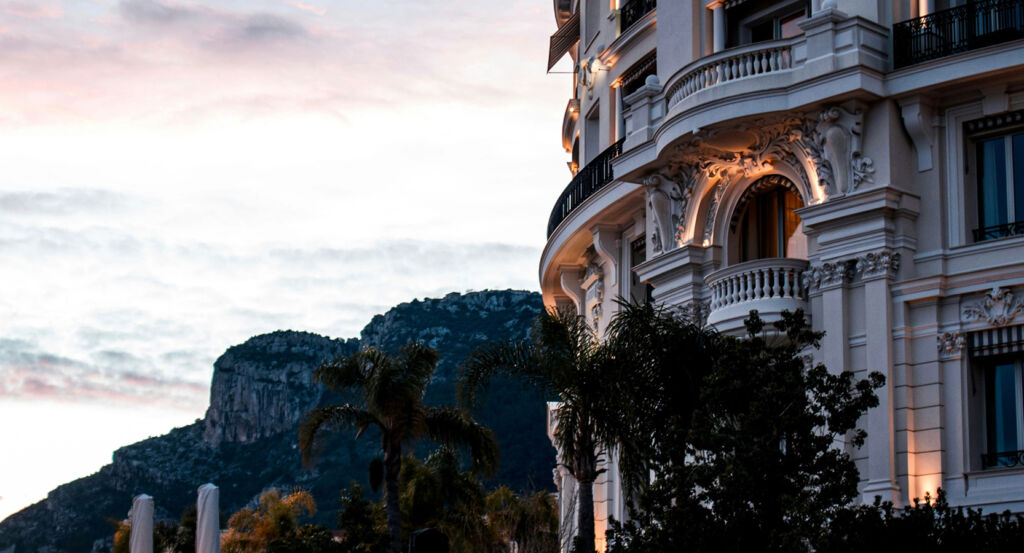
Hotel Metropole, Monte Carlo opened in 1889 on land formerly belonging to Pope Leo XIII, joining the grand hotels and entertainment institutions that transformed Monte Carlo during the Belle Époque. Danish architect Hans-Georg Tersling designed the original building, contributing another major Riviera commission to a career that also shaped prominent properties along the French Mediterranean coast. Lebanese developer Nabil Boustany acquired the hotel in the 1980s and undertook an extensive reconstruction that preserved the historic facade while rebuilding much of the property behind it. Jacques Garcia later developed interiors rooted in the decorative traditions of European grand hotels, and Karl Lagerfeld created the Odyssey pool setting as a distinctly contemporary intervention. Hotel Metropole captures more than a century of architectural reinvention beside the Casino de Monte-Carlo.
3. Monte-Carlo Bay Hotel & Resort
Monte-Carlo Bay Hotel & Resort opened in 2005 on the Larvotto peninsula as a major expansion of Société des Bains de Mer's hospitality holdings beyond the historic core surrounding Place du Casino. The company itself was founded in 1863 under François Blanc, whose casino and hotel developments became fundamental to Monaco's transformation into an international resort destination. Architect Louis Rué designed the complex around a broad Mediterranean-facing site with towers, terraces, gardens, and extensive water features that give it a markedly different scale from Monte Carlo's nineteenth-century palace hotels. The project extended the principality's luxury geography eastward along a coastline progressively reshaped through reclamation and dense development. Monte-Carlo Bay represents the twenty-first-century evolution of the same hospitality enterprise that built the foundations of Monaco's resort economy.
2. Hôtel Hermitage Monte-Carlo
Hôtel Hermitage Monte-Carlo emerged during the Belle Époque as Monaco's expanding resort economy drew European aristocracy and international wealth to the Mediterranean coast. Architect Nicolas Marquet developed the hotel through successive construction phases, with Gustave Eiffel responsible for the soaring glass-and-steel dome above its winter garden. Société des Bains de Mer incorporated the property into the hospitality empire centered on the nearby Casino de Monte-Carlo and Hôtel de Paris, creating an interconnected luxury district around Place du Casino. Its architecture combines richly ornamented facades, expansive staircases, frescoes, and the Eiffel dome with views descending toward Port Hercule. Hôtel Hermitage preserves the architectural ambition of the period when Monaco converted its constrained territory and Mediterranean setting into one of Europe's most concentrated resort economies.
1. Hôtel de Paris Monte-Carlo
Hôtel de Paris Monte-Carlo is best known for its central role in François Blanc's transformation of Monaco into an international resort during the reign of Prince Charles III. Blanc opened the hotel in 1864 beside the Casino de Monte-Carlo, creating a hospitality counterpart to the gaming institution that generated crucial revenue for the principality. Successive expansions produced an increasingly elaborate Belle Époque palace whose wine cellars, ceremonial interiors, and position on Place du Casino became inseparable from Monte Carlo's international reputation. Société des Bains de Mer undertook a multiyear reconstruction completed in 2019, retaining historic elements while substantially rebuilding and reorganizing the property. Hôtel de Paris stands at the center of the nineteenth-century economic strategy that transformed Monaco from a financially precarious principality into one of the Mediterranean's defining centers of luxury tourism.
Where your story begins.
Foresyte Travel reveals places that feel extraordinary long before you arrive.
Enjoy editorial crafted for luxury travelers.
Foresyte may earn a commission when you book.