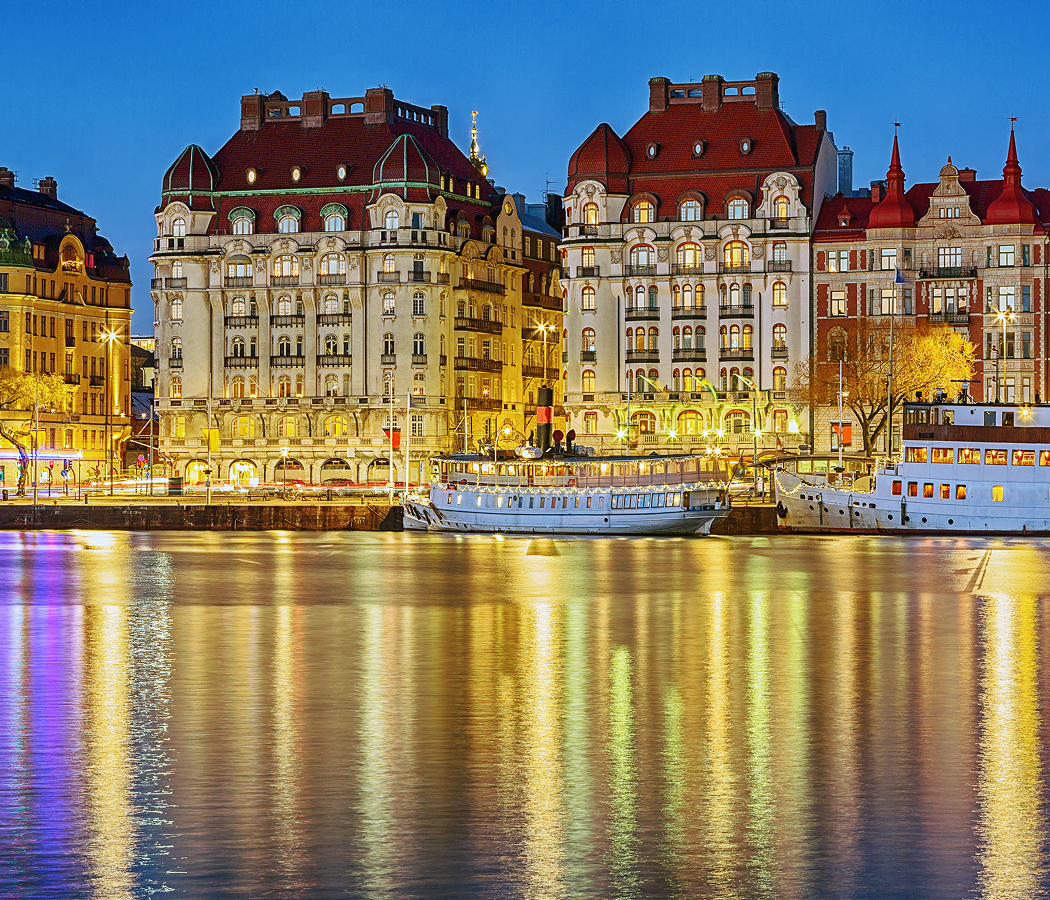
Top places to stay in Stockholm, Sweden.
Stockholm's evolution into one of Northern Europe's great capitals followed its rise from a Baltic trading settlement to the political, financial, and cultural center of Sweden. Founded in the thirteenth century under Birger Jarl, the city occupied a strategic position between Lake Mälaren and the Baltic Sea, controlling commercial traffic between Sweden's interior and the wider maritime world. Merchants associated with the Hanseatic trading network brought international commerce to its waterfront, supporting inns and lodging houses near the harbor. During Sweden's seventeenth-century imperial expansion, Stockholm developed into a substantial royal capital, attracting diplomats, military officials, and foreign merchants. The nineteenth century brought industrialization, expanding steamship services, and a growing international visitor economy. The opening of Stockholm Central Station in 1871 strengthened connections with the Swedish countryside and continental Europe. The Grand Hôtel opened in 1874 under the direction of French hotelier Régis Cadier, establishing a prestigious waterfront address overlooking the Royal Palace. Its development introduced a new standard of luxury accommodation to the Swedish capital. The Hôtel Rydberg, operating on Gustav Adolfs torg during the nineteenth century, became a celebrated meeting place for Stockholm society and contributed an enduring name to Swedish culinary history. The inauguration of the Nobel Prize ceremonies in 1901 brought an annual gathering of international scientific and literary figures to the city, strengthening demand for distinguished hospitality. The Hotel Diplomat began welcoming guests in 1966 within an elegant Art Nouveau building on Strandvägen, connecting historic architecture with contemporary hotel operations. During the later twentieth century, Stockholm's expanding financial sector, international corporations, and cultural institutions supported substantial business hotel development. Sweden's growing international design reputation encouraged a new generation of boutique properties emphasizing architectural preservation and Scandinavian craftsmanship. The conversion of the former bank headquarters on Brunkebergstorg into At Six in 2017 reflected the transformation of central commercial buildings into sophisticated hospitality spaces. Stockholm's contemporary hotel industry encompasses historic grand hotels, design-oriented urban properties, and intimate waterfront retreats, expressing a hospitality culture shaped by royal patronage, Baltic commerce, international diplomacy, and the enduring influence of Swedish design.
Stockholm occupies an extraordinary archipelago landscape where fourteen central islands are connected by bridges, quays, and waterways opening toward the Baltic Sea. Norrmalm forms the principal commercial and hospitality center, with substantial hotels concentrated around major shopping streets, cultural institutions, and transportation connections. The district's architecture combines expansive nineteenth-century buildings with modernist commercial structures and contemporary towers. Hotels near Sergels torg and the surrounding avenues provide convenient access to restaurants, retail destinations, and major cultural venues. Southward, the waterfront surrounding Strömkajen offers a prestigious setting through elegant buildings overlooking the Royal Palace and the surrounding channels. Across the water, Gamla Stan preserves the atmospheric character of Stockholm's medieval center through narrow cobblestone streets, colorful historic façades, and intimate public squares. Boutique hotels occupy carefully restored merchant houses and traditional buildings, offering immediate access to historic churches, restaurants, and the royal precinct. Eastward, Östermalm presents an established environment of substantial residential buildings, sophisticated shopping streets, and refined urban hotels. The neighborhood's broad avenues and carefully detailed stone façades create an atmosphere of enduring metropolitan elegance. Along Strandvägen, prestigious accommodation overlooks the waterfront promenade and the boats moving between the central islands. Farther east, Djurgården provides an exceptionally green hospitality setting through extensive parkland, wooded paths, and major cultural attractions. Smaller hotels and historic properties occupy secluded sites near gardens and waterfront routes, creating a quieter environment within easy reach of the city center. South of Gamla Stan, Södermalm introduces a more contemporary creative atmosphere through steep residential streets, independent galleries, and lively restaurant districts. Boutique hotels occupy converted industrial buildings and traditional urban properties, particularly around Mariatorget and the streets surrounding Slussen. Elevated viewpoints along the island's northern edge provide panoramic perspectives across the harbor and central skyline. Westward, Kungsholmen offers a quieter residential environment through substantial apartment buildings, landscaped waterfront promenades, and neighborhood restaurants. Hotels near the central transportation corridors provide convenient access to the surrounding districts, and the island's shoreline offers expansive views across Lake Mälaren. Farther west, Vasastan presents another distinctive accommodation setting through traditional residential architecture, intimate cafés, and established commercial streets. Smaller boutique properties provide a neighborhood-oriented experience near parks and cultural institutions. Across the central waterways, Skeppsholmen occupies a secluded island landscape of historic naval buildings, substantial trees, and waterfront gardens. Its intimate hotel accommodation offers exceptional views toward the surrounding islands. Beyond the urban center, the Stockholm Archipelago extends through thousands of islands, with historic seaside inns, boutique retreats, and seasonal waterfront properties occupying sheltered bays and wooded shorelines. Across Stockholm, accommodation ranges from prestigious grand hotels and sophisticated contemporary towers to intimate historic inns and secluded island retreats, with the surrounding waterways creating an exceptional relationship between urban architecture and natural landscape. Foresyte may earn a commission when you book.
Foresyte Travel's top five choices.
5. Bank Hotel
Bank Hotel occupies a former banking headquarters on Arsenalsgatan beside Stockholm's waterfront and the cultural institutions surrounding Kungsträdgården. Architect Thor Thorén designed the building for Bankaktiebolaget Södra Sverige, completing it in 1910 with an expansive stone facade and an elaborate banking hall suited to the financial ambitions of early twentieth-century Stockholm. The building later served additional financial institutions before hospitality group ESS transformed it into Bank Hotel in 2018. Original architectural elements were incorporated into interiors that preserve the scale and formality of the structure's banking origins. Bank Hotel gives a major artifact of Stockholm's financial history a new function within the dense institutional quarter between Norrmalm and the harbor.
4. Nobis Hotel Stockholm
Nobis Hotel Stockholm occupies two nineteenth-century buildings on Norrmalmstorg, a square embedded in the commercial and cultural development of Central Stockholm. One of the buildings entered international history during the 1973 Kreditbanken robbery, when hostages developed sympathetic relationships with their captors and the episode subsequently inspired the term “Stockholm syndrome.” Nobis Hospitality transformed the interconnected structures into a hotel that opened in 2010, commissioning Swedish architectural studio Wingårdhs to negotiate their historic fabric. Wingårdhs created a soaring internal lounge beneath a contemporary glass ceiling, turning the courtyard between the buildings into the architectural center of the property. Nobis Hotel connects Stockholm's nineteenth-century urban fabric, among the city's most famous twentieth-century events, and contemporary Swedish design within a single Norrmalmstorg address.
3. Hotel Diplomat
Hotel Diplomat occupies an Art Nouveau building completed in 1911 on Strandvägen, the ceremonial waterfront boulevard developed during Stockholm's late nineteenth-century expansion. Architects Hagström & Ekman designed the structure during the period when Strandvägen became lined with elaborate residences facing Nybroviken and the harbor approaches to Djurgården. The Malmström family converted the building into Hotel Diplomat in 1966 and has maintained family stewardship across subsequent generations. Swedish designer Per Öberg later reshaped its interiors through a restrained combination of historic architectural detail and contemporary Scandinavian furnishings. Hotel Diplomat preserves the residential character of one of Stockholm's grandest waterfront avenues through a family-run property rooted in the city's early twentieth-century architectural transformation.
2. Ett Hem
Ett Hem occupies a 1910 Arts and Crafts townhouse in Lärkstaden, the residential enclave developed around the irregular terrain north of Central Stockholm during the early twentieth century. Architect Fredrik Dahlberg designed the house as a private residence for government official Ivar Tengbom and his family, giving the building the domestic scale that continues to govern its character. Owner Jeanette Mix transformed the property into Ett Hem with British designer Ilse Crawford, opening the hotel in 2012 around the premise of retaining the rhythms and spatial intimacy of a private Stockholm home. Crawford integrated Scandinavian furniture, contemporary works, antiques, books, fireplaces, and garden spaces into the original residential architecture. Ett Hem turned a single Lärkstaden townhouse into an influential expression of hospitality built around the cultural and architectural traditions of domestic Stockholm.
1. Grand Hôtel
Grand Hôtel opened in 1874 on Blasieholmen under the direction of French hotelier Régis Cadier, establishing a major international hotel opposite the Royal Palace and Stockholm's historic center. Architect Axel Kumlien designed the original building during a period when Stockholm was rapidly modernizing its waterfront, transportation systems, and expansive public architecture. The hotel became closely associated with the Nobel Prize after the awards began in 1901, accommodating laureates and placing the property within one of Sweden's most consequential international traditions. The Wallenberg family acquired Grand Hôtel in 1968 through Investor AB, beginning a new period of Swedish ownership that later placed the property within the family-controlled FAM investment company. Grand Hôtel binds Stockholm's nineteenth-century transformation, Nobel culture, Swedish industrial capital, and the ceremonial geography of the royal waterfront into one enduring institution.
Where your story begins.
Foresyte Travel reveals places that feel extraordinary long before you arrive.
Enjoy editorial crafted for luxury travelers.
Foresyte may earn a commission when you book.