
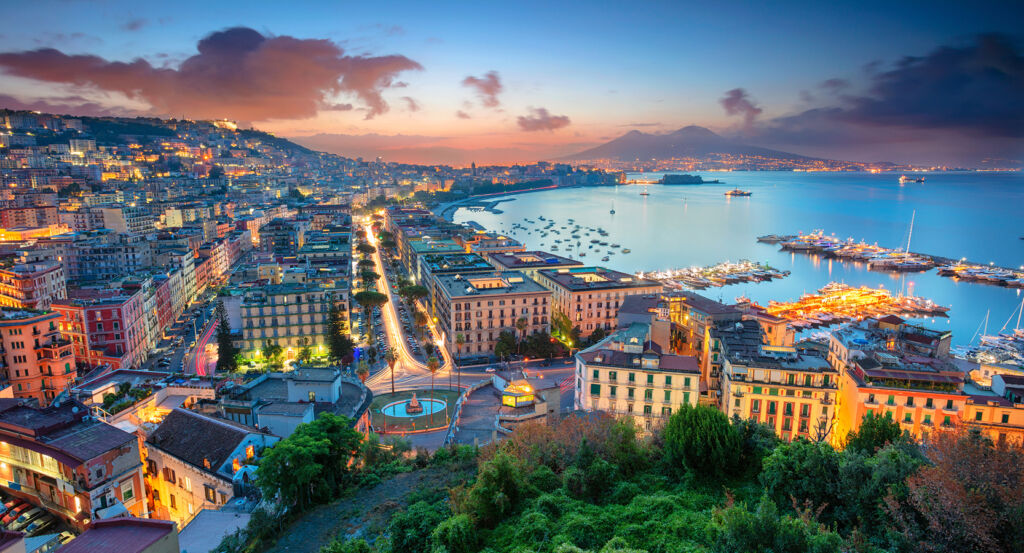
Top places to stay in Naples, Italy.
Naples carries a hospitality legacy shaped by the maritime commerce of the Mediterranean, the splendor of the Bourbon royal court, and the cultural importance of the Grand Tour, with historic palaces, celebrated Neapolitan cuisine, and the dramatic setting of the Bay of Naples sustaining a tradition of refined Southern Italian hospitality. Founded by Greek settlers as Neapolis during the fifth century BCE, the city became a prosperous center of trade and learning under Roman rule. Its surrounding coastline attracted wealthy Romans to villas and thermal establishments, establishing an early association between the Bay of Naples and luxurious leisure. Medieval Naples grew into a major political capital under the Angevin dynasty, whose court attracted diplomats, merchants, and ecclesiastical visitors. The arrival of Spanish rule in the early sixteenth century expanded the city's administrative importance, supporting inns and lodging houses near its commercial streets and port. Under the Bourbon dynasty, Naples became one of Europe's largest cities and a principal destination on the Grand Tour. Eighteenth-century aristocrats, artists, and scholars traveled south to encounter classical antiquity, the excavations at Pompeii and Herculaneum, and the volcanic performance of Mount Vesuvius. The Albergo dei Poveri, commissioned by Charles of Bourbon in 1751, reflected the enormous scale of royal urban ambitions, although its purpose was charitable housing. The nineteenth century brought more recognizable grand hotels as international tourism expanded along the waterfront. The Hotel Royal des Étrangers became an important establishment for foreign visitors, and the opening of the Grand Hotel Vesuvio in 1882 established a prestigious address overlooking the bay. Its association with distinguished international guests strengthened Naples's reputation for sophisticated coastal accommodation. Italian unification in 1861 altered the city's political position, yet its cultural institutions and maritime economy continued attracting travelers. The development of railway connections increased access from northern Italy and European capitals, encouraging hotels near transportation terminals and the principal commercial districts. The opening of the Grand Hotel Parker's in 1870 introduced another enduring luxury institution above the waterfront. During the twentieth century, wartime destruction and economic upheaval interrupted investment, followed by the gradual recovery of tourism centered on the historic city and surrounding archaeological landscapes. The expansion of international air travel strengthened Naples's position as a gateway to the Amalfi Coast, Capri, and southern Italy. More recently, the restoration of historic palazzi and the development of intimate boutique hotels have broadened accommodation beyond the traditional grand establishments. Naples's hospitality history reflects the extraordinary continuity of a Mediterranean capital whose royal heritage, maritime setting, and proximity to classical antiquity have attracted travelers for centuries.
Naples occupies a dramatic amphitheater of hills descending toward the Tyrrhenian Sea, with hotel districts distributed among ancient streets, expansive civic spaces, and elevated residential neighborhoods overlooking the Bay of Naples. The Centro Storico forms the city's most historically layered accommodation environment, where narrow lanes follow the ancient Greek street grid through densely arranged churches, palazzi, and residential buildings. Boutique hotels and intimate guesthouses occupy restored upper floors and former aristocratic residences near Spaccanapoli, the celebrated east, west route cutting through the old city. The surrounding streets reveal a distinctive architectural density through stone courtyards, expansive staircases, and richly decorated ecclesiastical façades. Southward, the districts surrounding Piazza Municipio and the expansive Castel Nuovo introduce a more expansive urban setting through substantial commercial buildings and prominent civic architecture. Hotels near Via Medina and the port provide access to ferry connections and the principal transportation routes serving the wider bay. Westward, the Quartieri Spagnoli climb through a compact grid of narrow streets originally developed during Spanish rule, with small guesthouses and boutique properties embedded among residential buildings and neighborhood businesses. Their steep pedestrian routes create an intensely urban environment closely connected to the central shopping streets. The adjoining Via Toledo corridor offers larger hotels near historic commercial buildings, theaters, and elegant retail establishments. Farther south, the Santa Lucia district occupies a prestigious waterfront position beneath the expansive Piazza del Plebiscito. Its substantial hotels overlook the harbor and the imposing silhouette of Castel dell'Ovo, with broad promenades connecting visitors to restaurants and public gathering places. The neighboring Chiaia district introduces an elegant residential atmosphere through nineteenth-century apartment buildings, fashionable boutiques, and established streets extending inland from the waterfront. Luxury accommodation occupies refined properties near Villa Comunale, whose landscaped gardens provide a green corridor beside the sea. Westward, Mergellina follows the curving shoreline beneath the slopes of Posillipo, combining marina facilities, historic residences, and waterfront restaurants. Hotels in this district emphasize panoramic views toward Vesuvius and the islands beyond the bay. Above the coast, Posillipo occupies a dramatic headland of volcanic tuff, with substantial villas and secluded residential properties overlooking rocky coves and small harbors. Intimate luxury accommodation benefits from elevated terraces and extensive sea views amid mature gardens. North of Chiaia, the Vomero district rises across a substantial hillside connected to the lower city by funicular railways. Its broad avenues, elegant apartment buildings, and established shopping streets offer a quieter metropolitan environment. Hotels near the hilltop provide remarkable perspectives across the dense historic center and surrounding coastline. The neighboring Arenella district extends into a more residential landscape through substantial twentieth-century buildings and established commercial streets. Across these varied settings, Naples offers accommodation ranging from intimate historic palazzi and prestigious waterfront hotels to elevated residential retreats whose views reveal the extraordinary geography of the bay. Foresyte may earn a commission when you book.
Foresyte Travel's top five choices.
5. Eurostars Hotel Excelsior
Eurostars Hotel Excelsior occupies the Via Partenope waterfront facing Castel dell'Ovo, embedding the property within the expansive seafront created as Naples expanded westward during the late nineteenth and early twentieth centuries. The hotel opened in 1908 during the development of the Santa Lucia waterfront into a prestigious district of grand hotels, apartment buildings, and public promenades. Its architecture combines an imposing symmetrical facade, classical ornament, and corner towers with the expansive scale associated with European grand-hotel construction of the period. The property later joined Spain's Eurostars Hotel Company, extending the international ownership history of a building conceived during Naples' emergence as a modern Mediterranean destination. Hotel Excelsior preserves the grand-hotel tradition that transformed Via Partenope into one of the defining architectural fronts of the Bay of Naples.
4. Palazzo Alabardieri
Palazzo Alabardieri occupies Via Alabardieri in Chiaia, a district whose aristocratic residences and commercial streets developed beyond Naples' historic core near the Villa Comunale and Riviera di Chiaia. The property incorporates the former convent associated with Santa Caterina a Chiaia, connecting the building to the religious institutions that historically occupied this part of the city. Its subsequent transformation preserved a palazzo-like composition organized around restrained masonry, internal courtyards, vaulted spaces, and traditional Neapolitan architectural proportions. The surrounding streets became one of Naples' principal bourgeois districts as nineteenth-century urban growth shifted elite residential life westward toward Chiaia. Palazzo Alabardieri draws its significance from that layered transition between ecclesiastical property, aristocratic urban form, and the commercial sophistication of modern Chiaia.
3. Grand Hotel Parker's
Grand Hotel Parker's traces its origins to 1870, when George Parker established the hotel on Corso Vittorio Emanuele high above the Bay of Naples. Its hillside position emerged from nineteenth-century urban expansion that opened panoramic routes above Chiaia and connected the city with increasingly fashionable western districts. British and other northern European travelers formed an important part of Naples' international culture during this period, and Parker's became closely associated with the grand-tour tradition that brought writers, artists, scholars, and affluent visitors to the city. The Avallone family later assumed stewardship of the property, preserving its historic character through successive periods of modernization. Grand Hotel Parker's captures the cosmopolitan hotel culture that flourished as nineteenth-century Naples became one of Europe's essential Mediterranean destinations.
2. Romeo Napoli
Romeo Napoli occupies a former office building near Molo Beverello, introducing a sharply contemporary architectural intervention to the historic port district facing the Bay of Naples. Japanese architect Kenzo Tange originally designed the structure, giving the property a direct connection to one of the twentieth century's most consequential modern architects. The building's transformation into a hotel incorporated interiors by Studio Marco Piva and an extensive art program spanning contemporary works, design objects, and antiquities. Its location beside the maritime terminals places the architecture within a port landscape that has connected Naples with Capri, Ischia, Sicily, and the wider Mediterranean for generations. Romeo Napoli uses international modernism and contemporary Italian design to reinterpret a section of Naples historically defined by maritime commerce and expansive civic architecture.
1. Grand Hotel Vesuvio
Grand Hotel Vesuvio opened in 1882 on Via Partenope, establishing a grand hotel directly opposite Castel dell'Ovo during the transformation of Naples' waterfront into a prestigious urban promenade. The property became closely associated with the international cultural life of the city, hosting figures including Enrico Caruso, who made the hotel his Neapolitan residence during the final period of his life. Severe wartime damage led to substantial reconstruction during the twentieth century, giving the building a physical history intertwined with Naples' destruction and recovery surrounding the Second World War. The hotel's position frames the Bay of Naples, Mount Vesuvius, and the ancient island fortress from the seafront that became the ceremonial face of modern Naples. Grand Hotel Vesuvio connects the city's nineteenth-century grand-tour economy, operatic history, wartime transformation, and enduring relationship with its bay.
Where your story begins.
Foresyte Travel reveals places that feel extraordinary long before you arrive.
Enjoy editorial crafted for luxury travelers.
Foresyte may earn a commission when you book.







































































































