Top places to stay in Montréal, Québec.
Montréal's rise from a fortified French settlement into Canada's great francophone metropolis created a distinctive tradition of commerce, cultural exchange, and architectural ambition. The island had long been inhabited by Indigenous peoples, including the Kanien'kehá:ka, before French colonists founded Ville-Marie in 1642 under Paul de Chomedey de Maisonneuve and Jeanne Mance. Its position at the meeting of the St. Lawrence and Ottawa river systems made the settlement an important center of the fur trade, attracting merchants, missionaries, and travelers moving between the Atlantic and the continental interior. Following the British conquest of 1760, Montréal's commercial networks expanded under British merchant houses, and inns developed around the harbor and principal trading streets. The opening of the Lachine Canal in 1825 accelerated industrial growth, strengthening demand for accommodation among manufacturers, shipping agents, and commercial visitors. Railway expansion transformed the city's international connections, particularly through the Grand Trunk Railway and the Canadian Pacific Railway. The Windsor Hotel opened in 1878 beside Dominion Square, becoming a celebrated gathering place for political leaders, industrialists, and visiting dignitaries. Its elaborate Victorian interiors reflected Montréal's emergence as Canada's leading commercial metropolis. The Ritz-Carlton Montréal opened in 1912 on Sherbrooke Street, establishing a prestigious address associated with the city's financial elite and international society. The Mount Royal Hotel followed in 1922, bringing substantial metropolitan accommodation to the fashionable shopping district. During the interwar years, Montréal's theaters, nightclubs, and restaurants supported a flourishing entertainment economy that attracted visitors from across North America. The Queen Elizabeth Hotel opened in 1958 above Central Station, introducing a modern railway-linked landmark. John Lennon and Yoko Ono held their celebrated Bed-In for Peace there in 1969, recording “Give Peace a Chance” during their stay. Expo 67 transformed Montréal's international profile, bringing millions of visitors to an ambitious world's fair devoted to modernity and cultural exchange. The 1976 Summer Olympics subsequently encouraged further investment in transportation and visitor infrastructure. Later decades brought the restoration of historic commercial buildings and the emergence of design-oriented boutique properties. Montréal's contemporary hospitality landscape reflects its French colonial foundations, nineteenth-century industrial prosperity, cosmopolitan entertainment traditions, and continuing importance as a center of international culture.
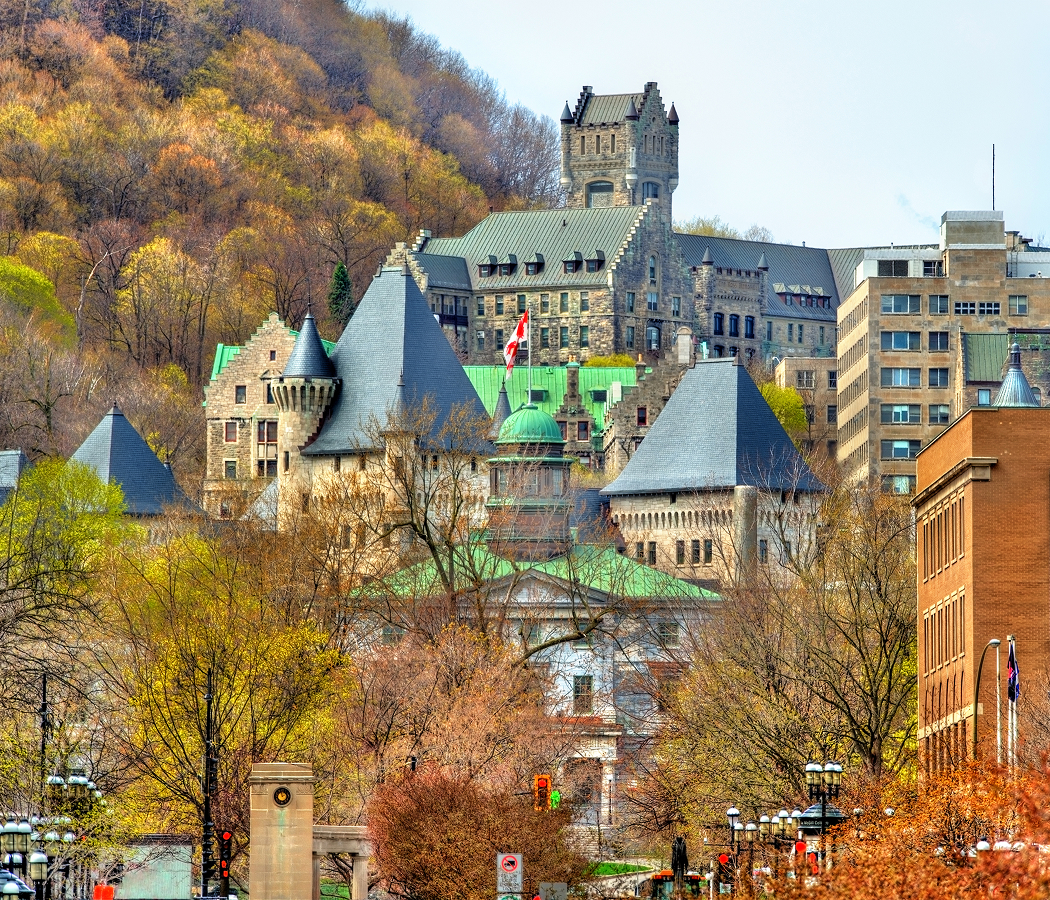
Montréal occupies an island in the St. Lawrence River, with Mount Royal rising above a dense urban landscape of historic stone buildings, tree-lined residential streets, and contemporary commercial towers. Old Montréal forms the city's most atmospheric historic lodging district, where narrow cobblestone streets connect former merchant warehouses, substantial nineteenth-century commercial buildings, and elegant public squares. Boutique properties occupy carefully restored stone structures, frequently incorporating exposed masonry, timber beams, and contemporary furnishings within their historic interiors. The surrounding streets provide convenient access to the Old Port, waterfront promenades, galleries, and distinguished restaurants. Immediately north, Downtown Montréal presents a more metropolitan environment through substantial office towers, prestigious shopping avenues, and major cultural institutions. Luxury properties cluster around René-Lévesque Boulevard and the commercial streets surrounding Sainte-Catherine Street, providing convenient access to theaters, restaurants, and the city's extensive underground pedestrian network. Westward, the Golden Square Mile preserves the architectural inheritance of Montréal's nineteenth-century merchant elite through substantial stone mansions, institutional buildings, and elegant residential streets. Hotels near Sherbrooke Street occupy distinguished positions beneath the wooded slopes of Mount Royal, with museums and refined shopping destinations nearby. South of downtown, Griffintown presents a contemporary landscape of converted industrial buildings, modern residential towers, and revitalized commercial streets. Design-oriented accommodation reflects the neighborhood's transition from manufacturing district to sophisticated urban community. The adjoining Lachine Canal corridor provides landscaped pedestrian and cycling routes along former industrial waterways. Eastward, the Quartier des Spectacles forms Montréal's principal performing arts district, where theaters, concert halls, contemporary hotels, and expansive public plazas create an energetic cultural environment. Properties near Place des Arts offer immediate access to major festivals and performances. North of the central business district, the Plateau-Mont-Royal introduces a markedly different atmosphere through colorful Victorian row houses, exterior staircases, intimate neighborhood parks, and independent commercial streets. Smaller guesthouses and boutique properties provide access to cafés, galleries, and established restaurants within one of the city's most recognizable residential landscapes. Farther north, Mile End offers a creative neighborhood setting through former industrial buildings, traditional brick residences, and independent businesses. Its intimate accommodation places visitors among bakeries, music venues, and design studios. Eastward, the Village extends along Sainte-Catherine Street through lively commercial blocks, public art, and a substantial concentration of restaurants and entertainment venues. Across the river, the islands of Parc Jean-Drapeau provide extensive recreational landscapes and exceptional views toward the downtown skyline. Beyond the central districts, Westmount offers a quieter residential environment through substantial historic houses, landscaped streets, and elegant institutional architecture. Montréal's accommodation ranges from intimate stone-built retreats and sophisticated heritage conversions to substantial contemporary towers, with the city's distinctive neighborhoods offering remarkably varied experiences within a compact island metropolis. Foresyte may earn a commission when you book.
Foresyte Travel's top five choices.
5. Le Mount Stephen
Le Mount Stephen incorporates the former George Stephen House on Drummond Street, among the great surviving residences of Montréal's Golden Square Mile. Architect William Tutin Thomas designed the mansion for railway financier George Stephen, later Lord Mount Stephen, completing it in 1883 during the period when Montréal concentrated an extraordinary share of Canadian corporate wealth. Stephen became the first president of the Canadian Pacific Railway and played a central financial role in completing the transcontinental line that reshaped the country's economy and settlement. The mansion later housed the Mount Stephen Club before an extensive redevelopment joined the restored nineteenth-century interiors to a contemporary hotel tower opened in 2017. Le Mount Stephen preserves a direct architectural connection with the financiers whose railway enterprises helped make Montréal the commercial capital of nineteenth-century Canada.
4. Fairmont The Queen Elizabeth
Fairmont The Queen Elizabeth opened in 1958 above Montréal Central Station as a major Canadian National Railways project integrated directly into the city's transportation infrastructure. Architects William Sutherland Maxwell and George Drummond designed the International Style hotel during Montréal's rapid postwar modernization, giving the railway-hotel tradition a distinctly modern architectural expression. John Lennon and Yoko Ono staged their second Bed-In for Peace there in 1969, recording “Give Peace a Chance” inside suite 1742 during the weeklong event. The property subsequently joined Fairmont and underwent an extensive transformation completed in 2017 that reworked its interiors and public spaces while retaining its connection with the station below. The Queen Elizabeth links Canada's railway-hotel lineage with Montréal's postwar modernism and one of the defining cultural episodes of the late 1960s.
3. Hôtel William Gray
Hôtel William Gray occupies a collection of historic and contemporary structures facing Place Jacques-Cartier in Old Montréal, within the street network inherited from the city's colonial development. The project incorporates Maison du Cabinet-de-Cuiller, an eighteenth-century stone house associated with merchant and magistrate Edward-William Gray, whose name the hotel adopted. A second historic residence and contemporary construction were integrated into the larger complex, preserving masonry fabric while introducing new circulation and hospitality spaces behind the old streetscape. The hotel opened in 2016 under Montréal-based Gray Collection as Old Montréal continued its transformation from a former mercantile district into a major cultural, residential, and hospitality quarter. William Gray uses adaptive reuse to connect contemporary hotel development with the domestic and commercial architecture surrounding one of Montréal's oldest public squares.
2. The Ritz-Carlton, Montréal
The Ritz-Carlton, Montréal opened on Sherbrooke Street in 1912, becoming one of the earliest hotels to operate under the Ritz-Carlton name and establishing a prestigious address within the Golden Square Mile. Architects Warren and Wetmore, whose work also included New York's Grand Central Terminal, collaborated with Montréal architect Charles Wetmore on a building conceived around the service standards associated with César Ritz. The hotel became closely connected with the city's business and social elite during an era when nearby mansions housed families controlling major Canadian railway, banking, mining, and industrial enterprises. An extensive restoration preceded its 2012 centennial, renewing the property while preserving significant elements of its historic fabric. The Ritz-Carlton Montréal carries the grand-hotel culture of the Golden Square Mile through more than a century of profound economic and architectural change.
1. Four Seasons Hotel Montréal
Four Seasons Hotel Montréal opened in 2019 within a purpose-built complex on de la Montagne Street at the eastern edge of the Golden Square Mile. Montréal developer Carbonleo created the project beside Holt Renfrew Ogilvy, connecting the hotel directly with the historic department-store institution whose roots on nearby Sainte-Catherine Street extend into the nineteenth century. Lemay and Sid Lee Architecture shaped the building and interiors through contemporary forms, extensive glazing, sculptural surfaces, and spaces integrated with the surrounding retail complex. The development arrived during a major cycle of investment that brought new residential towers, hotels, and commercial projects into the blocks between Sherbrooke Street and Downtown Montréal. Four Seasons represents the twenty-first-century reinvention of the Golden Square Mile as historic mercantile wealth gives way to a dense concentration of contemporary hospitality, retail, and residential architecture.
Where your story begins.
Foresyte Travel reveals places that feel extraordinary long before you arrive.
Enjoy editorial crafted for luxury travelers.
Foresyte may earn a commission when you book.