Top places to stay in Austin, Texas.
Austin built its reputation for Texas hospitality around the political life of the state capital, the cultural influence of the University of Texas, and a thriving live music scene, with the growth of technology, film, and major festivals bringing international visitors to a city celebrated for its independent spirit and creative energy. Originally known as Waterloo, the community became the republic's capital in 1839 and was renamed for Stephen F. Austin, whose role in Anglo-American colonization shaped the early history of Texas. The construction of government buildings and commercial establishments encouraged the development of boardinghouses and inns serving legislators, landowners, and visitors conducting business in the capital. Austin's incorporation into the United States following Texas annexation in 1845 strengthened its political importance, although the city's relative isolation limited commercial expansion during its early decades. The arrival of the Houston and Texas Central Railway in 1871 connected Austin with the growing transportation networks of the state, encouraging investment in substantial commercial buildings and metropolitan accommodation. The opening of the Driskill Hotel in 1886 introduced an ambitious expression of luxury hospitality, financed by cattle baron Jesse Driskill and distinguished by its Romanesque Revival architecture, expansive entrances, and elaborate public interiors. The completion of the Texas Capitol in 1888 reinforced Austin's political stature, establishing an expansive civic landmark that attracted officials, business travelers, and visitors from across the state. The expansion of the University of Texas, founded in 1883, introduced a complementary intellectual and cultural dimension, supporting the development of restaurants, lodging establishments, and commercial institutions around the growing campus. During the twentieth century, Austin developed a distinctive character through the interaction of state government, higher education, and the cultural traditions of Central Texas. The construction of major transportation infrastructure and the expansion of automobile travel encouraged the emergence of roadside motels and recreational accommodation serving visitors traveling through the Texas Hill Country. The development of Lake Austin and Lake Travis through Colorado River dam projects introduced substantial opportunities for waterfront recreation, strengthening the region's appeal for leisure travel. The emergence of Austin's modern music industry during the 1960s and 1970s transformed the city's cultural reputation, with performers including Willie Nelson and venues such as the Armadillo World Headquarters contributing to a distinctive convergence of country, rock, and progressive musical traditions. The establishment of Austin City Limits in 1974 introduced a nationally influential television program that strengthened the city's reputation as a center of American live music. The founding of South by Southwest in 1987 expanded this cultural influence into an international festival encompassing music, film, and emerging technology, bringing substantial numbers of visitors into the city's hotels and entertainment districts. The growth of semiconductor manufacturing and the subsequent expansion of software and technology companies encouraged major investment in corporate accommodation and convention infrastructure. The opening of the Austin Convention Center in 1992 strengthened the city's capacity to host large professional gatherings, contributing to the development of substantial downtown hotels. The opening of the W Austin in 2010 introduced a contemporary luxury landmark associated with the redevelopment of the Second Street District and the adjoining Moody Theater. The completion of the Fairmont Austin in 2018 reflected the continued expansion of the convention and business travel economy, establishing one of the city's most prominent contemporary hospitality properties. Austin's hotel industry expresses the relationship between political institutions, university culture, technological innovation, and the live music traditions that transformed the Texas capital into an internationally influential destination.
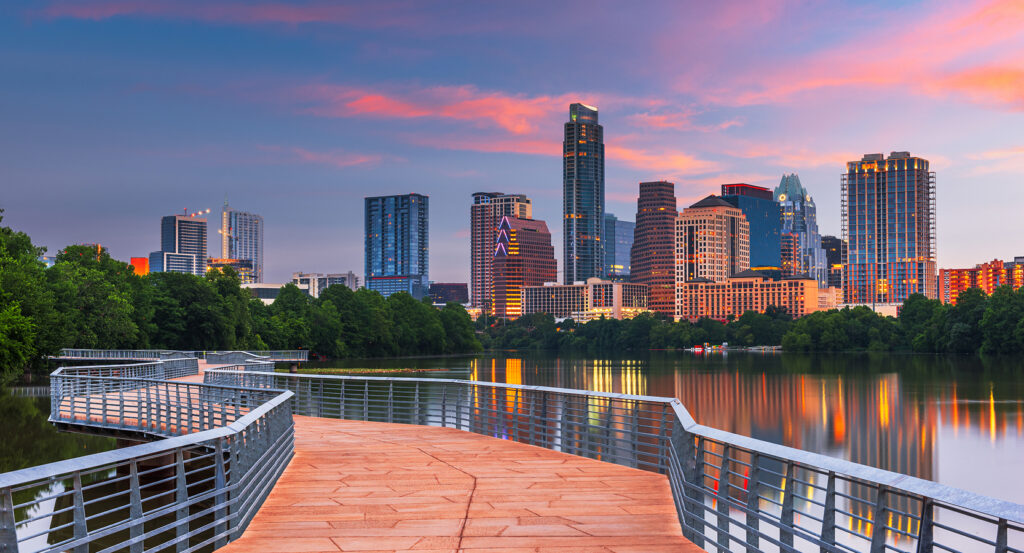
Austin's most distinctive places to stay occupy a landscape shaped by the Colorado River, the expansive institutions of the state capital, and the wooded limestone hills extending west toward the Texas Hill Country. Downtown forms the principal concentration of metropolitan hotels, with contemporary towers and restored historic buildings extending between the Texas Capitol and the northern shoreline of Lady Bird Lake. Congress Avenue establishes the city's principal ceremonial axis, connecting the expansive Capitol grounds with the river through a succession of commercial buildings, substantial hotels, and prominent cultural institutions. The surrounding streets preserve a mixture of late nineteenth-century architecture and contemporary development, creating an urban environment closely associated with government, business travel, and the city's entertainment economy. East of Congress Avenue, the Sixth Street Historic District retains a concentration of Victorian commercial buildings whose brick façades, decorative cornices, and intimate storefronts support a dense network of music venues, restaurants, and nightlife establishments. Boutique hotels within the surrounding blocks provide immediate access to the historic entertainment district, although the area's energetic evening atmosphere creates a distinctly urban accommodation experience. South of the central business district, the Second Street District presents a more contemporary environment through substantial mixed-use developments, sophisticated retail establishments, and modern luxury hotels near the waterfront. The adjoining streets surrounding the Austin Convention Center contain prominent metropolitan properties serving international conferences, cultural festivals, and corporate gatherings. Along the northern bank of Lady Bird Lake, substantial hotels overlook landscaped trails and the broad waterway created by the damming of the Colorado River, providing access to recreational paths and prominent views of the downtown skyline. Across the river, South Congress Avenue establishes one of Austin's most recognizable boutique hospitality environments, with historic motor courts, intimate contemporary hotels, and restored commercial buildings occupying a lively corridor of independent shops, restaurants, and music venues. The neighborhood's low-rise architecture and established residential streets preserve a distinctive relationship with the city's earlier commercial development, offering a contrasting atmosphere to the substantial towers of Downtown. West of South Congress, the South Lamar district supports contemporary boutique accommodation within a concentration of independent restaurants, cultural venues, and established residential neighborhoods. The neighboring Bouldin Creek area retains a quieter residential character through mature trees, historic cottages, and intimate streets connecting visitors with the southern waterfront. North of Downtown, the University of Texas district occupies a substantial institutional landscape distinguished by expansive academic buildings, established residential streets, and the commercial corridors surrounding Guadalupe Street. Hotels in this area provide convenient access to university institutions, museums, and the principal transportation connections of Central Austin. East of Interstate 35, East Austin preserves an architectural environment shaped by historic residential neighborhoods, former industrial buildings, and contemporary commercial redevelopment. Boutique hotels occupy restored properties and modern low-rise developments near independent restaurants, galleries, and neighborhood gathering places, reflecting the district's evolving cultural identity. Westward, the landscape changes substantially as the city approaches the wooded hills and limestone escarpments of the Balcones Fault Zone. The Barton Creek area introduces a secluded resort environment through substantial landscaped properties, golf courses, and natural terrain extending toward the Texas Hill Country. The neighboring Barton Hills district offers a more intimate residential setting near Zilker Metropolitan Park and Barton Springs Pool, whose spring-fed waters establish one of Austin's most celebrated recreational landscapes. Farther west, Lake Austin occupies a winding river valley bordered by wooded slopes and substantial residential estates, supporting secluded luxury accommodation connected to boating and waterfront recreation. Beyond the metropolitan center, the communities surrounding Lake Travis offer expansive views, hillside resorts, and substantial recreational properties overlooking the broad reservoir. These geographic distinctions create a coherent hospitality landscape extending from historic downtown hotels and intimate South Congress properties to contemporary business towers and secluded Hill Country resorts, each shaped by Austin's distinctive relationship with the Colorado River and the surrounding limestone terrain. Foresyte may earn a commission when you book.
Foresyte Travel's top five choices.
5. Fairmont Austin
Fairmont Austin opened in 2018 as the hotel component of a major expansion of Austin's convention district, occupying a 37-story tower directly connected to the Austin Convention Center by an elevated pedestrian passage. Gensler designed the building with a sharply faceted glass exterior that added a substantial vertical presence to the eastern edge of downtown during a period of extraordinary high-rise development. The project also incorporated a publicly accessible connection between the convention district and the surrounding street network, tying the hotel to the redevelopment of blocks near Waller Creek. Fairmont Austin belongs to the generation of large-scale projects that transformed Austin's eastern downtown from a comparatively low-rise district into an increasingly dense extension of the city's commercial core.
4. Hotel ZaZa Austin Downtown
Hotel ZaZa Austin Downtown opened in 2019 within a mixed-use tower in the Warehouse District, extending the Texas-born hotel concept created by developers Charles Givens and Jeff Records into the center of Austin. The project combined the hotel with private residences, bringing the ZaZa model of theatrical interiors, contemporary art and individually conceived spaces to a district shaped by converted warehouses and Austin's nightlife economy. Architecture by Dallas-based BOKA Powell placed the development within the increasingly vertical blocks between Congress Avenue and Shoal Creek. The property represents the transformation of the Warehouse District from a collection of industrial and commercial structures into one of Downtown's principal concentrations of hospitality, residential development and entertainment.
3. The Loren Hotel Austin
The Loren Hotel Austin opened in 2022 on the southern bank of Lady Bird Lake, occupying a constrained site between South Lamar Boulevard and the Butler Hike-and-Bike Trail. Rhode Partners designed the building as a series of stacked volumes elevated above the landscape, preserving important sightlines and establishing a strong architectural relationship with the lakefront immediately below. Developer Stephen King conceived the property as the first Loren hotel, pairing the project with a collection of contemporary art and a design program shaped around limestone, wood, glass and the muted material character of Central Texas. Its construction introduced a substantial new architectural presence to the Barton Springs gateway, where Downtown, Zilker Metropolitan Park and the recreational landscape of Lady Bird Lake converge.
2. Four Seasons Hotel Austin
Four Seasons Hotel Austin opened in 1986 on the northern shore of Lady Bird Lake, establishing the Canadian hospitality company's presence in Texas during an important period of Downtown's commercial expansion. The low-rise building occupies former industrial land beside the Colorado River, connecting the hotel directly with the waterfront corridor that Austin progressively transformed into a major public recreational landscape. Michael Graves later led a significant interior redesign, bringing the work of one of America's most influential postmodern architects into the property's evolution. Decades of development have subsequently surrounded the hotel with towers, yet its landscaped riverfront site preserves a physical connection between downtown and Lady Bird Lake that predates much of the high-rise Austin skyline.
1. Hotel Saint Cecilia
Hotel Saint Cecilia occupies a secluded estate in Travis Heights near South Congress Avenue, where hotelier Liz Lambert transformed a 1940s property into an intimate hotel inspired by music, writers and the creative culture surrounding Austin. Lambert named the property for Saint Cecilia, patron saint of music and poetry, and built its character around references to figures including the Rolling Stones, William S. Burroughs and Hunter S. Thompson. Bunkhouse, the hospitality company Lambert founded in Austin, used Saint Cecilia to develop a highly specific model of small-scale Texas hospitality centered on historic properties, design and local cultural associations before the company expanded far beyond the city. The hotel represents an important chapter in Austin's independent hospitality movement and the transformation of South Congress into an internationally recognized design, music and commercial district.
Where your story begins.
Foresyte Travel reveals places that feel extraordinary long before you arrive.
Enjoy editorial crafted for luxury travelers.
Foresyte may earn a commission when you book.