
Why Four Seasons Hotel Austin matters.
Four Seasons Hotel Austin is a lakeside luxury hotel where Downtown's civic and commercial character meets the Texas capital's hospitality history, the architectural traditions of Hill Country residences, and nearly four decades of international hotel operations.
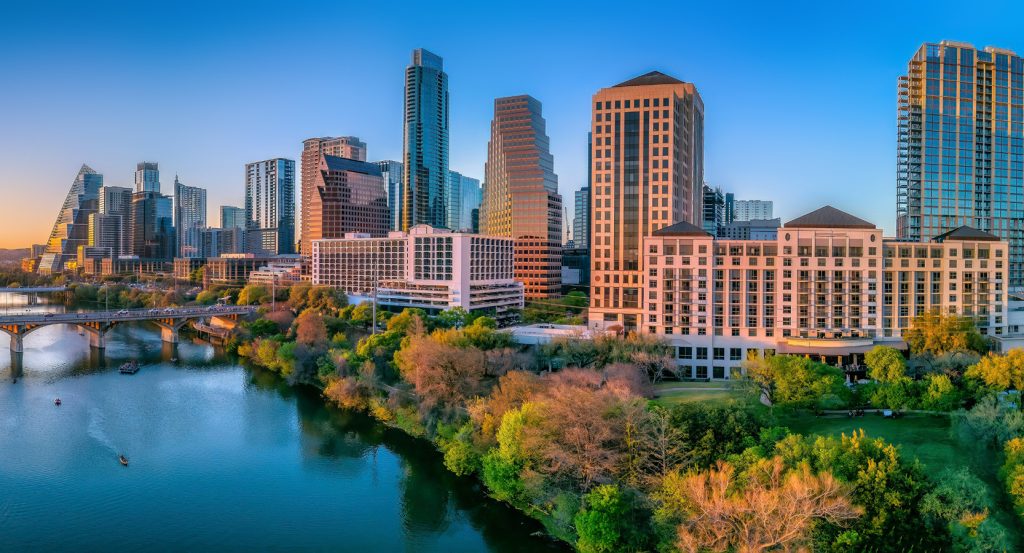
Occupying the northern shoreline of Lady Bird Lake between San Jacinto Boulevard and Trinity Street, immediately south of East Cesar Chavez Street and east of Congress Avenue, the hotel stands beside the downtown waterfront, with the South Congress corridor visible across the water. Its nine-story building rises above landscaped grounds that descend toward the shoreline, establishing a physical separation between the street frontage and the waterfront gardens. Pale exterior surfaces, recessed windows, and projecting balconies give the building the proportions of a substantial urban residence. A broad lawn extends toward the water beneath mature live oaks, connecting the principal hospitality interiors with the surrounding landscape. The outdoor swimming pool occupies a sheltered position within the gardens, and an adjoining terrace overlooks the lake. The result is a downtown hotel whose established grounds and comparatively restrained height preserve an extensive relationship with Austin's central waterfront.
What defines Four Seasons Hotel Austin.
Four Seasons Hotel Austin is best known for opening in December 1986 as an early international luxury hotel on Austin's downtown waterfront, establishing a substantial hospitality presence before the city's subsequent expansion as a technology and convention destination. The property was developed on a 2.3-acre site formerly occupied by Matt's El Rancho, the Tex-Mex restaurant founded by Matt and Janie Martinez in 1952. The restaurant relocated to South Lamar Boulevard during the 1980s, releasing its former premises for the hotel development. Four Seasons entered the Texas capital during a period of significant commercial expansion associated with state government, higher education, and the regional technology industry. Its original construction established a permanent luxury hotel overlooking the Colorado River, which had been impounded through the construction of Longhorn Dam in 1960. The opening introduced a substantial international hospitality operation into a downtown district whose commercial development had historically concentrated farther north. The hotel's association with Austin's major cultural events developed during the following decades, connecting its waterfront setting with the expansion of South by Southwest and Austin City Limits Music Festival. Its ownership subsequently passed through institutional hotel investment organizations, including Strategic Hotels & Resorts. On May 1, 2015, Strategic Hotels entered an agreement to acquire the property from PR LCP Austin Hotel TH LLC for $197 million. The transaction established a significant valuation for the established waterfront property during a period of substantial hotel investment in Central Austin. Blackstone acquired Strategic Hotels & Resorts later that year, bringing the hotel into a larger institutional real estate portfolio. A comprehensive renovation began in 2016 under the direction of Chicago-based Whitespace Interiors, introducing successive improvements to the accommodation, spa, fitness facilities, and meeting spaces. The project culminated in September 2018 with the reopening of the principal restaurant and public interiors, completing a three-year transformation of the hotel's hospitality facilities. General manager Rob Hagelberg oversaw the final stages of the redevelopment, which introduced a new culinary partnership with chef Richard Sandoval. A subsequent capital project began in June 2023, converting thirty-two existing accommodations into ten larger suites through an interior redevelopment valued at $1 million. The project concluded in February 2024, extending the hotel's investment history through a substantial reconfiguration of its upper floors. These successive ownership transactions and architectural investments have preserved the property's original role as an established waterfront hotel through Austin's continued metropolitan expansion.
Michael Dalton, principal of Whitespace Interiors and a University of Texas alumnus, developed the 2018 renovation around the architectural character of Texas Hill Country lake houses. His commission drew on the colors and textures of Central Texas landscapes, introducing muted blues, warm grays, natural wood, and restrained metallic detailing into the hotel's principal interiors. The design established a relationship between domestic architectural proportions and the property's substantial public gathering spaces. In the lobby, new furnishings and decorative treatments created an open arrangement connecting reception with the adjoining lounge. Natural textures and botanical references extended through the interior, introducing visual continuity between the landscaped grounds and enclosed hospitality areas. The accommodation renovation incorporated contemporary residential furnishings, coordinated lighting, and decorative surfaces influenced by the surrounding region. The spa received complementary architectural treatments, extending the residential design program into its treatment and relaxation facilities. The restaurant redevelopment introduced a separate cultural contribution through Mexican-born chef Richard Sandoval, whose international culinary career developed around interpretations of Latin American cooking. Sandoval collaborated with Four Seasons chef de cuisine James Flowers on Ciclo, which opened in September 2018. The restaurant replaced Trio, establishing a culinary program combining Texas ingredients with Mexican and broader Latin American preparations. Flowers brought experience from Austin's restaurant industry, contributing knowledge of regional ingredients and local cooking traditions to the partnership. Pastry chef Amanda Pallagi-Naim developed the dessert program, extending the collaboration into contemporary pastry production. The adjoining Live Oak lounge opened during the same redevelopment, introducing a bar whose architectural arrangement incorporated an outdoor deck overlooking the waterfront. Its design extended Dalton's landscape-inspired treatment through natural surfaces, upholstered seating, and broad openings toward the surrounding grounds. The renovation connected a Texas architectural reference with a culinary program developed through collaboration between Austin-based professionals and an internationally established Mexican restaurateur.
How Four Seasons Hotel Austin fits.
Four Seasons Hotel Austin works as the starting point for a walking exploration connecting Austin's nineteenth-century literary history, the personal consequences of the Texas Revolution, and the development of Mexican American cultural institutions along the eastern downtown waterfront.
Begin at O. Henry Museum, northeast of the hotel in Brush Square, where the former residence of William Sydney Porter preserves the Austin years of the American short-story writer. Porter occupied the modest cottage with his family during the 1890s, working as a bank teller and journalist before achieving literary recognition under the name O. Henry. His Austin newspaper, The Rolling Stone, combined satire, political commentary, and observations of local society, establishing an early foundation for the narrative techniques that later characterized his fiction. The house was moved to its preserved location in 1934 and became a municipal museum dedicated to his literary career. Continue to Susanna Dickinson Museum, immediately adjoining the first stop, where an 1869 limestone residence preserves the later life of one of the surviving witnesses to the Battle of the Alamo. Susanna Dickinson escaped the destruction of the Alamo garrison in March 1836 and carried news of the defeat to Sam Houston's revolutionary forces. Her subsequent marriage to German immigrant Joseph Hannig established the household preserved within the museum. Hannig constructed the residence using rubble-rock techniques associated with German settlement in Central Texas, incorporating locally available stone into a modest domestic structure. The City of Austin acquired the property in 2003 and opened it as a museum on March 2, 2010, preserving surviving family possessions and nineteenth-century furnishings. Conclude at Emma S. Barrientos Mexican American Cultural Center, southeast of Brush Square near the eastern waterfront, whose establishment emerged from decades of advocacy for a permanent municipal institution dedicated to Mexican American arts and history. Austin's Mexican American community pursued the project during the late twentieth century, seeking dedicated exhibition, educational, and performance facilities within the central city. Architects Teodoro González de León and Victor Legorreta developed the original architectural program, incorporating a curved building arrangement surrounding an outdoor plaza. The center opened in 2007, establishing a permanent municipal institution for cultural programming and community activities. A substantial expansion subsequently introduced additional exhibition and educational facilities, with the building reopening on June 6, 2026. The progression moves from Porter's development as an American literary figure through the preserved residence of an Alamo survivor and culminates in a municipal institution established through Mexican American cultural advocacy.
Where your story begins.
Foresyte Travel reveals places that feel extraordinary long before you arrive.
Enjoy editorial crafted for luxury travelers.
Foresyte may earn a commission when you book.














































































































