
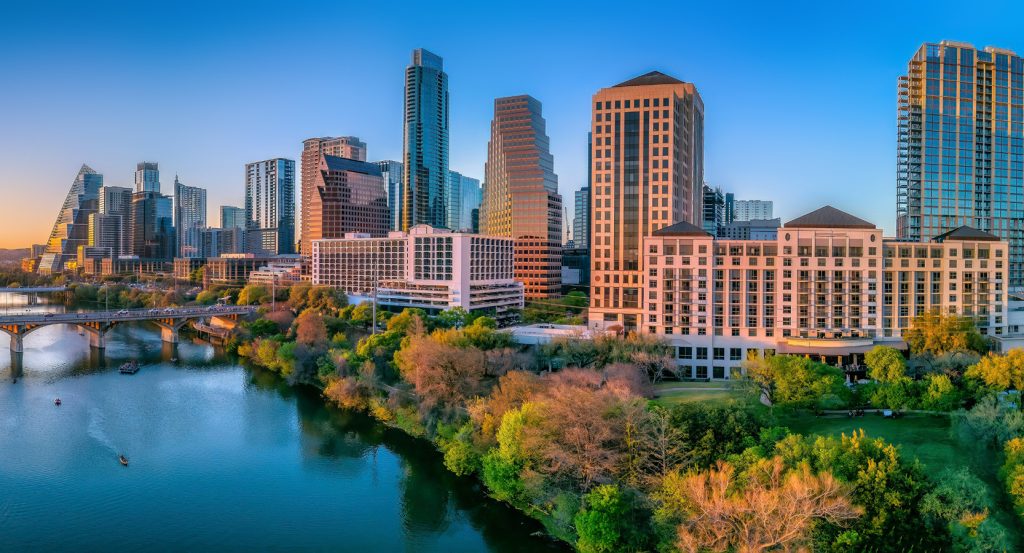
Why Lady Bird Lake matters.
Lady Bird Lake is a celebrated urban reservoir where Downtown's waterfront heritage meets the environmental transformation of the Colorado River, the civic legacy of Lady Bird Johnson and one of Texas's most extensive networks of metropolitan parks and recreational trails.
Stretching through Central Austin between the West End and East Austin, the reservoir follows the Colorado River eastward from Tom Miller Dam toward Longhorn Dam, passing beneath major downtown bridges and connecting the wooded shores of Zilker, South Lamar, Rainey Street and Holly through a continuous waterfront landscape. Its broad surface creates an open foreground for the downtown skyline, with landscaped banks and mature trees framing successive stretches of water. Limestone embankments, pedestrian bridges and shoreline pathways establish a varied physical setting that accommodates extensive public recreation. Sheltered coves and shallow margins support aquatic vegetation, waterbirds and other wildlife within the densely developed urban corridor. The result is a substantial metropolitan waterway whose natural setting and recreational infrastructure have become defining features of Austin's public landscape.
What defines Lady Bird Lake.
Lady Bird Lake is best known for its extensive waterfront recreation, its prominent position within Central Austin and the environmental improvements that transformed a utilitarian reservoir into a major public landscape. The waterway originated as part of the Colorado River, whose seasonal flooding and changing flows influenced Austin's development during the nineteenth and early twentieth centuries. The Lower Colorado River Authority subsequently developed a system of dams and reservoirs intended to provide flood management, hydroelectric generation and dependable water supplies across Central Texas. Longhorn Dam was completed in 1960, creating the reservoir originally named Town Lake along the southern edge of downtown. Its construction established a controlled body of water that extended westward through the central city, fundamentally changing the relationship between Austin's commercial districts and the river. The surrounding banks initially contained industrial properties, neglected land and limited public recreational infrastructure. Lady Bird Johnson became an influential advocate for improving the waterfront during the 1970s, encouraging the planting of native vegetation and the development of public trails. Her beautification efforts helped establish a broader civic commitment to accessible green space and the preservation of Austin's natural setting. The Town Lake Beautification Committee coordinated landscaping initiatives, encouraging volunteers and public agencies to participate in the transformation of the shoreline. The development of a continuous recreational trail strengthened the connection between neighborhoods on opposite sides of the water. Subsequent park improvements introduced additional pedestrian routes, landscaped gathering spaces and facilities supporting boating and other outdoor activities. Austin renamed the reservoir Lady Bird Lake in 2007 following Johnson's death, recognizing her substantial contribution to the city's waterfront landscape. The designation preserved the association between the former first lady and one of Austin's most consequential environmental improvement projects. The reservoir subsequently became a central element of the city's recreational infrastructure and an enduring expression of its commitment to public waterfront access.
The Colorado River supplies the reservoir through a regulated system of upstream dams, establishing the water conditions that support its extensive recreational use. The lake extends six miles through Central Austin and covers more than 400 acres, creating a substantial aquatic corridor within the metropolitan landscape. Motorized boating is restricted, encouraging activities such as kayaking, canoeing, rowing and stand-up paddleboarding. Rowing clubs and recreational outfitters operate along the shoreline, contributing to the lake's longstanding association with organized water sports. The reservoir also supports numerous fish species, including largemouth bass, sunfish and catfish, establishing an important recreational fishing resource. Great blue herons, egrets, cormorants and other waterbirds occupy the shoreline, taking advantage of aquatic habitats and sheltered vegetation. The Ann and Roy Butler Hike-and-Bike Trail encircles the central waterfront through ten miles of interconnected pathways. Its development created a continuous recreational route linking major parks, residential neighborhoods and downtown commercial districts. The Boardwalk at Lady Bird Lake opened in 2014, completing a critical southeastern section of the trail through an elevated pedestrian structure extending above the water. Its carefully arranged overlooks provide expansive views of the downtown skyline and the surrounding river corridor. The lake's northern shoreline incorporates substantial public spaces near the central business district, connecting the waterfront with Austin's expanding civic and cultural institutions. Southern sections introduce broader parkland, established recreational facilities and extensive tree cover. Seasonal changes in vegetation and wildlife contribute to the reservoir's varied appearance throughout the year. Lady Bird Lake's significance rests in its integration of engineered water infrastructure, sustained environmental stewardship and an extensive network of accessible public recreation.
How Lady Bird Lake fits.
Lady Bird Lake works as the recreational anchor for a Central Austin outing connecting the city's natural landscapes, its contemporary cultural institutions and the preserved industrial architecture associated with downtown redevelopment.
Begin at Zilker Metropolitan Park, the extensive public landscape occupying 350 acres southwest of downtown. The park developed through land donations and acquisitions associated with businessman Andrew Jackson Zilker, whose contributions established one of Austin's most important recreational properties. Its broad lawns, wooded areas and athletic facilities accommodate outdoor activities across a substantial portion of the city's central green space. The park also hosts major cultural gatherings, including the Austin City Limits Music Festival, which has become an internationally recognized event. Its varied terrain and extensive recreational facilities establish a significant connection between Austin's public landscape and its outdoor cultural traditions. Continue to Austin Central Library, the major civic institution overlooking Shoal Creek near the western edge of downtown. The building opened in 2017 and was designed by the architectural firms Lake|Flato and Shepley Bulfinch. Its contemporary structure incorporates extensive glass walls, landscaped terraces and a six-story atrium that introduces natural light deep into the interior. A rooftop garden provides views across the surrounding waterfront and downtown skyline, establishing an important connection between public architecture and the city's outdoor landscape. The library's collections, reading spaces and public programming support its role as a major cultural and educational resource. Conclude at Seaholm Power Plant, the historic industrial complex constructed during the mid-twentieth century to supply electricity to Austin. Its expansive Art Deco architecture incorporates substantial masonry surfaces, tall windows and distinctive industrial proportions associated with municipal infrastructure. The facility ceased generating electricity in 1989, eventually becoming the centerpiece of a major downtown redevelopment project. Preservation of the principal structure established an important architectural connection between Austin's industrial past and its expanding contemporary waterfront district. The surrounding plazas and pedestrian routes introduce landscaped public spaces within the former utility complex. The progression moves from Zilker Metropolitan Park's extensive recreational grounds through Austin Central Library's contemporary civic architecture and culminates at Seaholm Power Plant's preserved industrial complex, connecting three distinctive dimensions of Austin's environmental and architectural development.
Where your story begins.
Foresyte Travel reveals places that feel extraordinary long before you arrive.
Enjoy editorial crafted for luxury travelers.
Foresyte may earn a commission when you book.














































































































