
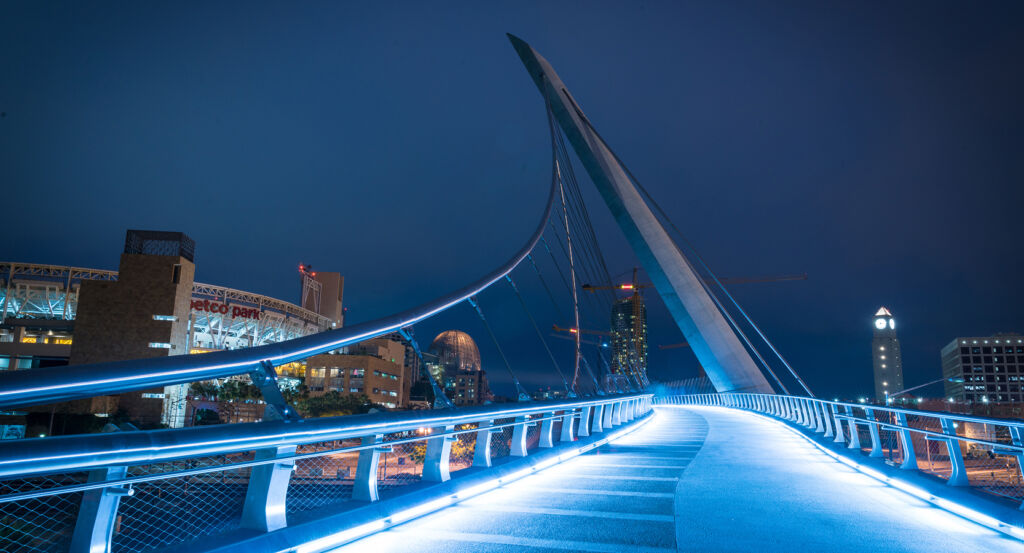
Perfect weekend in San Diego, California.
San Diego's position along the Pacific coast, immediately north of the Mexican border, has shaped more than two centuries of maritime commerce, military expansion, and cultural exchange between California and the Baja California Peninsula. The region's coastal valleys, sheltered bays, and inland mountains supported Indigenous communities for thousands of years before European colonization. The Kumeyaay established villages throughout the area, sustaining agricultural practices, fishing traditions, and trade networks extending from the Pacific shoreline into the eastern mountains. Spanish explorer Juan Rodríguez Cabrillo entered San Diego Bay in 1542, marking one of the earliest European encounters with the California coast. In 1769, Gaspar de Portolá's expedition established a Spanish military presence, and Franciscan missionary Junípero Serra founded Mission San Diego de Alcalá, the first of California's twenty-one Spanish missions. The mission subsequently moved inland to the San Diego River valley, where its agricultural operations became part of the colonial economy. Following Mexican independence in 1821, San Diego passed into Mexican territory, and its residents participated in the ranching economy of Alta California. The Mexican-American War brought the region under United States control in 1848. During the late nineteenth century, businessman Alonzo Horton promoted commercial development near the waterfront, establishing the foundations of the modern downtown district. Railroad connections strengthened San Diego's commercial relationships with the American interior, and the completion of the Panama Canal in 1914 increased the strategic significance of its harbor. Naval investment accelerated during the twentieth century, establishing shipbuilding, aviation, and defense industries as major components of the regional economy. The establishment of the University of California, San Diego in 1960 contributed to the expansion of scientific research, biotechnology, and advanced engineering. San Diego subsequently developed into a major Pacific metropolitan center with enduring connections to Mexico, international maritime commerce, and scientific innovation.
Californian artistic culture developed a particularly strong relationship with the Mexican borderlands in San Diego, where Indigenous craftsmanship, Chicano muralism, contemporary visual art, and regional music established enduring connections across national boundaries. The city's Chicano art movement gained prominence during the 1970s, with artists including Salvador Torres contributing murals that explored Mexican American history, Indigenous ancestry, political activism, and community solidarity. The Museum of Contemporary Art San Diego, founded in 1941, developed significant collections of modern and contemporary art, with particular attention to artists working in California and the border region. The San Diego Museum of Art, established in 1926, expanded the city's artistic institutions through collections encompassing European painting, Asian art, and works from the Americas. San Diego's literary associations include Raymond Chandler, whose later years in the coastal community of La Jolla connected the region with the development of American detective fiction. The city's musical history encompasses jazz, punk rock, Latin American performance traditions, and contemporary independent music. Tom Waits spent formative years in the San Diego area, developing musical influences that subsequently contributed to his distinctive songwriting and performance style. The San Diego Symphony, founded in 1910, became a principal institution of the city's classical music culture, performing orchestral repertoire and contemporary compositions. San Diego's culinary traditions developed through the agricultural resources of Southern California, Pacific fisheries, and longstanding connections with northern Mexico. Baja California cooking contributed preparations featuring grilled seafood, citrus marinades, fresh tortillas, and regional chile varieties. Fish tacos became closely associated with the coastal food culture of the border region, combining battered or grilled fish with cabbage, salsa, and creamy sauces. The California burrito, traditionally filled with carne asada, potatoes or french fries, cheese, and additional accompaniments, emerged as a San Diego specialty during the late twentieth century. Mexican American bakeries, markets, and restaurants sustain traditions involving tamales, birria, pozole, and regional preparations from across Mexico. The surrounding agricultural districts produce avocados, citrus, strawberries, and seasonal vegetables, supporting restaurants devoted to local ingredients. Pacific seafood, including yellowtail, sea bass, tuna, and sea urchin, contributes to the city's coastal cooking, and contemporary chefs incorporate Japanese, Mediterranean, and Mexican techniques into increasingly ambitious restaurant menus. San Diego rewards a weekend exploring the historical connections between California and Mexico, the artistic achievements of its border communities, and a culinary culture shaped by the Pacific Ocean and the agricultural landscapes of Southern California.
Three day itinerary.
Day 1: Coronado
Coronado is best known for combining San Diego Bay geography, naval history, resort development, and one of Southern California's defining beachfront communities. Elisha Babcock Jr. and Hampton Story acquired the peninsula during the 1880s and developed Coronado as a planned resort linked to San Diego by ferry. Their ambitions produced the Hotel del Coronado, whose immense timber structure and distinctive red roofs became the architectural centerpiece of the community after opening in 1888. Military development subsequently transformed the northern portion of Coronado as naval aviation expanded around San Diego Bay during the twentieth century. The San Diego-Coronado Bridge opened in 1969, permanently changing access to the peninsula and strengthening its physical integration with metropolitan San Diego.
Day 1: Addison by William Bradley
Addison by William Bradley is best known for William Bradley's transformation of Southern California ingredients into San Diego's most highly recognized fine-dining program. Bradley joined the restaurant at Fairmont Grand Del Mar in 2006 and progressively developed a tasting menu grounded in the agricultural and coastal products of California. His cooking combines French technical foundations with regional produce, seafood, chiles, citrus, masa, and other ingredients that connect the menu more directly to Southern California and neighboring Mexico. Long-term relationships with farmers, fishermen, and specialized producers strengthened that geographic character as the restaurant evolved. MICHELIN awarded Addison three stars in 2022, making it the first restaurant in San Diego to receive the guide's highest distinction and establishing Bradley as a central figure in the city's culinary maturation.
Day 2: San Diego Zoo
San Diego Zoo is best known for transforming zoological exhibition through naturalistic habitats and an institutional commitment to wildlife conservation. Physician Harry M. Wegeforth founded the Zoological Society of San Diego in 1916 after animals left from the Panama-California Exposition provided the foundation for a permanent collection. The zoo developed inside Balboa Park and progressively rejected conventional rows of cages in favor of environments designed around animal behavior, vegetation, topography, and mixed-species habitats. Its pioneering cageless exhibits influenced zoological institutions far beyond California. Research, veterinary medicine, breeding programs, and conservation work subsequently expanded through the organization now known as San Diego Zoo Wildlife Alliance, making the zoo both a major public institution and a significant center for global species conservation.
Day 2: Callie
Callie is best known for Travis Swikard's return to San Diego through a cuisine connecting Southern California agriculture with the eastern Mediterranean. Swikard grew up in the region before developing his career in New York under Daniel Boulud, eventually becoming culinary director of Boulud's restaurant group. He returned to his hometown and opened Callie in 2021, building the restaurant around the Greek word for “most beautiful.” Wood-fired cooking, seafood, handmade pasta, vegetables, olive oil, spices, and regional produce form the foundation of menus shaped by Mediterranean technique and San Diego ingredients. Callie became a defining expression of the city's contemporary independent restaurant culture and of Swikard's decision to redirect an international fine-dining career toward his native Southern California.
Day 2: La Jolla Cove
La Jolla Cove is best known for concentrating dramatic coastal geology and protected marine habitat within one of San Diego's most recognizable shorelines. Sandstone cliffs enclose a small beach facing the Pacific, where erosion has produced caves, rocky shelves, and steep coastal formations characteristic of La Jolla. The surrounding waters form part of a protected marine environment supporting kelp forests, garibaldi, rays, sea lions, harbor seals, seabirds, and extensive marine life. Underwater topography descends rapidly beyond the shoreline into the La Jolla Submarine Canyon, contributing to the biological richness of the surrounding ocean. The cove brings the geological and ecological systems of the Southern California coast into unusually close contact with a dense urban community.
Day 2: Jeune et Jolie
Jeune et Jolie is best known for bringing contemporary French cooking to Carlsbad through a restaurant shaped by Southern California ingredients and an unusually relaxed interpretation of fine dining. John Resnick and chef Eric Bost developed the restaurant around French culinary foundations expressed through seafood, vegetables, sauces, precise technique, and a tasting-menu structure. Bost brought experience from major kitchens in California and New York, translating that background into cooking responsive to San Diego County's agricultural abundance and Pacific coastline. The dining room and open kitchen reinforce the restaurant's lighter interpretation of the traditional French gastronomic institution. MICHELIN awarded Jeune et Jolie a star, establishing North County San Diego as an important component of the region's increasingly sophisticated culinary geography.
Day 3: Morning Glory
Morning Glory is best known for transforming breakfast into theatrical contemporary dining within San Diego's Little Italy. Consortium Holdings developed the restaurant above India Street as a vivaciously designed counterpoint to the utilitarian conventions of the American breakfast restaurant. Chef Jason McLeod helped shape its original culinary direction around soufflé pancakes, breakfast classics, globally influenced preparations, and technically ambitious morning cooking. Mirrored surfaces, elaborate lighting, metallic details, and a sweeping central bar make the interior integral to the restaurant's identity. MICHELIN awarded Morning Glory a Bib Gourmand, giving unusual institutional recognition to a restaurant devoted primarily to breakfast and reinforcing Little Italy's evolution from an immigrant neighborhood into one of San Diego's principal culinary districts.
Day 3: USS Midway Museum
USS Midway Museum is best known for preserving one of the longest-serving American aircraft carriers as an expansive record of twentieth-century naval aviation. USS Midway entered service in 1945 as the lead ship of a new carrier class and subsequently operated through major changes in aircraft, weapons, propulsion, and naval strategy. Extensive modifications allowed the ship to accommodate increasingly advanced jet aircraft during its decades of service. Midway participated in operations connected to Vietnam and the Persian Gulf before decommissioning in 1992 after 47 years in the fleet. The carrier opened as a museum on San Diego's waterfront in 2004, connecting the city's deep naval character to flight decks, hangars, aircraft, machinery, and operational spaces preserved aboard the ship itself.
Day 3: Balboa Park
Balboa Park is best known for concentrating Spanish Colonial Revival architecture, museums, gardens, and civic institutions within one of America's great urban cultural parks. San Diego reserved the land for public use in 1868, decades before major development transformed the plateau overlooking downtown. The 1915 Panama-California Exposition fundamentally reshaped the park as architect Bertram Goodhue developed an elaborate architectural ensemble inspired by Spanish and Mexican precedents. The California Building and its ornate tower became the exposition's defining work, establishing an architectural language subsequently associated with Southern California. The 1935 California Pacific International Exposition added another major phase of construction and reuse. Museums, theaters, gardens, the San Diego Zoo, and preserved exposition buildings subsequently made Balboa Park the institutional center of the city's cultural life.
Day 3: Valle
Valle is best known for Roberto Alcocer's expression of Baja California cuisine through the agricultural and viticultural landscape of Valle de Guadalupe. Alcocer grew up in Mexico and developed his culinary career through kitchens in Mexico, France, and Spain before establishing restaurants in Baja California. At Valle in Oceanside, he connects seafood from the Pacific, Mexican ingredients, contemporary technique, and the wine culture of the Baja peninsula within a tasting-menu format. The restaurant's character reaches south across the international border, treating San Diego County and Baja California as parts of a closely connected culinary region shaped by shared climate, coastline, agriculture, and migration. MICHELIN awarded Valle a star, strengthening the role of Baja-influenced cooking within Southern California fine dining.
Where your story begins.
Foresyte Travel reveals places that feel extraordinary long before you arrive.
Enjoy editorial crafted for luxury travelers.
Foresyte may earn a commission when you book.







































































































