
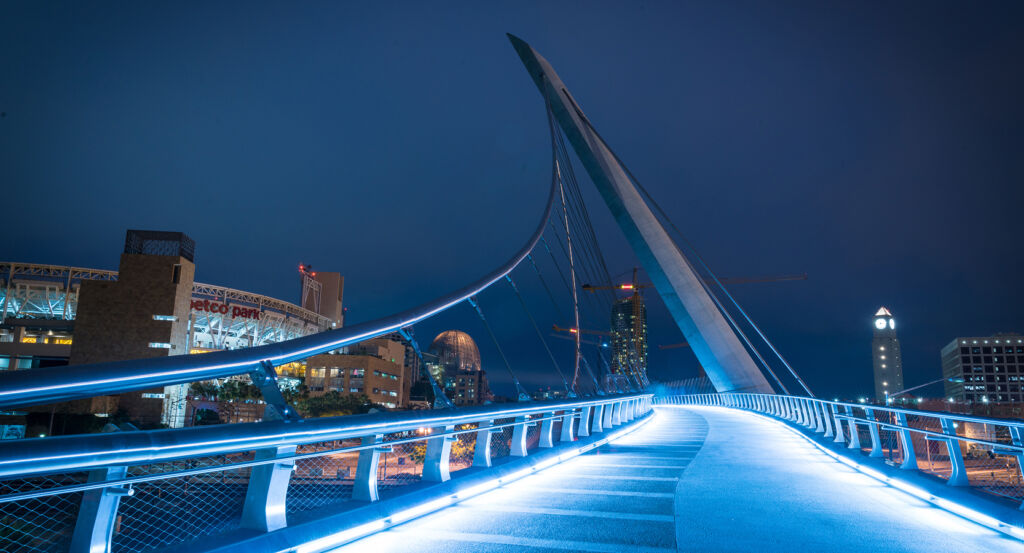
Why Callie matters.
Callie is a boundary-pushing Mediterranean restaurant where East Village's industrial reinvention meets chef Travis Swikard's classical French training, the agricultural abundance of Southern California and the culinary traditions of Greece, Italy and the eastern Mediterranean.
Set along Park Boulevard near Island Avenue and just steps from Petco Park, the restaurant occupies the ground floor of a contemporary mixed-use building at the southeastern edge of Downtown, surrounded by converted warehouses, residential towers and the neighborhood's expanding collection of restaurants and cultural venues. An open dining room combines pale wood surfaces, textured plaster, warm neutral upholstery and restrained decorative details, establishing an inviting environment centered on the energy of the kitchen. The restaurant's open cooking area places chefs and their preparations within direct view of the dining room, with a wood-fired hearth providing a focal point for the preparation of vegetables, seafood and meats. Carefully arranged tables, sculptural lighting and Mediterranean-inspired materials create a setting that balances contemporary architectural restraint with the warmth of a neighborhood gathering place. The result is a restaurant whose open architectural composition, visible culinary craftsmanship and position within East Village's transformed urban landscape establish an exceptional setting for contemporary Mediterranean cooking.
What defines Callie.
Callie is best known for establishing chef Travis Swikard as one of San Diego's most influential contemporary culinary figures through a deeply personal interpretation of Mediterranean cooking shaped by his California upbringing and years in New York's most demanding professional kitchens. Swikard grew up in Santee, east of San Diego, and developed an early interest in cooking through family meals and the agricultural traditions of Southern California. He studied at the California Culinary Academy in San Francisco before beginning a professional career that included work under celebrated chef Daniel Boulud in New York City. At Boulud's flagship restaurant Daniel, Swikard developed his technical foundation in classical French cuisine, mastering the disciplined preparation of sauces, proteins and elaborate multi-course meals. He subsequently became executive chef at Boulud Sud, the chef's Mediterranean-inspired restaurant near Lincoln Center, where he explored the culinary connections linking southern France, Italy, Greece, North Africa and the eastern Mediterranean. His leadership at Boulud Sud brought increasing recognition for his ability to combine classical technique with bold regional flavors, establishing the culinary direction that would eventually define his independent restaurant. After more than a decade in New York, Swikard returned to San Diego with the ambition of creating a restaurant rooted in the ingredients and agricultural relationships of his native region. He partnered with hospitality entrepreneur David Cohn and the Cohn Restaurant Group to develop a new dining destination in East Village, eventually establishing an independent ownership structure for the project. The restaurant's name derives from the Greek word kallos, meaning beauty, expressing Swikard's appreciation for the ingredients, hospitality traditions and culinary practices of the Mediterranean world. Callie opened in June 2021, introducing a menu built around seasonal Southern California produce, locally sourced seafood and the aromatic ingredients of Mediterranean cooking. The restaurant quickly became a major destination within San Diego's dining scene, attracting national attention for its ambitious culinary program and unusually personal connection between chef, ingredients and place. MICHELIN recognized Callie with a Bib Gourmand distinction, acknowledging its cooking and overall dining value within the California restaurant landscape. The restaurant's growing reputation helped establish East Village as an increasingly important destination for serious dining, extending the neighborhood's cultural transformation beyond its earlier association with warehouses, nightlife and professional baseball.
Travis Swikard's kitchen develops its culinary character through the interaction of wood-fired cooking, classical French technique and the bright, aromatic ingredients associated with the Mediterranean basin. The menu changes with the seasons, drawing on the extraordinary agricultural diversity of San Diego County and the relationships Swikard has developed with local farmers, fishermen and specialty producers. A signature preparation of Aleppo chicken introduces one of the restaurant's most recognizable dishes, combining deeply seasoned poultry with the fruity heat of Aleppo pepper and the concentrated flavors of carefully controlled roasting. Mediterranean spreads provide another defining element of the experience, with hummus, whipped feta and other preparations presented alongside warm pita bread for a communal opening sequence. The hummus achieves its characteristic texture through carefully cooked chickpeas and tahini, balancing nutty richness with lemon acidity and aromatic olive oil. Whipped feta develops a contrasting profile through cultured dairy, restrained seasoning and carefully chosen garnishes that complement the cheese's natural salinity. Seasonal vegetable dishes highlight the kitchen's ability to transform familiar California produce through charring, roasting and the use of preserved citrus, herbs and fermented condiments. Seafood preparations draw on the Pacific coastline and the wider traditions of Mediterranean fishing communities, combining precise cooking with sauces that emphasize olive oil, citrus and fresh aromatics. Richer meat courses incorporate slow cooking, direct heat and concentrated reductions, demonstrating Swikard's ability to connect classical French technique with the rustic cooking methods of the Mediterranean countryside. The restaurant's pasta preparations introduce another dimension of the menu, drawing on Italian traditions through carefully developed doughs, seasonal fillings and sauces that balance richness with freshness. Desserts continue the regional conversation through citrus, nuts, honey and cultured dairy, creating a progression that preserves the Mediterranean character of the meal through its final courses. The wine program emphasizes Mediterranean regions alongside California producers, with selections chosen to complement the menu's acidity, spice and complex herbal flavors. Callie's distinctive achievement lies in its ability to translate Swikard's international culinary education into a coherent expression of San Diego's agricultural abundance and the generous dining traditions of the Mediterranean.
How Callie fits.
Callie works as the culinary centerpiece for an outing connecting East Village's industrial transformation, the architectural heritage of San Diego's historic Gaslamp Quarter and the waterfront landscapes that established Downtown as a major Pacific port city.
Begin at Petco Park, the celebrated baseball stadium whose construction became a major catalyst for the redevelopment of San Diego's East Village neighborhood. Designed by Populous, formerly HOK Sport, the ballpark opened in 2004 as the home of the San Diego Padres, replacing Qualcomm Stadium as the team's principal venue. Its architecture incorporates the historic Western Metal Supply Company building, a brick warehouse completed in 1909 that was preserved and integrated into the left-field structure. The building's original industrial character provides a distinctive connection between the contemporary stadium and the neighborhood's early commercial development, with its brick façade and historic proportions establishing a striking contrast to the ballpark's open seating bowl. Continue to Gaslamp Quarter, the historic commercial district whose Victorian-era buildings preserve the architectural development of Downtown during the nineteenth century. The district emerged during the 1860s and 1870s as businessman Alonzo Horton promoted the development of New Town near San Diego Bay, shifting the city's commercial center away from Old Town. Its surviving buildings include ornate brick façades, cast-iron details and elaborate cornices that reflect the commercial prosperity of the late nineteenth century. The Gaslamp Quarter's designation as a National Historic District in 1980 established a foundation for the preservation and restoration of its architectural inheritance, supporting the transformation of the neighborhood into a major cultural and entertainment destination. Conclude at Seaport Village, the waterfront commercial complex developed along San Diego Bay as part of the city's late twentieth-century efforts to reconnect Downtown with its maritime setting. The destination opened in 1980, introducing a collection of pedestrian pathways, landscaped courtyards and small-scale buildings inspired by historical coastal architecture. Its location near Embarcadero Marina Park North provides expansive views across the harbor toward Coronado and the naval installations that have shaped San Diego's waterfront for generations. The surrounding promenade connects the complex with public art, waterfront gardens and the broader Embarcadero, creating a continuous pedestrian environment along the bay. The progression moves from Petco Park's integration of historic industrial architecture through Gaslamp Quarter's preserved Victorian commercial streetscape and culminates in Seaport Village's waterfront promenade, placing Callie within the architectural and cultural transformation of Downtown.
Where your story begins.
Foresyte Travel reveals places that feel extraordinary long before you arrive.
Enjoy editorial crafted for luxury travelers.
Foresyte may earn a commission when you book.





































































































