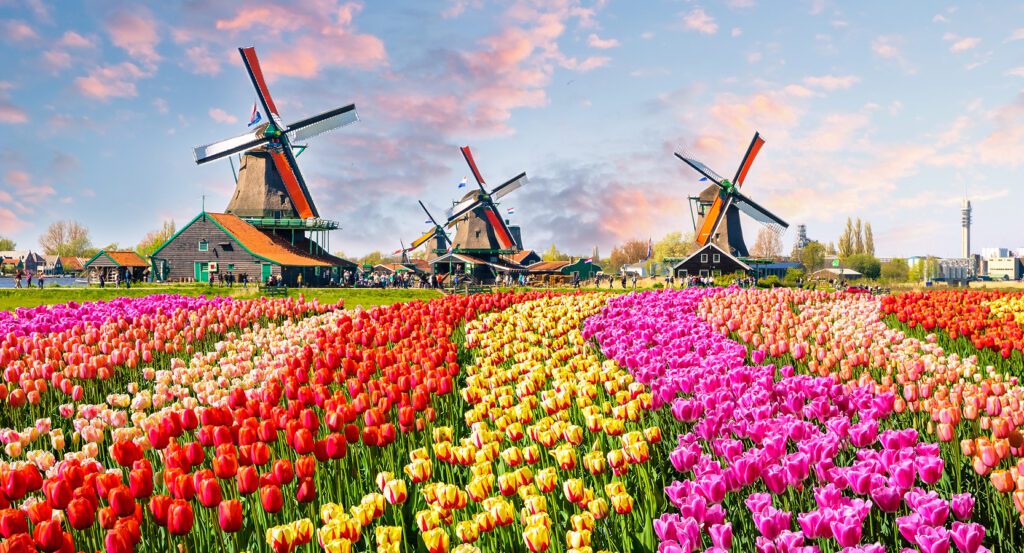
Fun facts about Amsterdam, Netherlands.
Amsterdam's architectural character follows an intricate network of canals, reclaimed land, and historic streets whose development reflects centuries of hydraulic engineering and the prosperity of the Dutch merchant class. The medieval center surrounds Dam Square, where the Royal Palace originated as the expansive seventeenth-century town hall designed by Jacob van Campen, its classical architecture expressing the wealth and political confidence of the Dutch Republic. Nearby, the Nieuwe Kerk preserves an important religious and ceremonial inheritance through its Gothic structure and longstanding association with royal inaugurations. The Oude Kerk, whose earliest surviving fabric dates to the thirteenth century, stands within the historic streets of De Wallen, connecting the city's medieval religious foundations with its densely developed commercial center. The most distinctive transformation of Amsterdam's urban geography occurred during the seventeenth century, when an ambitious canal expansion created the concentric waterways of the Herengracht, Keizersgracht, and Prinsengracht. These canals supported transportation, drainage, and residential development, establishing an orderly urban environment of narrow merchant houses, stone bridges, and tree-lined quays. Their characteristic façades incorporate stepped, neck, and bell gables, with projecting hoist beams reflecting the practical challenges of moving goods into upper storage floors. The Grachtengordel canal district became a UNESCO World Heritage Site in 2010, preserving an influential achievement in early modern urban planning. The Jordaan developed alongside this expansion as a densely inhabited district of artisans, laborers, and small workshops, retaining intimate streets and former industrial buildings that contrast with the grander merchant residences of the principal canals. The Anne Frank House stands beside the Prinsengracht, preserving the building where the Frank family and four others hid during the Nazi occupation. Southward, the Museumplein forms an expansive cultural precinct anchored by the Rijksmuseum, whose neo-Gothic and Renaissance Revival architecture was designed by Pierre Cuypers and completed in 1885. The nearby Van Gogh Museum, opened in 1973, contributes a modern architectural expression through its principal building designed by Gerrit Rietveld. Amsterdam Centraal, another major work by Cuypers, opened in 1889 on artificial islands along the historic waterfront, symbolizing the city's expanding railway connections and industrial modernization. Across the IJ, the former shipbuilding grounds of NDSM preserve immense industrial structures that have been adapted for creative studios, cultural events, and contemporary commercial uses. The EYE Filmmuseum introduces a striking architectural landmark along the northern waterfront through its angular white exterior and prominent position beside the river. Amsterdam's physical character emerges from this sustained negotiation between water management, merchant wealth, religious institutions, industrial infrastructure, and the preservation of an urban landscape whose canals remain fundamental to the city's identity.
Dutch cultural achievement found one of its most influential centers in Amsterdam, where the wealth of international commerce supported artistic patronage, intellectual freedom, scientific inquiry, and a flourishing tradition of independent publishing. During the seventeenth century, the city's prosperous merchant households, civic institutions, and professional associations commissioned portraits, landscapes, and scenes of everyday life that transformed the development of European painting. Rembrandt van Rijn established his career in Amsterdam during the 1630s, producing celebrated portraits and historical compositions, including The Night Watch, completed in 1642 for a civic militia company. The Rijksmuseum preserves this masterpiece alongside works by Johannes Vermeer, Frans Hals, and other leading artists of the Dutch Golden Age. Amsterdam's printing industry acquired comparable international importance through publishers who circulated philosophical, scientific, and religious works across Europe, benefiting from the Dutch Republic's comparatively permissive intellectual environment. Baruch Spinoza, born into Amsterdam's Portuguese Jewish community in 1632, became one of the defining philosophers of the early Enlightenment, developing influential arguments concerning reason, religion, political authority, and individual freedom. The city's Jewish history also reflects the arrival of Sephardic refugees from the Iberian Peninsula and subsequent Ashkenazi migration from Central and Eastern Europe, whose communities established synagogues, schools, commercial institutions, and distinctive cultural traditions. The Portuguese Synagogue, completed in 1675, preserves an imposing expression of this inheritance through its expansive brick architecture and historic interior. Amsterdam's cultural character also developed through the decorative arts, particularly the craftsmanship of Dutch furniture, silverwork, ceramics, and the production of luxury goods for affluent merchant households. During the nineteenth century, the city's artistic life expanded through influential painters including Vincent van Gogh, whose work subsequently became central to the international reputation of Dutch modern art. The twentieth century introduced important experiments in architecture and design through the Amsterdam School, whose expressive brickwork, sculptural façades, and elaborate decorative detailing challenged conventional approaches to urban housing. Het Schip, designed by Michel de Klerk and completed in 1921, became a defining example of this movement through its imaginative treatment of workers' housing. Amsterdam subsequently developed an influential contemporary cultural environment through experimental theater, electronic music, independent galleries, and the creative communities associated with its former industrial districts. The city's musical institutions include the Royal Concertgebouw Orchestra, founded in 1888, whose international reputation developed alongside the celebrated acoustics of the Concertgebouw concert hall. Dutch culinary traditions contribute another dimension through aged cheeses, herring, stroopwafels, and the Indonesian-influenced rijsttafel, whose development reflects the historical connections between the Netherlands and its former colonial territories. Amsterdam ultimately brings the artistic achievements of the Dutch Golden Age, the intellectual ambitions of the Enlightenment, and the creative independence of modern Dutch society into a cultural character shaped by maritime exchange, religious diversity, and centuries of urban innovation.
Five fascinations.
5. Amsterdam's narrow houses reveal how the city once taxed property.
Many of Amsterdam's historic canal houses are extraordinarily narrow, a characteristic shaped partly by the value and taxation of scarce canal frontage during the city's expansion. Merchants responded by building upward and extending houses deep into their plots, producing the tall, slender façades now inseparable from Amsterdam's appearance. Large goods were difficult to maneuver through tight staircases, so projecting beams and hooks near the roofline allowed furniture and merchandise to be hoisted through upper windows. A fiscal and spatial constraint ultimately helped create one of the city's defining architectural signatures.
4. Amsterdam built its seventeenth-century canal belt as a massive urban expansion.
Amsterdam's celebrated Canal Ring was not simply the result of waterways accumulating organically around the medieval city. During the seventeenth century, authorities undertook an ambitious planned expansion that extended the Herengracht, Keizersgracht, and Prinsengracht in sweeping arcs around the historic center. The project created new residential districts, commercial space, infrastructure, and prestigious addresses during the Dutch Golden Age. Centuries later, the concentric waterways still determine the physical organization of Central Amsterdam. UNESCO inscribed the seventeenth-century canal ring area on the World Heritage List in 2010.
3. Amsterdam Centraal stands on thousands of wooden piles.
Amsterdam's soft, waterlogged ground has forced builders to solve difficult foundation problems for centuries. When architect Pierre Cuypers and engineer A.L. van Gendt created Amsterdam Centraal in the nineteenth century, the enormous station required support from thousands of wooden piles driven deep into the unstable soil. The building opened in 1889 on artificial islands along the IJ, fundamentally changing the relationship between the historic city and its waterfront. Its expansive brick façade rests upon an immense foundation system largely invisible beneath one of Amsterdam's busiest landmarks.
2. Amsterdam turned a former shipyard into an experimental cultural district.
Across the IJ from the historic center, the Nederlandsche Dok en Scheepsbouw Maatschappij once operated one of the Netherlands' major shipbuilding complexes. After the shipyard collapsed in the 1980s, its enormous industrial buildings and waterfront terrain entered a radically different chapter. Artists, creative organizations, festivals, restaurants, and cultural projects progressively occupied the former industrial landscape, producing what is now NDSM. Towering cranes, slipways, warehouses, and contemporary interventions coexist across the site, making the district an unusually visible example of Amsterdam converting obsolete maritime infrastructure into a new piece of the city.
1. Amsterdam has more bicycles than residents.
Cycling dominates Amsterdam so tho that bicycles number in the hundreds of thousands across a city of fewer than one million residents, with estimates commonly placing the total above the resident population. That dominance was not inevitable. Rising automobile ownership transformed Dutch streets after World War II, and growing concern over traffic deaths helped drive powerful campaigns for safer urban environments during the 1970s. Amsterdam subsequently expanded cycling infrastructure across the city. The result is not merely a cultural stereotype: decades of transportation policy turned the bicycle into a fundamental component of how Amsterdam's streets and daily life function.
Where your story begins.
Foresyte Travel reveals places that feel extraordinary long before you arrive.
Enjoy editorial crafted for luxury travelers.
Foresyte may earn a commission when you book.