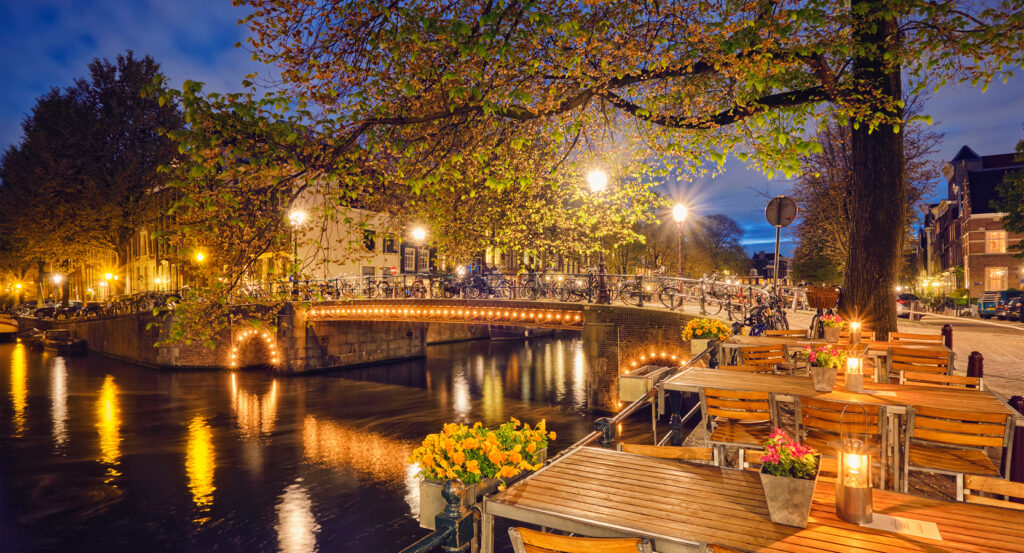
Why the Canal Belt matters.
The Canal Belt is Amsterdam's defining masterpiece, where elegant merchant houses, arched bridges, tree-lined waterways, and centuries of prosperity combine to create one of the most beautiful urban landscapes in the world.
Constructed during the Dutch Golden Age, the district unfolds through concentric canals lined with gabled townhouses, hidden courtyards, waterside cafés, historic warehouses, and architectural landmarks that reflect the extraordinary wealth and ambition of seventeenth-century Amsterdam. Boats drift quietly beneath hundreds of bridges, cyclists navigate streets that have changed remarkably little over the centuries, and residents continue to live within buildings originally commissioned by merchants, financiers, and traders at the height of a global empire. Along the border of neighboring Jordaan, narrower residential canals and intimate side streets blend naturally into the grand waterways of the Canal Belt, creating a neighborhood where nearly every view feels worthy of a painting. The combination of architectural harmony, human scale, and historic continuity makes the district one of Europe's most extraordinary urban achievements.
What defines Canal Belt.
The Canal Belt is best known for being a UNESCO World Heritage Site recognized as an outstanding example of large-scale seventeenth-century urban planning and engineering.
Developed during Amsterdam's rapid expansion in the early 1600s, the canal system was designed to support commerce, transportation, defense, drainage, and residential growth within a single integrated structure. The project transformed Amsterdam into one of the world's most advanced cities and provided the infrastructure that supported its emergence as a global center of trade and finance. The elegant canal houses that line the waterways became symbols of status and prosperity, while the overall design established a model that influenced urban planning far beyond the Netherlands. More than four centuries later, the canal network continues to function as both a living neighborhood and a defining symbol of Dutch ingenuity. Few cities possess a historic urban landscape that remains so complete, influential, and immediately recognizable.
How Canal Belt fits.
The Canal Belt is an ideal centerpiece for a day spent exploring Amsterdam's history, architecture, and most iconic cityscapes.
Begin the morning along the Herengracht, when the canals are at their most tranquil and the reflections of centuries-old merchant houses ripple across the water. From there, wander between the Keizersgracht and Prinsengracht, crossing bridge after bridge while discovering hidden courtyards, boutique shops, and waterside cafés tucked throughout the district. The Anne Frank House, Negen Straatjes, and Westerkerk all sit within easy reach, creating a natural progression between historic landmarks, neighborhood culture, and some of Amsterdam's most photographed streets. As the afternoon unfolds, the Canal Belt rewards unstructured exploration, with every canal bend revealing new architectural details and postcard-worthy views. The Canal Belt fits naturally into that rhythm of discovery, serving as both the physical structure of Amsterdam's Golden Age and the city's most enduring symbol.
Where your story begins.
Foresyte Travel reveals places that feel extraordinary long before you arrive.
Enjoy editorial crafted for luxury travelers.
Foresyte may earn a commission when you book.