
Why Anne Frank House matters.
Anne Frank House is a profoundly significant historic house museum where Jordaan's seventeenth-century canal architecture meets the concealed lives of eight Jewish people persecuted during the Nazi occupation, the survival of Anne Frank's diary and the enduring responsibility to confront antisemitism and the Holocaust.
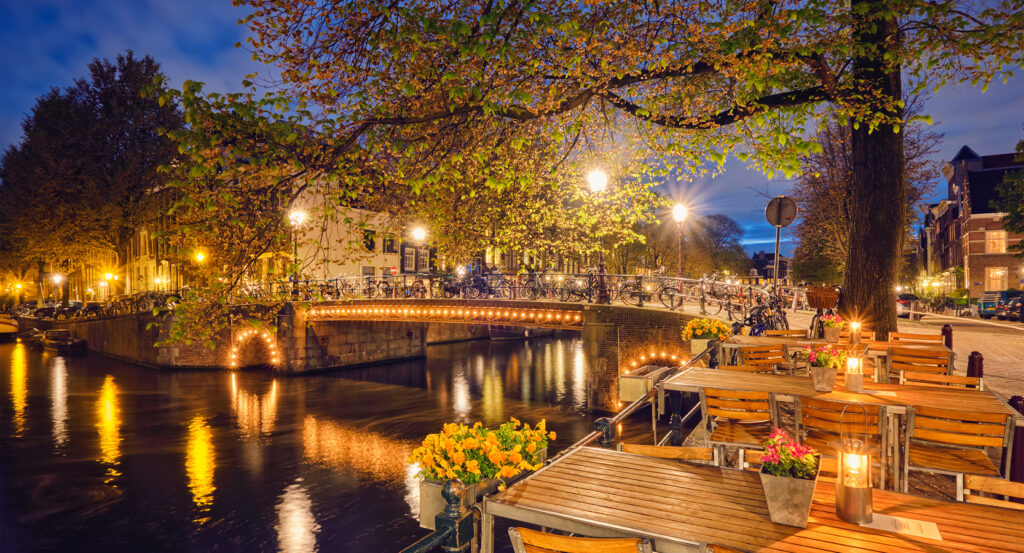
Standing on Prinsengracht near Westermarkt and the Bloemgracht canal junction, the museum occupies adjoining historic buildings on the western side of Amsterdam's canal belt, with a narrow canal-facing merchant house connected to the concealed rooms of a rear annex above a former business premises. The brick frontage retains the vertical proportions and regularly spaced windows characteristic of the surrounding canal houses. Interior staircases, compact rooms and carefully preserved architectural features establish the physical conditions of the wartime hiding place. The adjoining museum facilities accommodate exhibitions and public access, connecting the historic property with spaces devoted to education and remembrance. The result is a place of exceptional historical gravity whose surviving domestic interiors make the persecution of European Jews comprehensible through the experiences of one family and the people who shared their confinement.
What defines the Anne Frank House.
Anne Frank House is best known for preserving the Secret Annex where Anne Frank, her family and four other Jewish people hid from Nazi persecution between July 1942 and August 1944. Anne was born in Frankfurt am Main in 1929 to Otto and Edith Frank, joining an established German Jewish family that also included her older sister, Margot. Adolf Hitler's appointment as German chancellor in 1933 prompted Otto to seek greater security for his family in the Netherlands. The Franks relocated to Amsterdam, where Otto developed a business importing and distributing pectin and other food-related products. Germany invaded the Netherlands in May 1940, bringing the country under Nazi occupation and exposing its Jewish population to escalating restrictions. Anti-Jewish measures progressively excluded Jewish residents from public institutions, commercial activities and ordinary civic participation. In 1942, Margot received a summons to report for forced labor, accelerating the family's decision to enter a previously prepared hiding place. Otto had arranged concealed accommodation within the rear portion of his company's premises, establishing a refuge accessible through the building's interior. Anne, Margot, Otto and Edith entered hiding on July 6, 1942, beginning a period of confinement that would last more than two years. Hermann, Auguste and Peter van Pels subsequently joined the family, followed by dentist Fritz Pfeffer in November. The eight occupants depended upon trusted employees and associates who supplied food, information and essential provisions at considerable personal risk. Their helpers included Miep Gies, Jan Gies, Johannes Kleiman, Victor Kugler, Bep Voskuijl and her father, Johan Voskuijl. On August 4, 1944, German security personnel raided the premises and arrested the eight people in hiding. The prisoners were transported through detention facilities and deported to concentration camps, where seven of the eight ultimately died. Otto Frank survived Auschwitz and returned to Amsterdam following the war. Miep Gies had preserved Anne's notebooks and loose manuscript pages after the arrests, returning them to Otto when Anne's death became known. Otto arranged the publication of her writings in Dutch in 1947 under the title Het Achterhuis, establishing the foundation for the diary's subsequent international readership. The building faced demolition during the 1950s, prompting a preservation campaign supported by Otto and other advocates. The Anne Frank Foundation was established in 1957, and the preserved hiding place opened as a museum on May 3, 1960. The institution subsequently expanded its educational activities and exhibition facilities, becoming an internationally important center for Holocaust remembrance and the examination of discrimination and persecution.
How the Anne Frank House fits.
Anne Frank House works as the historical anchor for an Amsterdam outing connecting the city's wartime persecution of Jewish residents, its institutions of remembrance and the surviving cultural heritage of the Jewish community.
Begin at National Holocaust Museum, the institution situated on Plantage Middenlaan within Amsterdam's historic Jewish cultural district. The museum occupies buildings associated with the wartime persecution of Jewish residents, including a former teacher-training college whose proximity to a Nazi-controlled assembly location enabled acts of rescue. During the occupation, children were separated from their families at the nearby Hollandsche Schouwburg before deportation, and resistance networks helped some escape through adjoining properties. The museum's exhibitions examine the systematic exclusion, deportation and murder of Dutch Jews through personal testimony, original objects and historical materials. Its permanent presentation connects individual experiences with the institutions and administrative measures that enabled persecution. Continue to Hollandsche Schouwburg, the former theater that became a central assembly and deportation site for Jewish residents during the German occupation. Originally opened as a theater in 1892, the building was commandeered by Nazi authorities in 1942 and used to detain people awaiting transportation to transit camps. Thousands of Jewish men, women and children passed through the building before deportation. The site subsequently became a memorial dedicated to the victims of the Holocaust, preserving the historical significance of the former theater through commemorative architecture and exhibitions. Its courtyard memorial and historical presentation establish a direct connection between the city's surviving urban fabric and the destruction of its Jewish community. Conclude at Portuguese Synagogue, the seventeenth-century Jewish house of worship situated on Mr. Visserplein. Completed in 1675, the synagogue was constructed for Amsterdam's Sephardic Jewish congregation, whose ancestors had fled religious persecution in the Iberian Peninsula. Its spacious interior contains wooden furnishings, brass chandeliers and a traditional arrangement centered on the congregation's religious practices. The building preserves an important chapter of Amsterdam's Jewish history preceding the twentieth-century catastrophe. Its associated collections and ceremonial objects illuminate the religious, intellectual and communal traditions maintained by generations of Jewish residents. The progression moves from National Holocaust Museum's account of persecution through Hollandsche Schouwburg's history of deportation and culminates at Portuguese Synagogue's surviving religious heritage, connecting Anne Frank House with the broader history of Jewish Amsterdam.
Where your story begins.
Foresyte Travel reveals places that feel extraordinary long before you arrive.
Enjoy editorial crafted for luxury travelers.

















































































































