Why Jordaan matters.
Jordaan is a historic residential enclave where Amsterdam's seventeenth-century commercial expansion meets the working-class traditions of its canal-side neighborhoods, the artistic legacy of the Dutch Golden Age and the transformation of a former artisans' quarter into one of the city's most culturally significant districts.
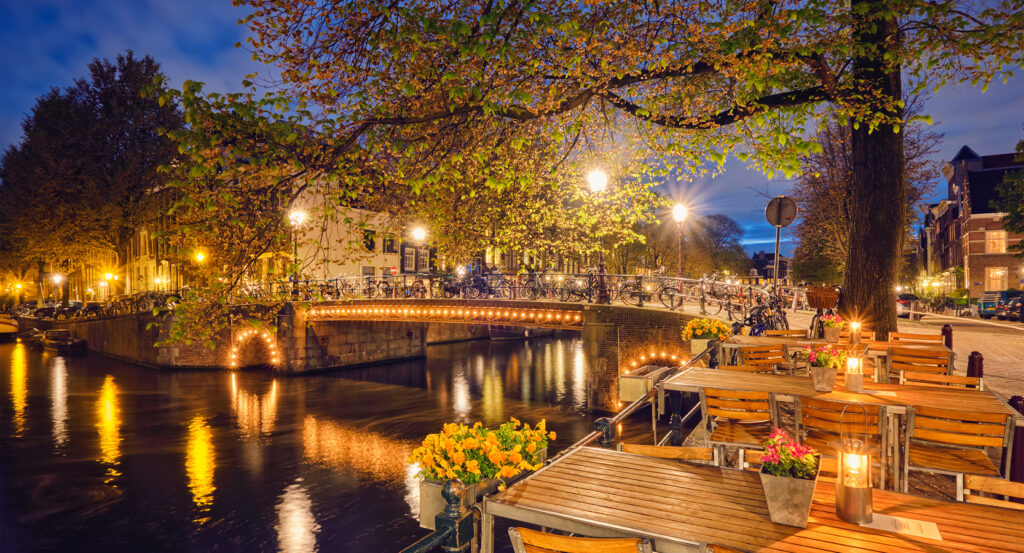
Positioned west of the Canal Ring between the Brouwersgracht, Prinsengracht, Leidsegracht and Singelgracht, the neighborhood occupies a closely arranged network of narrow streets and smaller waterways, with the Egelantiersgracht, Bloemgracht and Lauriergracht connecting former industrial plots, traditional residences and intimate public spaces. Brick row houses rise above stone-paved streets, their varied gables and modest proportions preserving the architectural character of a district originally developed for workers and craftsmen. Small courtyards and former almshouse complexes occupy interior parcels, introducing sheltered communal spaces behind the continuous street frontages. Independent shops, neighborhood cafés and traditional markets operate among residential buildings, maintaining the close relationship between domestic life and local commerce. The result is a distinctive urban district whose preserved waterways, working-class architectural heritage and longstanding artistic associations contribute substantially to Amsterdam's cultural character.
What defines Jordaan.
Jordaan is best known for its origins as a seventeenth-century working-class district, its association with Rembrandt van Rijn and its longstanding traditions of popular music, neighborhood markets and independent craftsmanship. Amsterdam's rapid commercial expansion during the Dutch Golden Age created substantial demand for housing beyond the medieval center. Municipal authorities began a major westward expansion in 1613, incorporating land previously occupied by gardens, agricultural plots and small settlements. The new district developed beside the city's planned residential canals, accommodating laborers, artisans and immigrants who supported its expanding maritime economy. Its streets followed elements of the earlier rural property boundaries, producing an irregular arrangement that contrasted with the more formally planned waterways to the east. Textile workers, carpenters, metalworkers and other craftsmen established workshops within modest houses, combining residential and commercial functions on compact plots. Religious refugees and migrants from the southern Netherlands contributed to the district's growing population, introducing additional skills and cultural traditions. The neighborhood's name has been associated with the French word jardin, meaning garden, although its precise linguistic origin remains disputed. Rembrandt moved to the Rozengracht in 1658 after financial difficulties forced the sale of his substantial residence elsewhere in Amsterdam. He spent his final years in the district and died there in 1669, establishing one of Jordaan's most important associations with Dutch painting. The neighborhood's population increased during the eighteenth and nineteenth centuries, placing considerable pressure on its limited housing stock. Industrial employment and commercial activity supported dense residential development, and many working families occupied small dwellings with inadequate sanitation. Public health concerns and deteriorating buildings encouraged municipal housing reforms during the late nineteenth and early twentieth centuries. The district became associated with labor activism, including the Jordaan riots of July 1934, which followed government reductions in unemployment benefits during the economic depression. The disturbances resulted in violent confrontations between residents and security forces, exposing the economic insecurity affecting Amsterdam's working-class population. Postwar redevelopment proposals threatened portions of the neighborhood's older buildings, prompting preservation campaigns that sought to protect its historic streets and residential character. Restoration programs and changing housing demand subsequently attracted artists, students and professionals, accelerating the district's transformation during the late twentieth century. Jordaan developed into a prominent residential and cultural neighborhood, preserving substantial elements of its working-class heritage amid rising property values and commercial investment.
Johnny Jordaan became one of the neighborhood's most recognizable cultural figures through popular songs celebrating Amsterdam's working-class communities. Born Johannes Hendricus van Musscher in 1924, the singer grew up in Jordaan and developed a repertoire associated with the sentimental traditions of Dutch popular music. His performances helped establish the Jordaanlied as a distinctive musical form, combining accessible melodies with stories of neighborhood life, family relationships and urban hardship. The genre's popularity extended beyond Amsterdam, introducing the district's cultural traditions to audiences throughout the Netherlands. Tante Leen, born Helena Kok-Polder, became an important performer within the same musical tradition, developing a repertoire closely associated with the neighborhood's popular entertainment venues. The district's cafés supported informal musical gatherings and performances, preserving the relationship between local businesses and communal entertainment. Traditional markets established an equally important component of Jordaan's commercial life, particularly along the streets surrounding the Noorderkerk. The Noordermarkt developed as a center for the sale of household goods, clothing and agricultural produce, connecting urban residents with merchants and regional suppliers. Its contemporary market activity includes antiques, secondhand goods and organic food, maintaining a commercial function established over successive generations. The nearby Lindengracht market occupies a broad street originally constructed above a filled-in canal, demonstrating the adaptation of the neighborhood's waterways to changing transportation and commercial requirements. Former almshouses, known as hofjes, preserve a significant dimension of Jordaan's social history through enclosed courtyards established to accommodate elderly residents and people with limited financial resources. These complexes frequently originated through charitable foundations supported by wealthy merchants and religious institutions, introducing carefully organized communal housing within the densely developed district. Their architectural arrangements combine modest residential units with shared gardens and controlled entrances, establishing a distinctive form of urban social provision. Independent galleries, specialty shops and small restaurants subsequently occupied former workshops and commercial premises, extending the neighborhood's association with craftsmanship and artistic production. The survival of traditional residential buildings, public markets and courtyard housing preserves the physical setting of Jordaan's historical development. Its cultural importance rests in the relationship between working-class social institutions, artistic communities and the architectural continuity of one of Amsterdam's most historically significant residential districts.
How Jordaan fits.
Jordaan works as the historical anchor for an Amsterdam outing connecting the district's seventeenth-century religious architecture, its traditional neighborhood markets and the cultural institutions that preserve the history of Dutch popular music.
Begin at Noorderkerk, the Protestant church constructed between 1620 and 1623 during Amsterdam's seventeenth-century expansion. Designed by Hendrick de Keyser and completed following his death, the church adopted a centralized Greek-cross plan suited to Protestant worship, emphasizing the congregation's relationship with the pulpit. Its substantial brick exterior and restrained architectural details distinguish it from the more elaborate ecclesiastical buildings associated with earlier Catholic traditions. The surrounding square became an important neighborhood gathering place, establishing a direct connection between religious life and public commerce. The church continues to serve a congregation and accommodates musical performances, preserving its historical role within the district. Continue to Noordermarkt, the traditional market square adjoining the church and surrounded by historic residential buildings. The square developed as a commercial gathering place during the neighborhood's early expansion, supporting the exchange of food, household goods and other essential commodities. Its contemporary markets include a Saturday farmers' market associated with organic produce and specialty foods, alongside stalls selling antiques, clothing and secondhand objects. The market's compact arrangement encourages pedestrian movement between vendors and surrounding cafés, maintaining the district's traditional relationship between commerce and neighborhood social life. Its location among preserved seventeenth-century streets provides a concentrated introduction to Jordaan's historical urban character. Conclude at Jordaan Museum, a cultural institution devoted to preserving the neighborhood's social history, artistic traditions and working-class heritage. Its activities focus on the lives of residents whose labor, music and community institutions shaped the district across successive generations. Historical photographs, personal accounts and cultural materials illuminate the neighborhood's transformation from a densely populated workers' quarter into a prominent residential district. The museum's programs also examine the architectural development of local streets and the preservation of traditional housing. Its educational activities contribute to the continuing interpretation of Jordaan's cultural heritage within the broader history of Amsterdam. The progression moves from Noorderkerk's Protestant architecture through Noordermarkt's traditional commerce and culminates at Jordaan Museum's preservation of neighborhood history, connecting Jordaan with the religious, commercial and cultural institutions that shaped its development.
Where your story begins.
Foresyte Travel reveals places that feel extraordinary long before you arrive.
Enjoy editorial crafted for luxury travelers.
Foresyte may earn a commission when you book.