Perfect weekend in Austin, Texas.
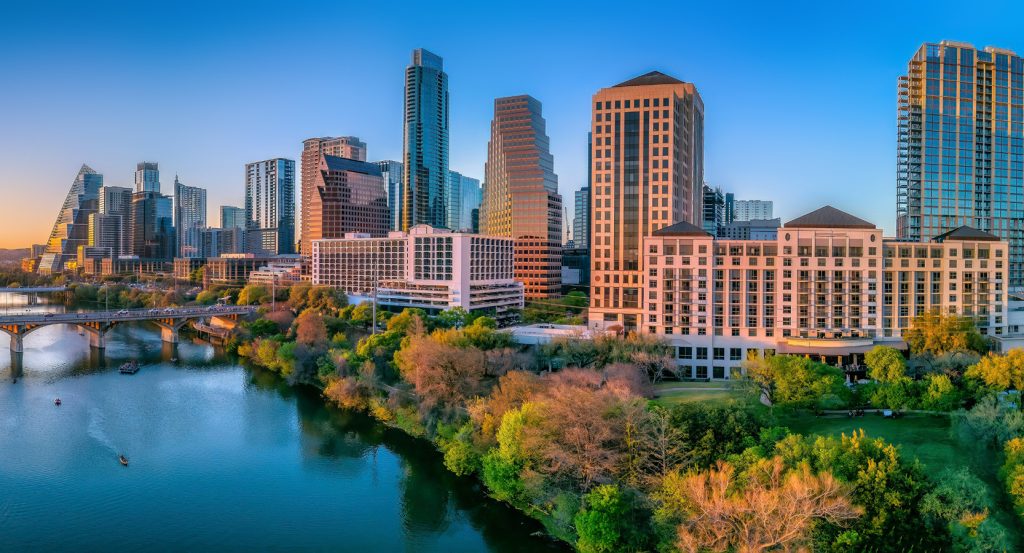
Austin's development from a frontier settlement on the Colorado River into the capital of Texas and a center of American technology, education, and music followed nearly two centuries of political change and economic expansion. Located along the eastern edge of the Texas Hill Country, the city occupies a landscape of limestone escarpments, wooded valleys, and waterways separating the Blackland Prairie from the rugged terrain of Central Texas. Indigenous peoples, including the Tonkawa, Comanche, and Lipan Apache, maintained longstanding relationships with the region before Anglo-American settlement. The community of Waterloo emerged along the Colorado River during the 1830s, attracting settlers through its position near established transportation routes and agricultural land. In 1839, the Republic of Texas selected the settlement as its capital and renamed it Austin in honor of Stephen F. Austin. Edwin Waller directed the planning of the new capital, establishing a street grid that organized government buildings, commercial properties, and residential blocks across the surrounding hills. Following Texas annexation in 1845, Austin retained its political importance despite disputes over the location of the state government. The establishment of the University of Texas at Austin in 1883 strengthened the city's educational foundations and encouraged the growth of publishing, scientific scholarship, and professional employment. During the twentieth century, state government, higher education, and military investment supported metropolitan expansion. The establishment of major semiconductor and computer manufacturing operations during the 1960s and 1970s contributed to Austin's development as a technology center. Companies including IBM, Motorola, and Texas Instruments strengthened the region's engineering workforce, and subsequent investment in software development expanded its economic reach. Austin's population growth brought substantial residential construction and commercial investment, transforming the former frontier capital into a metropolitan center closely associated with technological innovation and creative enterprise.
Texan musical culture found one of its most influential modern centers in Austin, where country, blues, folk, rock, and independent performance traditions developed through the city's universities, clubs, and recording enterprises. During the 1970s, performers including Willie Nelson, Waylon Jennings, and Jerry Jeff Walker contributed to the growth of progressive country and outlaw country, bringing national attention to Austin's music community. The television program Austin City Limits, first broadcast in 1976, became an important platform for American roots music, subsequently expanding its repertoire to include rock, jazz, blues, and international performers. Stevie Ray Vaughan developed his musical career in Austin, combining Texas blues traditions with virtuosic electric guitar performance before achieving international prominence during the 1980s. The South by Southwest festival, established in 1987, expanded from a regional music conference into a major gathering devoted to music, film, and technology. Austin's literary culture developed through the University of Texas and institutions including the Harry Ransom Center, whose collections encompass manuscripts, photography, rare books, and materials associated with major writers and artists. The Blanton Museum of Art, established in 1963, strengthened the city's visual arts institutions through collections of European painting, Latin American art, and contemporary works. Austin's culinary foundations developed through Central Texas cattle ranching, German and Czech immigration, and the longstanding food traditions of Mexican American communities. Central Texas barbecue became particularly associated with slow-smoked beef brisket, sausages, and oak-fired cooking, supported by the region's ranching economy. Mexican and Tex-Mex preparations contributed breakfast tacos, enchiladas, tamales, and chile-based sauces, establishing enduring neighborhood dining traditions. German and Czech communities introduced smoked meats, kolaches, and traditional baked goods, strengthening the culinary character of the surrounding Hill Country. The agricultural districts of Central Texas supply seasonal vegetables, pecans, peaches, and locally raised livestock, supporting restaurants devoted to regional ingredients. Contemporary chefs extend these foundations through modern American cooking, Mexican regional techniques, and international culinary influences. Austin rewards a weekend exploring the musical innovations, historic communities, and deeply rooted food traditions that distinguish the Texas capital.
Three day itinerary.
Day 1: 6th Street
6th Street is best known for concentrating Austin's live-music culture within a historic downtown commercial corridor whose buildings preserve the city's nineteenth-century growth. Originally known as Pecan Street, the avenue developed rapidly after the arrival of the railroad strengthened Austin's role as a regional commercial center. Limestone and brick storefronts, hotels, saloons, warehouses, and mercantile buildings created the architectural fabric that survives across the East Sixth Street Historic District. Music clubs subsequently occupied many of these structures as Austin's reputation for live performance expanded during the twentieth century. Blues, rock, country, punk, and alternative music all found stages along the corridor, embedding 6th Street within the network of small venues that helped establish Austin as one of America's most consequential live-music cities.
Day 1: Barley Swine
Barley Swine is best known for Bryce Gilmore's transformation of Central Texas ingredients into an ambitious contemporary tasting-menu restaurant. Gilmore returned to Austin after developing his career in professional kitchens and first established the Odd Duck farm-to-trailer project before opening Barley Swine in 2010. Relationships with Texas farmers, ranchers, and artisans became fundamental to a kitchen structured around seasonal vegetables, grains, meats, fermentation, preservation, and whole-product utilization. The restaurant progressively evolved from an intimate neighborhood operation into a more elaborate multicourse format without severing its connection to regional agriculture. Gilmore's work helped define Austin's transition from a celebrated casual-food city into a serious center for chef-driven dining grounded specifically in the products of Central Texas.
Day 2: Texas Capitol
Texas Capitol is best known for expressing the political character and nineteenth-century ambitions of Texas through one of the nation's largest state capitol buildings. Architect Elijah E. Myers designed the Renaissance Revival structure after winning a national competition, and construction began in 1882 on a prominent site overlooking Central Austin. Texas supplied the builders with distinctive sunset-red granite from Granite Mountain near Marble Falls after concerns arose over the original limestone exterior. The building was completed in 1888 with a central dome rising above symmetrical legislative wings and an expansive rotunda. A major underground extension completed during the 1990s expanded government facilities while protecting the historic exterior composition. The Capitol remains the architectural and governmental center of the state whose political institutions drove Austin's development from frontier settlement to major metropolis.
Day 2: Nixta Taqueria
Nixta Taqueria is best known for Edgar Rico and Sara Mardanbigi's transformation of the neighborhood taqueria through heirloom corn, nixtamalization, and intensely personal Mexican-American cooking. Rico built the kitchen around masa produced from carefully selected corn, making the grain itself a primary source of flavor, texture, and cultural continuity. Tacos combine those tortillas with vegetables, meats, seafood, fermentation, and preparations informed by Mexican traditions and Rico's culinary background. The restaurant's compact East Austin setting gave the project the informality of a neighborhood counter even as its cooking attracted national attention. Rico received the James Beard Award for Emerging Chef in 2022, establishing Nixta as an influential expression of the renewed importance of heirloom maize within contemporary American cooking.
Day 2: Ann W. Richards Congress Avenue Bat Bridge
Ann W. Richards Congress Avenue Bat Bridge is best known for forming the world's largest urban bat colony beneath a major transportation crossing in Central Austin. Reconstruction of the Congress Avenue Bridge during the 1980s created narrow expansion joints whose dimensions proved exceptionally suitable for Mexican free-tailed bats. The colony grew dramatically as migrating females used the bridge as a maternity roost, producing an immense seasonal concentration directly above Lady Bird Lake. Early public anxiety gradually gave way to scientific study and conservation as residents recognized the bats' ecological role as insect predators. Their mass evening emergence subsequently became one of Austin's defining natural spectacles, demonstrating how an ordinary piece of urban engineering unintentionally created habitat for an extraordinary wildlife population in the center of a rapidly growing city.
Day 2: Hestia
Hestia is best known for Kevin Fink and Tavel Bristol-Joseph's exploration of live-fire cooking through a kitchen organized around an expansive hearth. The restaurant takes its name from the Greek goddess of the hearth, translating that reference into a culinary system in which embers, smoke, radiant heat, and direct flame shape ingredients across the menu. Seafood, meats, vegetables, breads, and sauces acquire different characteristics through carefully controlled exposure to fire, making heat itself a primary cooking medium. Fink's technical background and Bristol-Joseph's pastry expertise broaden the restaurant's range beyond conventional wood-fired cooking into a tightly integrated tasting-menu format. Hestia established a sophisticated expression of Austin's longstanding relationship with fire, smoke, and Central Texas ingredients.
Day 3: Birdie's
Birdie’s is best known for Tracy Malechek-Ezekiel and Arjav Ezekiel's combination of chef-driven cooking, serious wine, and counter service in East Austin. Malechek-Ezekiel developed her career in major New York restaurants before returning to Texas, where the couple created Birdie's around a deliberately streamlined service model. Seasonal vegetables, handmade pasta, seafood, meats, and carefully developed sauces reflect her classical training without imposing the formal structure traditionally associated with comparable cooking. Arjav Ezekiel's wine program concentrates on distinctive producers and regions, making wine integral to the restaurant's character from its inception. Birdie's became an influential Austin restaurant by joining ambitious culinary execution to the accessibility and informality that have long characterized the city's independent dining culture.
Day 3: Lady Bird Lake
Lady Bird Lake is best known for turning a dammed section of the Colorado River into the recreational and ecological center of Austin. The reservoir originated with construction of Longhorn Dam in 1960 as part of the city's water and power infrastructure. Lady Bird Johnson later championed efforts to improve the neglected shoreline, helping inspire extensive beautification and planting along the water. Trails, native vegetation, parks, boat access, and restored shoreline subsequently transformed the reservoir into a continuous public landscape through Central Austin. Renamed for Johnson in 2007, the lake became inseparable from the city's outdoor culture and environmental identity. Its linear geography now connects downtown, residential neighborhoods, parkland, wildlife habitat, and the Colorado River system within the metropolitan core.
Day 3: South Congress Avenue
South Congress Avenue is best known for concentrating Austin's independent commercial culture along the historic approach to the Texas Capitol. The avenue extends south from the Congress Avenue Bridge and preserves the axial relationship between downtown and the Capitol established by the city's nineteenth-century plan. Motels, music venues, restaurants, shops, and low-rise commercial buildings subsequently created a district whose character reflected successive eras of automobile travel and neighborhood commerce. The Continental Club became a particularly consequential anchor after opening in 1955, evolving into an important venue for roots, rockabilly, country, and blues. Decades of reinvestment transformed the surrounding blocks into one of Austin's principal pedestrian commercial districts, preserving a strong connection between independent businesses, music, street life, and the city's central urban geography.
Day 3: Dai Due
Dai Due is best known for its pioneering interpretation of Texas regional cuisine and chef Jesse Griffiths's influential commitment to local agriculture, whole-animal butchery, and traditional food preservation. Founded in 2006 as a supper club and later developed into a permanent restaurant and butcher shop on Manor Road, the establishment emerged from Griffiths's determination to reconnect contemporary cooking with the agricultural and hunting traditions of Texas. His culinary philosophy emphasizes ingredients raised, harvested, and produced within the state, establishing direct relationships with ranchers, farmers, fishermen, and independent agricultural producers. The restaurant's working butcher shop reflects Griffiths's expertise in whole-animal utilization, transforming locally raised livestock and wild game into carefully prepared cuts, house-made sausages, charcuterie, and substantial regional dishes. Traditional preservation techniques, including smoking, curing, fermenting, and pickling, extend the culinary possibilities of seasonal ingredients and reinforce the kitchen's relationship with Texas food history. Griffiths expanded his influence through and , whose exploration of wild food preparation earned a James Beard Foundation Book Award in 2022. The restaurant's beverage program emphasizes Texas wines and beers, connecting its agricultural philosophy with the state's expanding independent beverage industry. Dai Due represents a defining achievement in contemporary Texas gastronomy through its integration of regional agriculture, traditional craftsmanship, and an uncompromising commitment to the culinary resources of the state.
Where your story begins.
Foresyte Travel reveals places that feel extraordinary long before you arrive.
Enjoy editorial crafted for luxury travelers.
Foresyte may earn a commission when you book.