
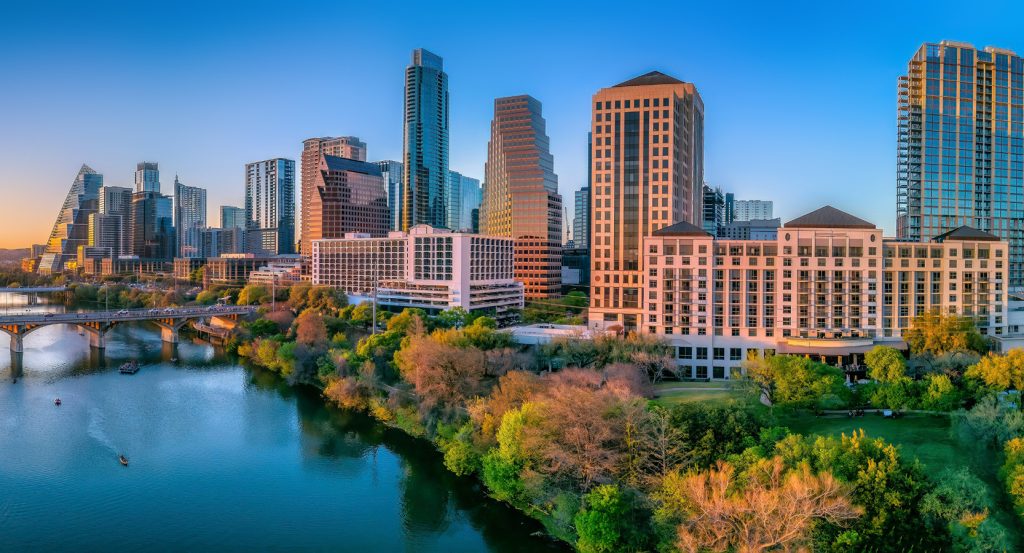
Why 6th Street matters.
6th Street is a historic entertainment corridor where Downtown's musical heritage meets the commercial ambitions of nineteenth-century Texas, the independent performance culture that shaped the Live Music Capital of the World and the nightlife traditions of the city's most celebrated thoroughfare.
Running through Downtown between the West End and East Austin, the entertainment corridor follows East 6th Street from Congress Avenue toward Interstate 35, crossing Brazos, San Jacinto, Trinity, Neches and Red River streets through successive blocks of Victorian commercial buildings, music clubs and historic storefronts. Ornamental brick facades, arched windows and decorative cornices preserve the architectural character of the former mercantile district. Neon signs and illuminated marquees identify performance venues, bars and restaurants occupying narrow buildings with deep interior rooms. Sidewalks connect closely spaced entrances beneath restored masonry elevations, creating a continuous pedestrian streetscape distinguished by historic architecture and concentrated nightlife. The result is a distinctive urban corridor whose surviving commercial buildings and performance establishments preserve Austin's development into an internationally recognized center of live music.
What you didn't know 6th Street.
6th Street is best known for its concentration of live music venues and its transformation from a nineteenth-century commercial district into the principal entertainment corridor of Central Austin. The thoroughfare originated as Pecan Street within Edwin Waller's 1839 plan for the newly designated capital of the Republic of Texas. Its position within the original downtown grid connected government institutions, commercial properties and transportation routes serving the growing settlement. Merchants established stores, warehouses, hotels and professional offices along the street as Austin developed into a regional trading center. German immigrant entrepreneurs became particularly influential during the nineteenth century, establishing substantial commercial enterprises within the expanding business district. Joseph Nalle and other prominent merchants contributed to the development of brick commercial buildings that replaced earlier wooden structures. The arrival of railroad transportation in the 1870s strengthened Austin's commercial connections and encouraged additional investment in downtown properties. Pecan Street was renamed 6th Street during the city's adoption of a numbered street system in 1884, establishing the designation that subsequently became internationally recognized. Victorian commercial architecture proliferated during the late nineteenth century, introducing elaborate masonry facades and multistory buildings that accommodated retail, lodging and professional activities. The corridor experienced changing economic conditions during the twentieth century as commercial activity shifted toward newer districts and suburban shopping centers. Historic preservation efforts gained momentum during the 1970s, encouraging the rehabilitation of surviving buildings and the development of entertainment businesses within former commercial properties. The Sixth Street Historic District entered the National Register of Historic Places in 1975, recognizing its substantial concentration of nineteenth-century architecture. Austin's expanding music culture subsequently transformed the corridor into a destination for live performances, nightlife and independent entertainment. The district's reputation developed alongside the city's broader emergence as a national center for country, blues, rock and alternative music.
The Driskill Hotel occupies a commanding position at the intersection of Sixth and Brazos streets, preserving one of Austin's most elaborate nineteenth-century commercial buildings. Cattleman Jesse Driskill financed the Romanesque Revival hotel, which opened in 1886 with richly decorated interiors and an imposing masonry exterior. Its development demonstrated the wealth and commercial ambitions associated with Texas's expanding cattle industry. The Ritz Theater introduced another important entertainment institution when it opened in 1929, accommodating motion pictures and live performances within a prominent 6th Street building. Its later adaptations incorporated music programming and other entertainment uses, preserving the property's longstanding association with public performance. Esther's Follies emerged during the late 1970s as a distinctive comedy and theatrical institution, combining political satire, musical performances and stage magic. The venue's productions became closely associated with Austin's independent creative culture and its tradition of rebellious local commentary. Maggie Mae's developed into another recognizable 6th Street establishment, contributing to the concentration of multilevel music and nightlife venues. The Parish became associated with live performances by emerging and established musicians, supporting Austin's independent music community through intimate concert programming. The corridor's historic commercial buildings accommodate a broad range of performance spaces, including compact stages, dance floors and upper-level gathering areas. Blues, country, rock, punk and electronic music contribute to the district's varied musical programming. During major cultural events, the surrounding streets support substantial pedestrian activity as performances extend across downtown clubs and temporary venues. South by Southwest, founded in 1987, strengthened Austin's international music reputation through a festival and industry gathering that incorporated numerous downtown performance establishments. 6th Street's cultural significance rests in the preservation of its nineteenth-century architecture and the continued development of a performance district shaped by independent musicians, entertainment entrepreneurs and successive generations of Austin audiences.
How 6th Street fits.
6th Street works as the musical anchor for a Central Austin outing connecting the city's political institutions, its historic performance architecture and the preservation of Texas's musical traditions.
Begin at Texas Capitol, the expansive government building occupying a prominent hilltop position north of downtown. Designed by architect Elijah E. Myers, the structure was completed in 1888 using distinctive sunset-red granite quarried near Marble Falls. Its Renaissance Revival architecture incorporates a commanding central dome, elaborate legislative chambers and extensive decorative details associated with Texas's political history. The surrounding grounds contain monuments commemorating significant figures and events in the state's development. The building's imposing scale and carefully organized interiors establish one of the most consequential examples of nineteenth-century government architecture in the United States. Continue to Paramount Theatre, the historic performance venue located along Congress Avenue. The theater opened in 1915 as the Majestic Theatre, introducing an elaborate interior designed for vaudeville productions and motion pictures. Architect John Eberson developed its decorative composition, incorporating classical ornament and theatrical detailing associated with early twentieth-century entertainment architecture. The venue subsequently became an important setting for film screenings, concerts, comedy performances and cultural events. Its restored auditorium preserves a substantial connection with Austin's early commercial entertainment industry. Conclude at Austin City Limits Live at the Moody Theater, the contemporary concert venue associated with the celebrated American music television program. The theater opened in 2011 within the W Austin complex, establishing a purpose-built home for performances connected with the long-running Austin City Limits series. Its interior accommodates 2,750 spectators and incorporates advanced acoustic and production systems. The venue presents concerts by nationally recognized performers alongside recordings associated with the television program's continuing musical legacy. Its location within the Second Street District connects contemporary performance culture with Downtown's expanding entertainment infrastructure. The progression moves from Texas Capitol's expansive government architecture through Paramount Theatre's historic performance traditions and culminates at Austin City Limits Live at the Moody Theater's contemporary concert programming, connecting three defining dimensions of Austin's political and musical development.
Where your story begins.
Foresyte Travel reveals places that feel extraordinary long before you arrive.
Enjoy editorial crafted for luxury travelers.
Foresyte may earn a commission when you book.














































































































