Fun facts about Houston, Texas.
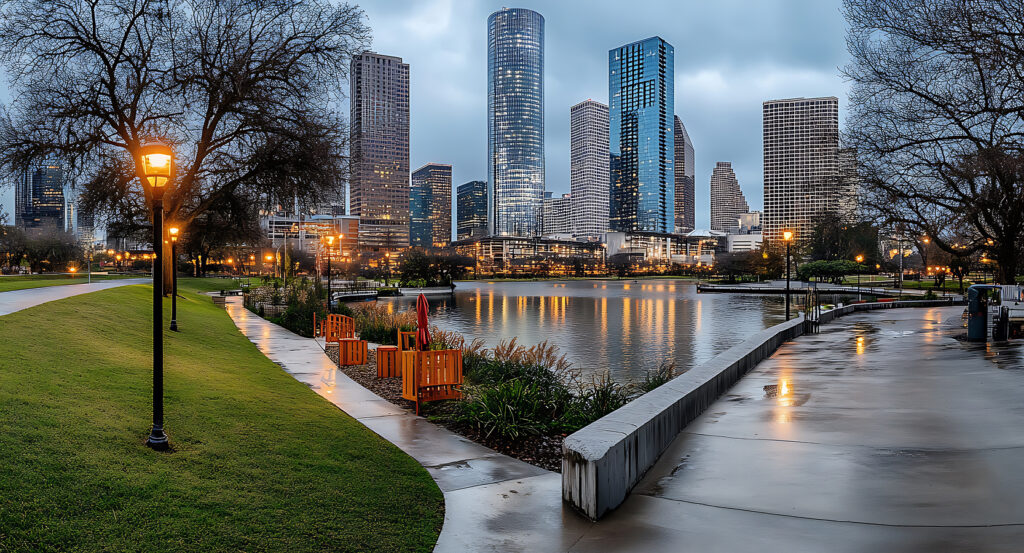
Houston spreads across the flat coastal plain of southeastern Texas, where bayous, expansive residential districts, expansive office towers, and industrial waterways form a metropolitan landscape shaped by rapid growth and the engineering demands of a subtropical environment. The city lies fifty miles northwest of the Gulf of Mexico, within a region of low elevation, clay-rich soils, and interconnected drainage systems that channel rainfall toward Galveston Bay. Buffalo Bayou forms a principal geographic corridor through Central Houston, linking the historic settlement area with landscaped parks, commercial districts, and the industrial port farther east. Downtown occupies the original urban core near the confluence of Buffalo and White Oak bayous, where a rectilinear street grid supports an imposing concentration of commercial skyscrapers. The JPMorgan Chase Tower, designed by I. M. Pei & Partners and completed in 1982, rises through a distinctive five-sided composition that became a defining element of the skyline. The Wells Fargo Plaza introduces another prominent tower through its stepped glass exterior, contributing to the concentration of late twentieth-century architecture associated with Houston's energy economy. The Theater District occupies the northwestern portion of downtown, with major performance venues including the Wortham Theater Center, Jones Hall, and the Hobby Center for the Performing Arts. Discovery Green provides a substantial landscaped public space near the George R. Brown Convention Center, connecting downtown's commercial environment with contemporary recreational infrastructure. Westward, Buffalo Bayou Park extends along the waterway through trails, gardens, public art, and restored natural landscapes, establishing an important green corridor within the urban center. The park's elevated terrain provides expansive views of downtown, particularly near the historic Eleanor Tinsley Park. South of downtown, the Museum District contains an exceptional concentration of cultural institutions surrounded by established residential neighborhoods and landscaped streets. The Museum of Fine Arts, Houston, occupies a campus combining historic museum buildings with contemporary architectural additions, including the Nancy and Rich Kinder Building designed by Steven Holl Architects. Nearby, the Menil Collection presents a contrasting architectural environment through Renzo Piano's understated museum building, whose carefully controlled natural lighting supports the display of an internationally significant art collection. Hermann Park anchors another major civic landscape through gardens, recreational spaces, and institutions including the Houston Museum of Natural Science and Houston Zoo. The Texas Medical Center extends southward through an immense concentration of hospitals, research facilities, academic buildings, and interconnected medical campuses. The Rice University campus introduces another distinctive architectural environment through its Mediterranean Revival buildings, tree-lined pathways, and carefully organized academic quadrangles. West of the central districts, Uptown Houston contains a major commercial skyline surrounding the Galleria, with Williams Tower rising as a prominent landmark through its postmodern architectural composition. Houston's residential geography reflects decades of metropolitan expansion, with neighborhoods including the Heights, Montrose, River Oaks, and Third Ward preserving contrasting architectural traditions and social histories. The Heights contains extensive collections of early twentieth-century bungalows and Victorian residences, reflecting the development of an independent suburban community later incorporated into Houston. Montrose presents an eclectic urban environment of historic houses, apartment buildings, galleries, and commercial corridors associated with the city's artistic and LGBTQ+ communities. River Oaks preserves substantial residential estates and landscaped streets developed during Houston's twentieth-century expansion. Eastward, the Houston Ship Channel extends through a vast industrial corridor of refineries, chemical plants, terminals, and maritime infrastructure connecting the city with the Gulf. Houston's physical character emerges from the relationship between its low-lying bayou landscape, dispersed metropolitan development, expansive commercial architecture, and the transportation systems supporting one of the world's major industrial port regions.
Texan cultural life finds a distinctive international expression in Houston, where African American musical traditions, immigrant communities, contemporary art, scientific institutions, and regional cuisine have developed through the city's rapid demographic and economic transformation. Houston's African American cultural inheritance extends through neighborhoods including Third Ward and Fifth Ward, whose churches, schools, music venues, and civic organizations contributed to the development of influential local communities. Third Ward became an important center of Black intellectual and artistic life, supported by institutions including Texas Southern University, established in 1947. The university's art programs and collections contributed to the development of African American visual culture, particularly through the work of painter John T. Biggers, whose murals and paintings explored Black history, community life, and the cultural connections between Africa and the American South. Houston's musical traditions encompass blues, gospel, jazz, country, and hip-hop, reflecting the city's position at the intersection of Gulf Coast and Southern cultural influences. The city's blues history includes influential performers associated with the Texas tradition, while its contemporary musical character developed substantially through the emergence of Houston hip-hop during the late twentieth century. The Geto Boys helped establish the city's national reputation through recordings that addressed urban life, social conflict, and the experiences of marginalized communities. DJ Screw subsequently developed the chopped-and-screwed production technique, characterized by slowed tempos and repeated musical phrases, creating a distinctive sound that influenced hip-hop far beyond Texas. Artists including UGK, whose members originated in Port Arthur, and later Houston performers contributed to the broader regional musical movement. Beyoncé, raised in Houston, developed into one of the most influential performers in contemporary popular music, incorporating elements of R&B, pop, hip-hop, and Southern musical traditions into an internationally recognized artistic career. Houston's visual arts environment developed through major institutions and independent creative communities. The Museum of Fine Arts, Houston, maintains extensive collections encompassing European painting, American art, Latin American traditions, photography, and contemporary works. The Menil Collection preserves an important assembly of modern and contemporary art, including works associated with Surrealism, Abstract Expressionism, and the art of ancient cultures. The Rothko Chapel, commissioned by John and Dominique de Menil, introduces a distinctive environment combining expansive paintings by Mark Rothko with a contemplative architectural space. Houston's performing arts institutions include Houston Grand Opera, Houston Ballet, the Houston Symphony, and the Alley Theatre, establishing a substantial infrastructure for opera, dance, orchestral music, and dramatic performance. The city's international communities contribute another defining dimension through cultural festivals, religious institutions, neighborhood businesses, and artistic traditions connected to Mexico, Vietnam, China, India, Nigeria, and numerous other countries. Houston's culinary landscape reflects this diversity through the intersection of Tex-Mex, barbecue, Gulf Coast seafood, Vietnamese cooking, South Asian cuisine, and contemporary fusion traditions. Tex-Mex remains central to the city's food culture through dishes including fajitas, enchiladas, and queso, supported by generations of Mexican American restaurants and family-owned businesses. Gulf Coast seafood traditions contribute shrimp, oysters, blue crab, and crawfish, often prepared through cooking methods associated with Louisiana and the broader coastal South. Houston's Vietnamese communities have introduced influential culinary traditions, particularly through the development of Viet-Cajun crawfish, which combines Vietnamese seasonings with Gulf Coast seafood boils. Barbecue remains another important regional specialty, with smoked brisket, ribs, and sausage reflecting the broader traditions of Texas pit cooking. The city's cultural institutions also include Space Center Houston, which connects the public with the history of NASA's human spaceflight programs and the scientific ambitions associated with the Johnson Space Center. Houston's cultural importance lies in the interaction between Southern heritage, international migration, musical invention, scientific achievement, and a culinary environment shaped by the remarkable diversity of the modern Gulf Coast.
Five fascinations.
5. Houston contains an underground pedestrian network beneath its downtown streets.
Beneath Central Houston lies an interconnected system of tunnels and skywalks linking office towers, hotels, shops, restaurants, and other buildings across numerous downtown blocks. Much of the network developed privately as individual property owners connected neighboring buildings, gradually producing a larger pedestrian environment below street level. The climate-controlled passages became particularly valuable in a city defined by intense summer heat and humidity. Houston developed a second layer of downtown circulation largely hidden from the surface, allowing thousands of workers to move between buildings through infrastructure embedded beneath the conventional street grid.
4. The Astrodome changed stadium design by forcing engineers to invent a new playing surface.
When the Houston Astrodome opened in 1965, its vast enclosed, air-conditioned interior represented a dramatic response to the city's hot climate. The translucent roof initially allowed natural grass to grow, but glare interfered with baseball players tracking fly balls. Painting sections of the roof reduced the glare and simultaneously deprived the grass of sufficient sunlight. The resulting problem accelerated adoption of a synthetic playing surface marketed as AstroTurf. Houston's futuristic stadium helped popularize an entirely new category of sports surface, extending the Astrodome's influence far beyond the building itself.
3. Houston became the center of human spaceflight because NASA chose it for a new spacecraft headquarters.
NASA selected Houston in 1961 for the facility that became the Manned Spacecraft Center, later renamed Johnson Space Center. From there, engineers, flight controllers, scientists, and astronauts directed crucial elements of the Gemini, Apollo, Space Shuttle, and subsequent human-spaceflight programs. Mission Control became inseparable from the city's character during Apollo, particularly through communications between spacecraft and controllers in Houston. The center's presence transformed Houston into one of the world's principal aerospace cities and gave the city's name a permanent place in the language and history of human space exploration.
2. Buffalo Bayou is the geographic reason Houston exists where it does.
Brothers Augustus Chapman Allen and John Kirby Allen founded Houston in 1836 near the confluence of Buffalo and White Oak bayous, recognizing the commercial potential of a navigable connection toward Galveston Bay and the Gulf of Mexico. Subsequent dredging and engineering transformed that watery route into the Houston Ship Channel, which opened to deep-water traffic in 1914. Industries and port facilities expanded along the channel as Houston developed into an international center of shipping, petrochemicals, and energy. The metropolis that appears far inland on a map owes much of its rise to a bayou system connecting its urban core with the sea.
1. Houston has no conventional zoning ordinance.
Unlike other major American cities, Houston developed without a comprehensive use-based zoning code separating land into conventional residential, commercial, and industrial districts. Voters rejected proposed zoning systems multiple times during the twentieth century, leaving development governed through a different combination of ordinances, deed restrictions, subdivision rules, building regulations, and market forces. The result contributed to unusual contrasts of buildings and land uses across the city and became one of Houston's defining characteristics in American urban planning. Its famously expansive physical form reflects not merely rapid growth, but a fundamentally distinctive approach to regulating that growth.
Where your story begins.
Foresyte Travel reveals places that feel extraordinary long before you arrive.
Enjoy editorial crafted for luxury travelers.
Foresyte may earn a commission when you book.