
Why Houston Zoo matters.
Houston Zoo is a major zoological institution where the Museum District's cultural and scientific heritage meets global wildlife conservation, immersive animal habitats, and more than a century of public education in Hermann Park.
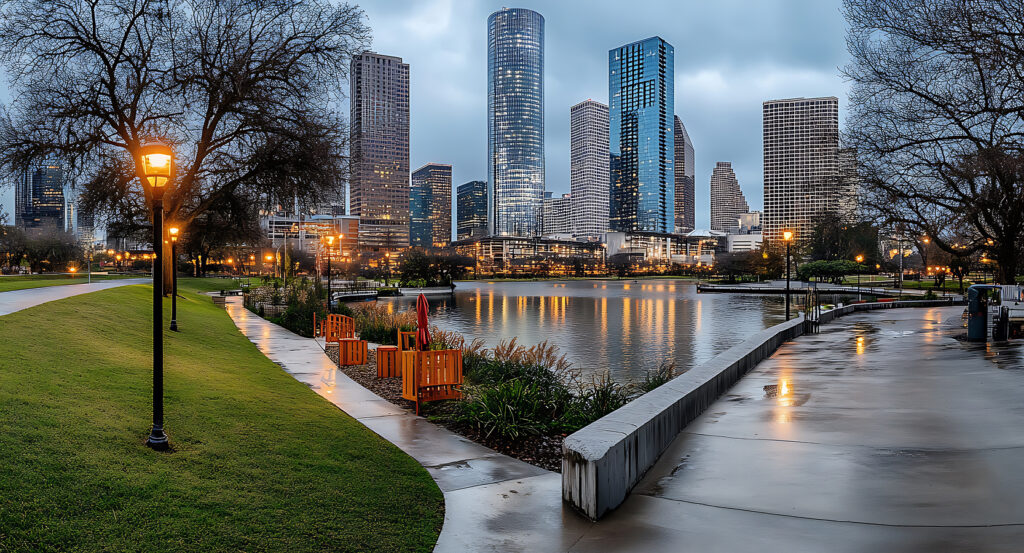
Set along Hermann Park Drive near Cambridge Street and just steps from McGovern Lake, the zoo occupies a wooded section of Houston's Museum District, between the Texas Medical Center and the residential streets surrounding Rice University, with landscaped grounds extending through Hermann Park. Mature live oaks shade pedestrian pathways connecting outdoor habitats, garden areas, and substantial animal facilities. Water features, planted enclosures, and carefully arranged viewing spaces create distinct environments across the grounds. The landscape alternates between broad gathering areas and intimate passages bordered by dense vegetation, giving the property a varied physical character. The result is an extensive zoological setting whose mature parkland supports wildlife encounters, environmental education, and outdoor recreation.
What defines Houston Zoo.
Houston Zoo is best known for its development from a modest municipal animal collection into one of the nation's most prominent zoological institutions, with a substantial commitment to wildlife conservation and public education. Its origins date to 1922, when the City of Houston established a small collection of animals within Hermann Park. The earliest collection included a bison donated by a traveling circus, establishing the foundation for a permanent municipal zoo. During the following decades, the institution expanded through the construction of animal houses, outdoor enclosures, and facilities supporting a growing variety of species. Houston's increasing population contributed to rising attendance and encouraged further investment in zoological infrastructure. The zoo became an important component of the city's public recreation system, combining animal exhibitions with educational programs for local schools and families. Twentieth-century improvements gradually replaced older enclosure designs with larger habitats incorporating vegetation, varied terrain, and environmental features associated with the animals' natural surroundings. The institution also expanded its veterinary facilities and professional animal-care programs, strengthening its capacity to manage complex zoological collections. In 2002, the nonprofit Houston Zoo organization assumed responsibility for operations through an agreement with the City of Houston, establishing a new governance structure supported by admissions, memberships, philanthropy, and private fundraising. That transition accelerated investment in habitat development, conservation programs, and educational facilities. The zoo subsequently expanded its participation in international wildlife protection initiatives, supporting projects involving threatened species and their natural habitats. Its conservation work developed partnerships with researchers and field organizations addressing habitat loss, wildlife trafficking, and human-wildlife conflict. The institution also established programs connecting visitors with the environmental consequences of everyday consumer choices, including efforts to reduce threats to wildlife populations. Houston Zoo's development demonstrates the evolution of American zoological institutions from municipal animal collections into organizations combining professional animal care, scientific education, and international conservation.
The Galápagos Islands habitat introduced one of Houston Zoo's most ambitious recent developments, bringing the ecological character of the Ecuadorian archipelago into a substantial exhibition environment. Opened in 2023, the complex incorporates marine habitats, volcanic-inspired terrain, and exhibits devoted to species associated with the islands' distinctive ecosystems. Its centerpiece is a large aquarium accommodating California sea lions, sharks, rays, and other marine animals within an environment designed for underwater observation. Expansive viewing windows allow visitors to examine swimming behavior and movement through the water, connecting the exhibit's architectural design with the animals' aquatic activity. A dedicated habitat for Galápagos tortoises introduces another dimension through substantial terrestrial animals whose longevity and evolutionary history have made them internationally significant. The tortoise exhibit emphasizes the relationship between the islands' isolated geography and the development of distinctive wildlife populations. The zoo's South America's Pantanal complex provides a contrasting ecological setting inspired by the vast tropical wetland shared by Brazil, Bolivia, and Paraguay. Its habitats support species including jaguars, giant river otters, and capybaras, connecting different animals through the environmental characteristics of a major South American ecosystem. Waterways and planted landscapes contribute to the exhibit's interpretation of wetland habitats, establishing relationships between animal behavior and the surrounding environment. The Texas Wetlands exhibit introduces a regional conservation perspective through species associated with the state's coastal and freshwater habitats. Its emphasis on native wildlife connects the zoo's international programs with environmental issues affecting southeastern Texas. These distinct exhibition environments demonstrate how contemporary zoological design integrates animal care, habitat interpretation, and conservation education into the physical organization of a major public institution.
How Houston Zoo fits.
Houston Zoo works as the anchor for a Houston outing connecting the city's botanical heritage, a major natural history museum, and a historic outdoor performance venue within the surrounding cultural district.
Begin at McGovern Centennial Gardens, the landscaped botanical destination developed within Hermann Park to commemorate the park's centennial. The gardens opened in 2014 following a major redevelopment project led by the Hermann Park Conservancy, transforming a former garden area into a carefully organized landscape of formal plantings and public gathering spaces. Landscape architect Laurie Olin contributed to the design, which incorporates a substantial central lawn, themed gardens, and a prominent thirty-foot garden mount. A spiral pathway ascends the mount, creating elevated views across the surrounding landscape. The gardens establish a carefully composed introduction to Houston's tradition of public horticulture and civic landscape design. Continue to the Houston Museum of Natural Science, the institution founded in 1909 and developed into one of the nation's most substantial natural history museums. Its permanent exhibitions encompass paleontology, mineralogy, astronomy, energy, and the natural sciences, connecting the history of Earth with contemporary scientific understanding. The Morian Hall of Paleontology contains an extensive collection of prehistoric fossils and skeletal reconstructions, presenting major developments in the evolution of life. The Cullen Hall of Gems and Minerals introduces another dimension through extraordinary geological specimens, including large mineral crystals and rare gemstones. The museum's Burke Baker Planetarium extends the scientific program into astronomy and space exploration. Conclude at Miller Outdoor Theatre, the historic public performance venue established in Hermann Park in 1923. Its original facility developed through the philanthropy of Jesse H. Jones and other civic supporters, establishing a permanent outdoor setting for cultural performances. The present theater building, completed in 1968, introduced a distinctive covered stage and substantial hillside seating area. The venue presents free performances encompassing classical music, dance, theater, and international cultural traditions, creating one of Houston's most accessible public arts programs. Its outdoor configuration allows audiences to experience professional performances within the surrounding park landscape. The progression moves from McGovern Centennial Gardens' formal horticultural design through the Houston Museum of Natural Science's extensive scientific collections and culminates at Miller Outdoor Theatre's public performance tradition, connecting three distinctive expressions of Houston's cultural and educational development.
Where your story begins.
Foresyte Travel reveals places that feel extraordinary long before you arrive.
Enjoy editorial crafted for luxury travelers.
Foresyte may earn a commission when you book.














































































































