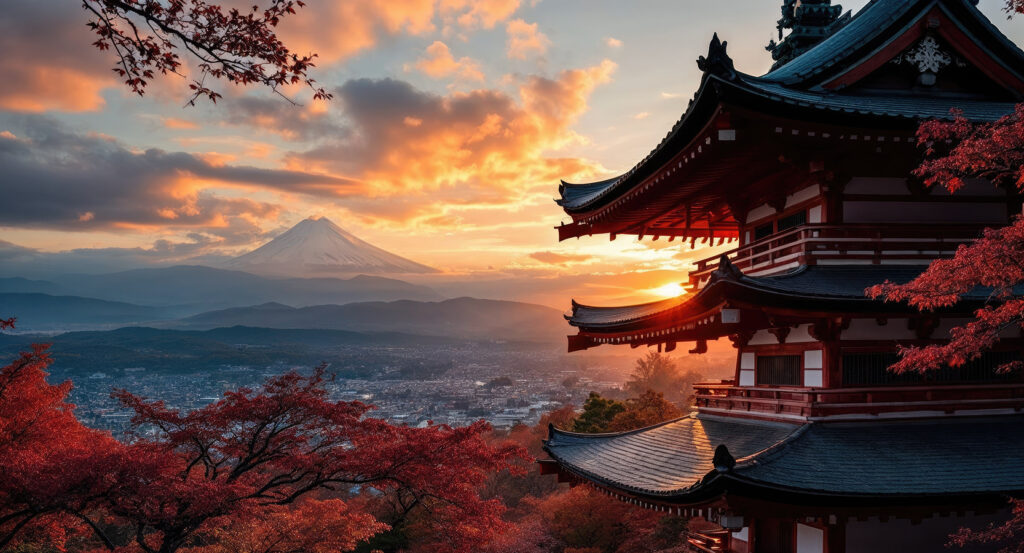
Perfect weekend in Kyoto, Japan.
Kyoto's historical importance extends across more than a millennium of imperial government, Buddhist scholarship, artistic patronage, and the development of Japan's classical cultural traditions. Situated within a mountain-framed basin on the island of Honshu, the city became Japan's imperial capital in 794 when Emperor Kanmu transferred the court to Heian-kyō. Its original layout followed principles of Chinese capital planning, incorporating an extensive rectangular street grid influenced by the architecture and urban organization of Tang dynasty Chang'an. During the Heian period, Kyoto became the center of aristocratic literature, poetry, and court ceremony, producing masterpieces including Murasaki Shikibu's The Tale of Genji and Sei Shōnagon's The Pillow Book. The establishment of the Kamakura shogunate in 1185 transferred substantial political authority to eastern Japan, although Kyoto retained its imperial court and considerable religious prestige. Under the Ashikaga shogunate, the city became an important center of Zen Buddhism, landscape gardening, ink painting, and the artistic traditions associated with medieval Japanese culture. The Ōnin War, beginning in 1467, devastated extensive portions of Kyoto and accelerated the political fragmentation of Japan during the Sengoku period. Reconstruction under Oda Nobunaga and Toyotomi Hideyoshi helped restore the city's religious institutions and commercial importance during the late sixteenth century. Kyoto continued as the imperial capital throughout the Edo period, sustaining generations of craftsmen, merchants, scholars, and religious communities. The transfer of the imperial residence to Tokyo in 1869 fundamentally altered its political position, encouraging new investment in education, manufacturing, and the preservation of traditional Japanese arts.
Kyoto's artistic achievements encompass classical literature, Buddhist sculpture, ceramics, textile production, traditional theater, and one of the world's most sophisticated regional culinary traditions. The Kyoto National Museum, established in 1897, houses important collections of Japanese painting, calligraphy, sculpture, lacquerware, and archaeological objects, with particular emphasis on the cultural heritage of the former imperial capital. The Kyoto Imperial Palace preserves the ceremonial architecture associated with Japan's imperial household, including buildings reconstructed during the nineteenth century in architectural styles derived from earlier court traditions. The Kyoto International Manga Museum, established through collaboration between Kyoto Seika University and the municipal government, connects the city's longstanding artistic heritage with the development of Japanese popular culture. Kyoto's traditional performing arts include Noh theater, classical dance, and musical traditions cultivated through generations of professional performers and hereditary artistic schools. The annual Gozan no Okuribi ceremony illuminates the surrounding mountains with enormous ceremonial fires during the Obon season, continuing a religious tradition associated with honoring ancestral spirits. Kyoto's cuisine developed through the influence of Buddhist vegetarian cooking, imperial court traditions, and the seasonal agricultural resources of the surrounding countryside. Specialties include yudofu, Kyoto-style pickled vegetables, delicate preparations of local vegetables known as kyō-yasai, and traditional sweets associated with tea ceremony. The region's refined confectionery traditions draw upon ingredients including matcha, sweet bean paste, and glutinous rice, supporting specialist businesses whose techniques have been transmitted across generations. A perfect weekend in Kyoto brings together imperial history, traditional Japanese craftsmanship, religious heritage, and the culinary achievements of a city that shaped the artistic foundations of Japanese civilization.
Three day itinerary.
Day 1: Gion District
Gion District is best known for preserving Kyoto's historic kagai culture within streets lined by machiya townhouses, ochaya teahouses, temples, and traditional entertainment establishments. The district developed beside Yasaka Shrine as accommodations and businesses serving pilgrims expanded into a sophisticated urban quarter. Geiko and maiko became central to its cultural character through highly disciplined traditions of dance, music, conversation, dress, and hospitality cultivated through specialized communities and institutions. Hanamikoji preserves particularly dense stretches of traditional wooden architecture, with narrow facades concealing deep interiors characteristic of Kyoto merchant houses. Gion's survival gives Kyoto an exceptional concentration of living performing traditions, historic architecture, religious geography, and social customs rooted in the former imperial capital.
Day 1: Kikunoi Honten
Kikunoi Honten is best known for Yoshihiro Murata's preservation and evolution of Kyoto kaiseki through a restaurant lineage extending across generations. Murata inherited a culinary tradition intimately connected with Kyoto's seasonality, ceremonial culture, and exacting treatment of dashi. His cooking organizes vegetables, seafood, mountain products, ceramics, aroma, temperature, and presentation into courses whose progression reflects changes in the natural calendar. The restaurant occupies a traditional setting near Kodaiji and Yasaka Shrine, embedding its cuisine within the Higashiyama landscape that shaped Kyoto's temple and tea cultures. Murata became one of Japan's most consequential culinary figures through his work advancing Japanese cuisine internationally and transmitting the technical foundations of washoku to subsequent generations.
Day 2: Tō-ji Temple
Tō-ji Temple is best known for its five-story pagoda and its foundational relationship with Shingon Buddhism in Japan. Emperor Kanmu established the temple after the imperial capital moved to Heian-kyō, positioning it near the southern entrance to the planned city. Emperor Saga later entrusted Tō-ji to Kūkai, known posthumously as Kōbō Daishi, who transformed it into a major center of esoteric Buddhist teaching. The temple's sculptural mandala translates complex religious cosmology into an arrangement of Buddhist figures occupying three-dimensional space. Repeated fires destroyed earlier pagodas before the present five-story structure arose during the Edo period under Tokugawa patronage. Rising above southern Kyoto, the pagoda became both a masterpiece of timber construction and a defining architectural expression of the city's Buddhist history.
Day 2: Kyokaiseki Kichisen
Kyokaiseki Kichisen is best known for Yoshimi Tanigawa's rigorous expression of Kyoto kaiseki through seasonality, ceremony, and classical Japanese culinary technique. Tanigawa approaches cooking as a discipline encompassing ingredients, vessels, spatial presentation, hospitality, and the sequence of courses across a meal. Dashi, vegetables, seafood, rice, seasonal garnishes, and preparations calibrated to precise moments in the year connect the kitchen to Kyoto's highly developed culinary calendar. The restaurant's cooking draws strength from traditions associated with tea ceremony and formal banquet cuisine, where visual composition and temporal sequence carry significance alongside flavor. Kichisen stands among Kyoto's distinguished kaiseki institutions, preserving a form of dining whose structure developed through centuries of court, temple, tea, and merchant culture.
Day 2: Kinkaku-ji
Kinkaku-ji is best known for the gold-covered pavilion reflected across Kyōko-chi pond within one of Kyoto's defining temple landscapes. Shogun Ashikaga Yoshimitsu acquired the property during the late fourteenth century and developed it as his retirement villa during the cultural flowering of the Muromachi period. After Yoshimitsu's death, the complex became the Zen temple Rokuon-ji in accordance with his wishes. The pavilion combines architectural traditions across its three levels, joining aristocratic residential forms with samurai and Zen influences beneath a gilded exterior. A novice monk destroyed the structure by arson in 1950, and the pavilion was reconstructed during the following decade. Its relationship among architecture, water, garden composition, political patronage, and Zen culture preserves the aesthetic ambitions of medieval Kyoto at exceptional intensity.
Day 2: Shimogamo Saryo
Shimogamo Saryo is best known for carrying Kyoto cuisine through a culinary institution founded in the nineteenth century beside Shimogamo Shrine. The restaurant's cooking is rooted in kyo-ryori, drawing from seasonal vegetables, seafood, dashi, rice, preserved ingredients, and techniques refined within Kyoto's courtly, temple, and merchant cultures. Its location near one of the city's oldest Shinto sanctuaries gives the restaurant a deep physical connection to northern Kyoto and the cultural landscape surrounding the Kamo rivers. Successive generations developed the establishment through changing eras while preserving seasonality as the organizing principle of the meal. Shimogamo Saryo represents the continuity of Kyoto gastronomy through a restaurant whose history, setting, and culinary foundations belong directly to the former imperial capital.
Day 3: Lorimer Kyoto Jr.
Lorimer Kyoto Jr. is best known for transforming the structure of the traditional Japanese breakfast into a focused contemporary morning meal. Grilled fish, rice, miso soup, vegetables, pickles, and carefully prepared accompaniments give the menu a foundation in the balanced composition of Japanese asa-gohan. The kitchen treats individual components with unusual precision, allowing seasonality, fermentation, preservation, and restrained seasoning to carry the meal. Its compact Kyoto setting reinforces the intimacy of a format centered on a carefully assembled tray. Lorimer gives the brunch position a distinctly Japanese identity, making the morning meal an expression of culinary structure and craft in a city internationally associated with highly disciplined food traditions.
Day 3: Arashiyama Bamboo Grove
Arashiyama Bamboo Grove is best known for the towering bamboo corridor embedded within the temple and villa landscape of western Kyoto. The grove occupies part of Sagano, an area favored by aristocrats from the Heian period for its mountains, river, seasonal vegetation, and distance from the imperial city center. Dense stands of moso bamboo create immense vertical walls along pathways adjoining Tenryū-ji and the former villa landscapes surrounding it. Bamboo has long held practical and cultural importance in Japan through architecture, utensils, crafts, fencing, gardens, and seasonal symbolism. Arashiyama's grove concentrates that relationship within a landscape shaped by centuries of elite retreat, Buddhist institutions, and cultivated nature, giving western Kyoto one of its most distinctive intersections of plant material and cultural history.
Day 3: Philosopher's Path
Philosopher's Path is best known for following a canal beneath the Higashiyama foothills through a landscape associated with Kyoto's modern intellectual history. The route takes its name from philosopher Nishida Kitarō, a foundational figure of the Kyoto School, whose contemplative walks through the area became associated with his intellectual practice. The canal beside the path forms part of the Lake Biwa Canal system, an extraordinary Meiji-era engineering project that brought water from Japan's largest lake into Kyoto. Cherry trees subsequently transformed the waterway into one of the city's celebrated seasonal landscapes. Temples including Ginkaku-ji occupy the surrounding foothills, connecting modern philosophy and industrial infrastructure with a much older Buddhist geography. The path compresses several layers of Kyoto's intellectual, engineering, religious, and landscape history into a narrow corridor.
Day 3: Restaurant MOTOÏ
Restaurant MOTOÏ is best known for Motoi Maeda's synthesis of French culinary technique with the ingredients and sensibilities of Kyoto. Maeda began his professional development in Chinese cuisine before moving into French cooking, giving his work an unusually broad technical foundation. Seasonal vegetables, seafood, meat, sauces, and precise preparations draw from Kyoto's exceptional agricultural environment and its highly developed culture of ingredient seasonality. The restaurant occupies a historic residence arranged around a Japanese garden, placing contemporary cuisine within domestic architecture connected to the city's past. Maeda's cooking gives Kyoto a distinctive intersection of French technique, Japanese ingredients, and the disciplined seasonal awareness that has shaped the former imperial capital's food culture for centuries.
Where your story begins.
Foresyte Travel reveals places that feel extraordinary long before you arrive.
Enjoy editorial crafted for luxury travelers.
Foresyte may earn a commission when you book.