
Why Nijō Castle matters.
Nijō Castle in Kyoto is a living chronicle of Japan's political power and artistic grandeur, a fortress where beauty and authority once walked hand in hand.
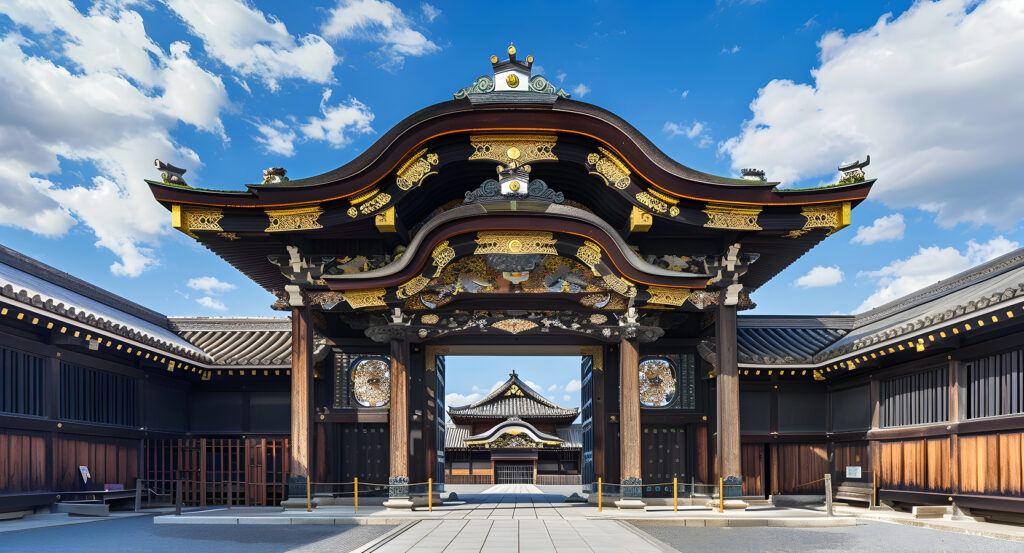
Built in 1603 as the Kyoto residence of Tokugawa Ieyasu, the first shogun of the Edo period, Nijō Castle stands as one of the most complete and symbolic examples of feudal architecture in Japan. Step through its imposing Karamon Gate, adorned with gold leaf and intricate wood carvings, and you're immediately transported into a world where every detail, from the painted sliding doors to the rhythmic creak of its famous “nightingale floors”, speaks to both elegance and control. The castle's design blends strength and sophistication: defensive moats and stone walls protect a delicate inner palace, where samurai armor once gleamed under candlelight and shoguns received emissaries amid screens painted with cranes and pines. It's a structure that feels alive, a place where footsteps echo across centuries, where diplomacy and artistry converged to shape Japan's history. Within Kyoto's sea of temples and gardens, Nijō Castle stands apart as a monument to human ambition tempered by exquisite restraint.
What defines Nijō Castle.
Beyond its grandeur, Nijō Castle tells a deeper story of transition, from samurai dominance to the dawn of modern Japan.
When Tokugawa Ieyasu commissioned its construction, he intended not only to project power but also to assert legitimacy over the imperial capital. The Ninomaru Palace, the castle's centerpiece, exemplifies this balance of intimidation and refinement. Inside, more than 3,000 fusuma (sliding doors) are painted by the Kano School, Japan's leading artistic dynasty, depicting tigers, peacocks, and pine trees, symbols of courage, longevity, and strength. The floorboards beneath your feet are known as “uguisubari,” or nightingale floors, engineered to chirp softly when walked upon, an ingenious early form of security that also adds a haunting musical quality to the air. The inner Honmaru Palace, later added by Emperor Nijo in the 17th century, reflects a shift from military to imperial aesthetics. But Nijō's true historical weight came in 1867, when the last shogun, Tokugawa Yoshinobu, returned political power to the emperor within its walls, ending over 260 years of shogunate rule. That single act, known as the Taisei Hōkan, marked the beginning of the Meiji Restoration and Japan's transformation into a modern nation. Few realize that this moment, which reshaped the course of Japanese history, unfolded inside rooms painted with gold dust and quiet dignity. Today, the castle's buildings and gardens are preserved as a UNESCO World Heritage Site, symbolizing not conquest but continuity, the ability of a culture to evolve.
How Nijō Castle fits.
A visit to Nijō Castle in Kyoto rewards both the history lover and the aesthete, offering a journey through layers of artistry, politics, and peace.
Begin at the Karamon Gate, where carved phoenixes and peonies crown the entrance like a prelude to splendor. From there, step into the Ninomaru Palace, remove your shoes, slow your pace, and let the soft creak of the nightingale floors accompany your walk through rooms once reserved for shoguns and emissaries. Take time to study the fusuma paintings; each room's theme was designed to influence the mood of those received, from the assertive tigers of the shogun's audience chamber to the gentle willows of his private quarters. After the palace, wander through the Ninomaru Garden, an immaculate landscape of ponds, stones, and sculpted pines designed by renowned gardener Kobori Enshū. Continue onward to the Honmaru Palace and climb its surrounding walls for panoramic views of Kyoto's skyline framed by cherry blossoms in spring or fiery maples in autumn. For a quieter moment, stroll the tree-lined paths along the outer moat, where reflections of the castle's white walls shimmer on the water. Nijō Castle lies just a short subway ride from Kyoto Station, making it easy to pair with nearby attractions like the Kyoto Imperial Palace or Nishiki Market. Yet its atmosphere is unlike anywhere else, solemn, golden, and meticulously preserved. Visiting Nijō Castle isn't just an architectural experience; it's a meditation on impermanence and power, where every echoing footstep reminds you that even the strongest empires eventually yield to the quiet beauty of time.
Where your story begins.
Foresyte Travel reveals places that feel extraordinary long before you arrive.
Enjoy editorial crafted for luxury travelers.
Foresyte may earn a commission when you book.

















































































































