Top places to stay in Sedona, Arizona.
Sedona welcomed a new era of Arizona hospitality as the red sandstone formations of Oak Creek Canyon attracted artists, filmmakers, and travelers seeking the restorative qualities of the high desert, establishing a retreat culture shaped by Southwestern architecture, Indigenous heritage, and the dramatic landscapes of the Colorado Plateau. The Sinagua people established communities throughout the region centuries before European arrival, cultivating crops along waterways and constructing substantial dwellings within the surrounding cliffs. Their architectural inheritance survives at sites including Palatki Heritage Site and Honanki Heritage Site, where ancient structures and rock art preserve important expressions of the region's Indigenous history. The Yavapai and Apache peoples maintained enduring relationships with the surrounding landscape, whose mountains, waterways, and seasonal resources shaped regional cultural traditions. Anglo-American settlement expanded into Oak Creek Canyon during the nineteenth century, with farmers and ranchers establishing agricultural communities along the creek's fertile banks. John James Thompson established a homestead in the area in 1876, contributing to the development of the settlement that eventually became Sedona. The community received its name in 1902 from Sedona Schnebly, the wife of early settler Theodore Carlton Schnebly, who operated a local post office and hospitality establishment serving travelers and residents. The region's isolation initially limited tourism, although its dramatic geological formations and temperate climate attracted increasing attention from visitors exploring the landscapes of northern Arizona. The development of improved roads during the early twentieth century encouraged automobile travel, connecting Sedona with Flagstaff, Phoenix, and the surrounding communities of the Verde Valley. The establishment of scenic motor courts and roadside lodging introduced an early model of leisure accommodation, with travelers drawn to Oak Creek Canyon and the grand sandstone formations surrounding the settlement. Hollywood's arrival during the 1940s transformed Sedona's national visibility, with filmmakers recognizing the exceptional visual character of its red rock landscape. The production of The Angel and the Badman in 1947, starring John Wayne, contributed to the region's reputation as a dramatic setting for Western films. The construction of substantial ranch properties and visitor accommodations supported the growing film industry, bringing actors, production crews, and tourists into the community. The opening of the Sedona Arts Center in 1958 strengthened the town's cultural identity, encouraging artists and craftspeople to establish studios within the surrounding landscape. The development of luxury resorts during the latter half of the twentieth century introduced a more sophisticated model of desert hospitality, with properties emphasizing architectural integration, outdoor recreation, and expansive views of the surrounding formations. The opening of Enchantment Resort in 1987 established an influential destination within Boynton Canyon, where secluded accommodation occupied a dramatic setting beneath towering sandstone cliffs. The emergence of Sedona's wellness industry introduced another important dimension through meditation retreats, spiritual tourism, and therapeutic experiences associated with the region's natural environment. The popularization of Sedona's vortex sites during the 1980s strengthened its reputation as a center of alternative spirituality, attracting visitors interested in contemplative practices and landscape-based wellness. The expansion of sophisticated spas, boutique resorts, and independent restaurants encouraged a distinctive hospitality economy connected to outdoor recreation and restorative travel. Sedona's incorporation as a city in 1988 formalized municipal governance during a period of substantial growth, supporting efforts to manage development within the region's environmentally sensitive landscape. Contemporary hospitality continues to reflect the relationship between Indigenous heritage, Western settlement, cinematic history, and the exceptional natural scenery that distinguishes Sedona among the American Southwest's most celebrated destinations.
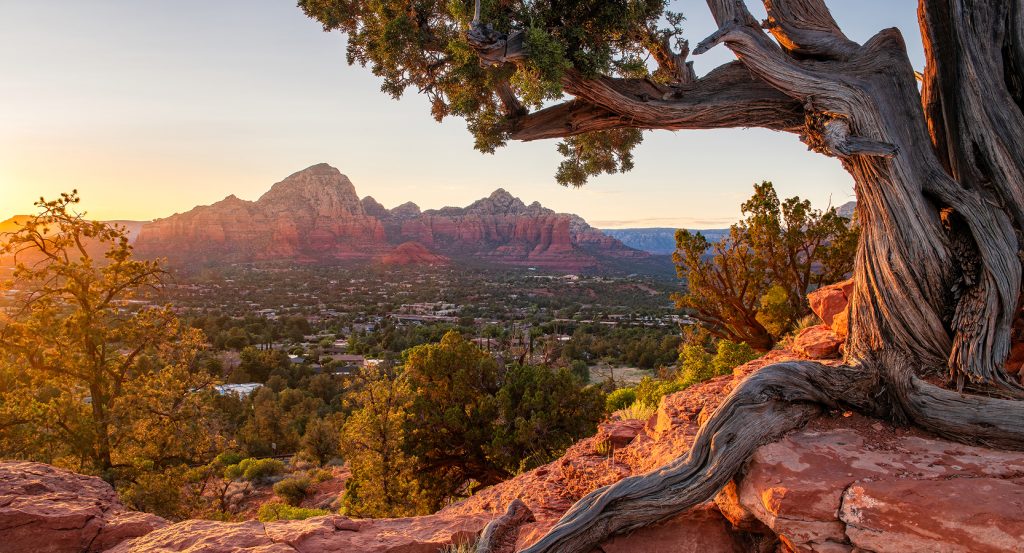
Sedona's most compelling places to stay occupy a dramatic landscape of sandstone buttes, wooded creek corridors, and elevated desert terraces, where the physical relationship between accommodation and the surrounding red rock formations defines the visitor experience. The city lies within the southern reaches of the Colorado Plateau, with substantial geological formations rising above the valley floor through layers of sandstone and limestone distinguished by vivid red, orange, and pale cream coloration. Uptown Sedona forms the principal historic visitor district, occupying a prominent position along State Route 89A beneath the surrounding cliffs. Boutique hotels, established inns, and intimate commercial properties extend through a compact corridor of galleries, restaurants, and independent shops, with elevated terraces offering views toward prominent formations including Snoopy Rock and the surrounding red rock ridges. The district's architecture incorporates regional stone, timber, and earth-toned stucco, creating a distinctive relationship with the surrounding desert landscape. Southward, the Chapel area occupies an elevated residential environment near the Chapel of the Holy Cross, whose dramatic modernist structure emerges from the sandstone cliffs overlooking the valley. Intimate accommodations and substantial residential properties occupy the surrounding hillsides, offering panoramic views across the red rock formations and wooded creek corridors. West Sedona introduces a more expansive residential and commercial environment along State Route 89A, where contemporary hotels, intimate resorts, and established neighborhood businesses occupy a broad valley bordered by grand sandstone formations. The district provides convenient access to hiking trails, galleries, and the principal transportation routes connecting Sedona with the surrounding communities of the Verde Valley. The nearby Airport Mesa rises above the urban center through a substantial sandstone plateau, providing panoramic views across the surrounding landscape and the distinctive formations of Cathedral Rock, Bell Rock, and the western red rock country. Accommodation near this elevated terrain emphasizes expansive views and convenient access to established recreational trails. Northward, Oak Creek Canyon introduces a contrasting environment through its narrow wooded valley, substantial sandstone cliffs, and the perennial waters of Oak Creek. Historic cabins, intimate lodges, and secluded luxury properties occupy sites along the creek, where sycamore trees, cottonwoods, and riparian vegetation create a shaded landscape distinct from the exposed desert terrain of the surrounding plateaus. The canyon's winding roadway connects Sedona with the higher elevations of the Mogollon Rim, passing through substantial forested terrain and dramatic geological formations. The surrounding creekside properties provide an especially intimate hospitality environment through landscaped gardens, stone terraces, and direct access to the water. West of the principal urban corridor, Boynton Canyon occupies a secluded landscape enclosed by towering sandstone walls and substantial desert vegetation. Luxury resorts within this setting emphasize privacy and architectural integration, with low-rise buildings arranged among native trees and carefully preserved natural terrain. The canyon's dramatic rock formations establish a distinctive environment for wellness-oriented accommodation and outdoor recreation. South of Central Sedona, the Village of Oak Creek occupies a broad valley surrounded by some of the region's most recognizable geological landmarks. Bell Rock and Courthouse Butte rise above the surrounding landscape, establishing grand visual anchors for the village's resorts, boutique inns, and established residential neighborhoods. The area's relatively open terrain supports substantial resort properties, golf courses, and landscaped grounds, with panoramic views extending toward the surrounding red rock formations. The nearby trails surrounding Bell Rock and the southern sandstone formations provide convenient access to hiking and mountain biking within a particularly accessible section of the region's recreational landscape. Farther southwest, the Red Rock Loop area follows a scenic corridor through agricultural properties, secluded residences, and substantial sandstone formations overlooking the Lower Oak Creek valley. Intimate retreats occupy landscaped sites within this quieter environment, offering access to wooded creek corridors and the dramatic geological setting surrounding Cathedral Rock. These contrasting environments establish a distinctive hospitality geography extending from Uptown's established visitor institutions and West Sedona's contemporary hotels to secluded creekside lodges, canyon resorts, and intimate desert retreats overlooking the grand formations that define the region. Foresyte may earn a commission when you book.
Foresyte Travel's top five choices.
5. Amara Resort and Spa
Amara Resort and Spa occupies the floor of Oak Creek Canyon immediately below Uptown Sedona, placing the property between the city's historic commercial center and the sandstone formations rising around the creek corridor. The resort originated as part of Sedona's transition from a small ranching and artistic community into a major destination, with successive transformations adapting the site to increasingly design-focused hospitality. A substantial redesign by Los Angeles-based studio Beleco introduced interiors built around desert tones, natural materials and abstract references to Sedona's geology, carrying the surrounding landscape into the property's architectural character. Its position below the Uptown mesa gives Amara an unusually direct physical relationship with Oak Creek and the red-rock escarpments that shaped Sedona's settlement and tourism geography.
4. The Wilde Resort & Spa
The Wilde Resort & Spa emerged from the extensive transformation of an existing West Sedona hotel, reopening in 2021 with a new architectural and wellness character centered on the surrounding desert landscape. The redevelopment reorganized the property around courtyards, fire features and outdoor gathering spaces, establishing a low-rise composition beneath Thunder Mountain and the sandstone formations west of Central Sedona. Its location on the city's western commercial corridor places the resort within the portion of Sedona that expanded substantially beyond the original Uptown settlement as tourism and residential development spread along State Route 89A. The Wilde represents a contemporary reinvention of an established hospitality site within West Sedona's broader evolution from peripheral development into a major component of the city's visitor economy.
3. Sky Ranch Lodge
Sky Ranch Lodge occupies Airport Mesa, a high sandstone table rising above Central Sedona and providing an unusually expansive perspective across the surrounding red-rock formations. The property traces its origins to the mid-twentieth century, when construction of Sedona Airport transformed the mesa into an aviation gateway and opened its elevated terrain to new commercial uses. Its low-rise buildings and gardens sit immediately beside the airport within a landscape associated with panoramic views toward formations including Coffee Pot Rock, Capitol Butte and the distant Mogollon Rim. Sky Ranch Lodge derives its character from one of Sedona's most distinctive pieces of infrastructure, joining the city's aviation history with the extraordinary geology that made Airport Mesa one of its defining geographic vantage points.
2. Enchantment Resort
Enchantment Resort occupies Boynton Canyon, a narrow red-rock enclosure northwest of Central Sedona whose towering sandstone walls create one of the region's most geographically distinctive settings. The resort was developed by the Struthers family and opened during the 1980s, with low-rise adobe-inspired structures distributed across the canyon floor to follow the surrounding terrain. Mii amo later emerged within the property as a dedicated destination spa conceived by architect Gluckman Tang, adding a major architectural and wellness institution to the Boynton Canyon complex. Enchantment's development tied large-scale hospitality directly to a deeply enclosed geological setting, making the canyon itself the organizing physical element of one of Sedona's most consequential resort properties.
1. L'Auberge de Sedona
L'Auberge de Sedona occupies the wooded banks of Oak Creek beneath Uptown, embedding the property within the riparian corridor that provided water, vegetation and agricultural potential to Sedona's earliest settlers. The resort began in the 1980s as a small creekside inn and developed around individual cottages distributed among sycamores and cottonwoods beside the water. Its physical separation from the streets immediately above is created by Sedona's abrupt topography, with the commercial mesa giving way to the cooler canyon floor within a remarkably short distance. L'Auberge expresses a different side of Sedona's geography from the exposed mesas and sandstone formations surrounding the city, grounding its character in the creek system that helped make permanent settlement in the high desert possible.
Where your story begins.
Foresyte Travel reveals places that feel extraordinary long before you arrive.
Enjoy editorial crafted for luxury travelers.
Foresyte may earn a commission when you book.