
Top places to stay in Colorado.
Vail's emergence as one of America's premier alpine resort communities grew from the ambitions of two men whose experiences in the Colorado mountains helped reshape the country's skiing culture. The surrounding Eagle Valley had long been inhabited and traversed by Ute peoples before nineteenth-century mining, ranching, and transportation development brought new settlement to the Central Rockies. During the Second World War, the U.S. Army's 10th Mountain Division trained at Camp Hale, southeast of present-day Vail, preparing soldiers for combat in mountainous terrain. Among them was Pete Seibert, whose wartime experiences and subsequent skiing career inspired his vision for a major Colorado resort. Seibert joined forces with rancher Earl Eaton, who had explored the surrounding mountains and recognized the exceptional potential of Vail Mountain's extensive slopes and natural bowls. Their partnership led to the formation of Vail Associates in 1961, with financial support from investors who shared their ambitions. Vail Mountain opened for skiing in December 1962, introducing a purpose-built resort at the base of the mountain. Austrian-born architect Fitzhugh Scott helped establish the village's distinctive alpine character through buildings inspired by traditional European mountain communities. The Lodge at Vail opened alongside the new ski area, providing an early foundation for a hospitality economy centered on winter recreation. The opening of Interstate 70 through the region strengthened connections with Denver and encouraged additional investment. During the 1970s, Vail expanded through new ski lifts, residential construction, restaurants, and substantial lodging properties. President Gerald Ford's frequent visits brought national attention to the resort, reinforcing its reputation among prominent American travelers. The development of Beaver Creek, which opened in 1980, broadened the Eagle Valley's luxury skiing market. Vail hosted the Alpine World Ski Championships in 1989 and again in 1999, strengthening its international standing. The 2015 championships, shared with Beaver Creek, brought another period of investment and global attention. Over subsequent decades, major hospitality companies introduced sophisticated hotels, condominium properties, and luxury residences, transforming the original mountain village into a substantial year-round resort community. Vail's lodging industry continues to reflect the legacy of its founders, the influence of European alpine architecture, and the development of Colorado's mountain recreation economy.
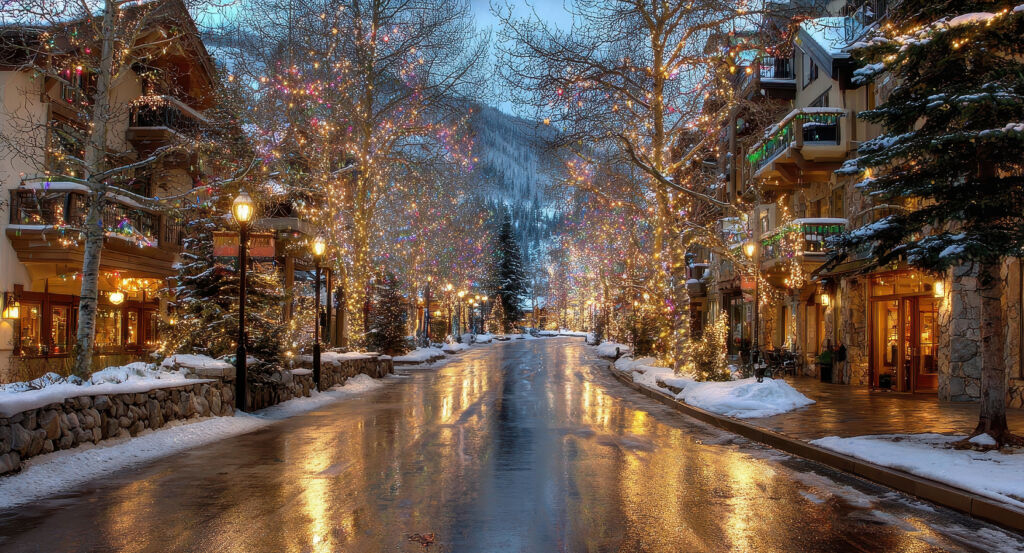
Vail occupies a narrow mountain valley along Gore Creek, enclosed by steep forested slopes and the dramatic peaks of the Gore Range. Its accommodation geography follows a succession of compact pedestrian villages and residential neighborhoods connected by landscaped pathways, bridges, and public transportation. Vail Village forms the historic resort center, where cobblestone pedestrian streets wind among steep-roofed buildings, intimate courtyards, and plazas inspired by traditional European alpine towns. Luxury hotels occupy prominent positions near the principal mountain access points, with stone façades, timber balconies, and substantial fireplaces contributing to the village's distinctive architectural identity. Restaurants, boutiques, and galleries create a lively environment throughout the year. Immediately west, Lionshead Village offers a complementary resort setting through substantial contemporary hotels, condominium properties, and pedestrian gathering spaces arranged around the Eagle Bahn Gondola. Its architecture combines traditional alpine materials with modern resort design, and the surrounding plazas provide convenient access to mountain recreation and dining. Between the two villages, the Golden Peak area occupies a quieter position near ski training facilities and the eastern slopes of the mountain. Accommodation includes upscale residences and intimate lodging properties within walking distance of recreational facilities. North of the central village, the neighborhoods surrounding Vail Golf Club extend through wooded residential streets and landscaped open spaces beneath the surrounding mountains. Private homes and condominium properties offer a more secluded environment near recreational trails and the creek corridor. Westward, Cascade Village occupies a sheltered setting along Gore Creek, with substantial resort properties surrounded by mature conifers and landscaped grounds. The area's hotels emphasize spacious accommodation, mountain views, and convenient access to the Cascade Village Lift. Farther west, West Vail presents a predominantly residential landscape through established condominium communities, private homes, and neighborhood commercial centers. Accommodation here offers convenient connections to the central resort districts and the surrounding transportation network. East Vail extends into a narrower alpine valley beneath dramatic mountain slopes, with residential properties, vacation rentals, and intimate lodging surrounded by dense evergreen forests. The neighborhood's setting provides exceptional access to hiking routes, waterfalls, and the natural landscapes of the White River National Forest. Across the valley, the surrounding mountains create a remarkable visual environment through extensive ski terrain, forested ridgelines, and substantial seasonal changes. Winter brings snow-covered rooftops and illuminated pedestrian streets, and summer transforms the resort into a landscape of wildflower gardens, outdoor terraces, and mountain recreation. Architectural character remains unusually cohesive throughout the principal villages, with steep rooflines, timber detailing, stone foundations, and carefully maintained public spaces creating a recognizable alpine identity. Vail's accommodation ranges from prestigious slopeside hotels and sophisticated condominium resorts to secluded mountain residences and intimate village inns, offering varied relationships to the surrounding terrain and pedestrian resort environment. Foresyte may earn a commission when you book.
Foresyte Travel's top five choices.
5. Grand Hyatt Vail Resort and Spa
Grand Hyatt Vail occupies the Gore Creek corridor west of Vail Village, where the valley narrows beneath the forested slopes of Vail Mountain. The property originated as the Vail Cascade Resort, part of the resort community that expanded outward from Vail's original village as skiing drove increasingly substantial development through the Gore Creek Valley. A major redevelopment transformed the property before its 2019 debut as Grand Hyatt Vail, the first Grand Hyatt hotel in the mountain destination. Its low-rise architecture follows the creek and surrounding terrain, with a dedicated chairlift connecting the property directly to Vail Mountain. Grand Hyatt Vail represents the continuing reinvestment in established resort sites that has accompanied Vail's evolution from a purpose-built ski village into an extensive alpine destination.
4. Sonnenalp Vail
Sonnenalp Vail traces its heritage to the Faessler family, whose hospitality business began in 1919 in Ofterschwang in the Bavarian Alps. Karlheinz and Gretl Faessler brought that tradition to Colorado after acquiring a small Vail property in 1979, establishing a direct connection between the young American ski town and generations of Bavarian hotelkeeping. Successive expansions transformed the hotel into a substantial creekside complex whose timber balconies, carved details, steep roofs, and interior woodwork draw deliberately from Alpine architecture. The Faessler family maintained stewardship as Vail developed from its 1962 beginnings into one of the most internationally recognized ski destinations in North America. Sonnenalp gives Vail an unusually direct line to European mountain hospitality through a family enterprise spanning the Bavarian and Colorado Alps.
3. The Arrabelle at Vail Square
The Arrabelle at Vail Square opened in 2008 as the architectural centerpiece of the extensive redevelopment of Lionshead, the western village created during Vail's formative decades. Vail Resorts undertook the broader transformation through its billion-dollar New Dawn initiative, replacing aging structures and public spaces with a denser pedestrian district connected directly to the mountain. The Arrabelle draws from the architecture of European alpine towns through masonry, timber, steep roofs, arcades, plazas, and a clock tower that organizes the surrounding Vail Square. Its position beside the Eagle Bahn Gondola places the property at the junction between the rebuilt village and the ski terrain above. The Arrabelle captures the twenty-first-century reconstruction that fundamentally changed Lionshead from an early Vail base area into a highly orchestrated alpine village.
2. Four Seasons Resort and Residences Vail
Four Seasons Resort and Residences Vail opened in 2010 near the eastern edge of Lionshead during a transformative period of investment across the resort town. The development combined hotel and privately owned residences within a substantial new building positioned between Vail's pedestrian villages and the Gore Creek corridor. Architecture draws on stone, heavy timber, pitched roofs, and deep overhangs associated with the mountain-building style that evolved across Vail after the resort's founding in 1962. Its arrival followed major redevelopment across both Lionshead and Vail Village as increasingly sophisticated residential and hospitality projects replaced or expanded the town's first generations of structures. Four Seasons Vail represents the maturation of the purpose-built ski town into a residential and hospitality market capable of supporting major international hotel brands.
1. The Lodge at Vail
The Lodge at Vail opened in 1962 alongside the newly created Vail ski area, making the property inseparable from the founding generation of the resort itself. Pete Seibert and Earl Eaton developed Vail Mountain after identifying the surrounding terrain as the setting for a new Colorado ski destination, with architect Fitzhugh Scott helping shape the pedestrian village at its base. The lodge became one of the settlement's earliest hospitality anchors beside the lifts rising from what developed into Vail Village. Vail Associates expanded from that original mountain operation into the company known as Vail Resorts, building a portfolio that ultimately extended far beyond Colorado. The Lodge at Vail occupies the physical and historical center of that progression, preserving a direct connection with the moment Vail emerged as a purpose-built American ski resort.
Where your story begins.
Foresyte Travel reveals places that feel extraordinary long before you arrive.
Enjoy editorial crafted for luxury travelers.
Foresyte may earn a commission when you book.







































































































