Top places to stay in Melbourne, Victoria.
Melbourne developed into Australia's great Victorian metropolis through the convergence of pastoral wealth, maritime commerce, and one of the nineteenth century's most extraordinary gold rushes. Established in 1835 on the lands of the Wurundjeri and Bunurong peoples of the Kulin Nation, the settlement occupied a strategic position beside the Yarra River and the sheltered waters of Port Phillip. The discovery of gold in Victoria in 1851 transformed the colonial economy, attracting prospectors, merchants, and entrepreneurs from Britain, Europe, China, and the Americas. Melbourne became the principal commercial gateway to the goldfields, and its expanding population supported an increasingly elaborate network of inns, boardinghouses, and grand establishments. The Criterion Hotel opened in 1850, followed by the Oriental Hotel in 1854, reflecting the prosperity and social ambitions of the growing colonial capital. The Melbourne Club, founded in 1838, reinforced the importance of private hospitality within the city's commercial elite. The completion of major railway connections strengthened Melbourne's position as a transportation hub, bringing visitors into the central streets surrounding Flinders Street and Spencer Street stations. The Federal Coffee Palace opened in 1888, embodying the temperance movement's ambition to provide luxurious accommodation and dining in an alcohol-free environment. Designed by William Pitt and Ellerker & Kilburn, its elaborate Second Empire architecture reflected the confidence of the land-boom era. The economic depression of the 1890s curtailed speculative construction, but established establishments continued serving commercial and international travelers. The Hotel Windsor, originally opened as the Grand Hotel in 1883, became an enduring symbol of Victorian elegance through its expansive façade and elaborate interiors. Melbourne's designation as the temporary seat of Australia's federal government in 1901 brought politicians, diplomats, and administrative visitors into the city. The opening of the Southern Cross Hotel in 1962 introduced a modern international-standard establishment, reflecting postwar economic expansion and growing overseas travel. Subsequent decades brought major investment in convention facilities, waterfront redevelopment, and sophisticated contemporary properties. The Crown entertainment complex opened in Southbank in 1997, encouraging extensive luxury accommodation along the southern riverfront. More recently, restored heritage buildings and design-led boutique establishments have expanded the city's hospitality identity. Melbourne's contemporary lodging landscape reflects the accumulated influence of colonial wealth, architectural ambition, international migration, and a deeply established culture of metropolitan sophistication.
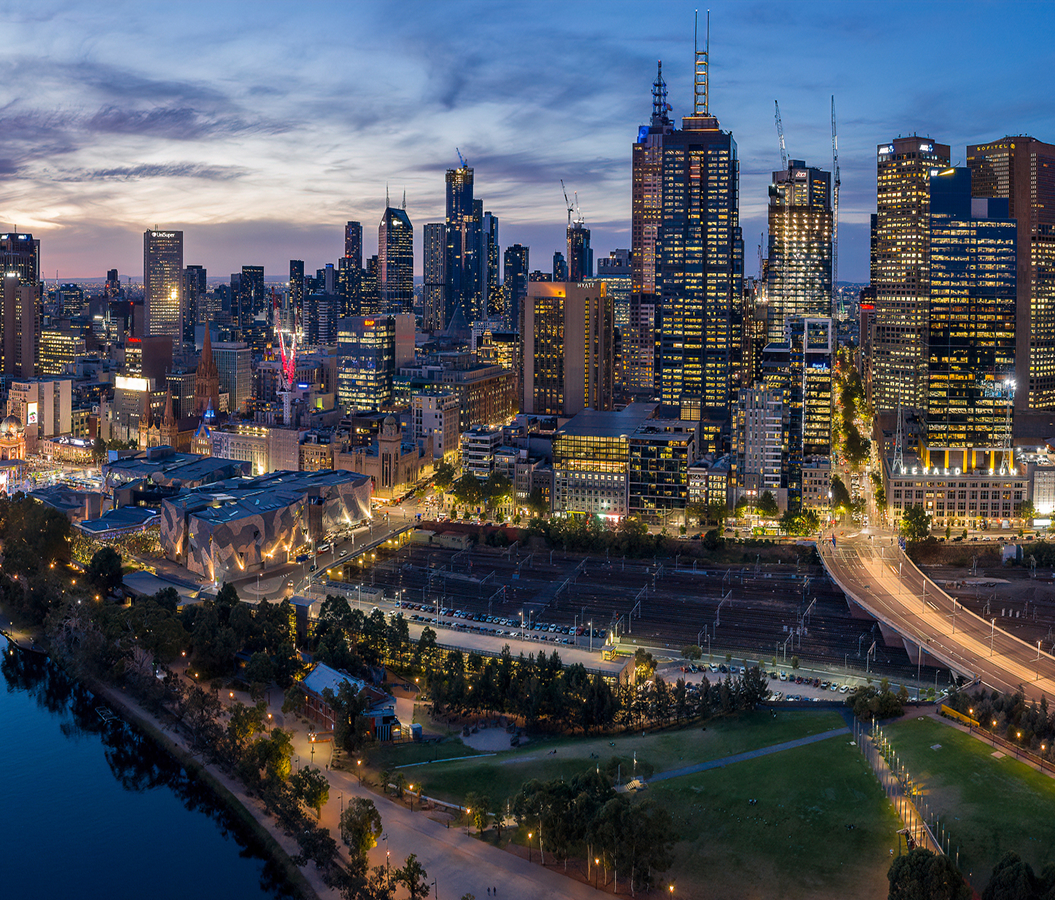
Melbourne occupies a broad coastal plain at the northern edge of Port Phillip, with the Yarra River dividing the historic central city from an extensive landscape of contemporary waterfront districts and established residential neighborhoods. The Central Business District forms the principal concentration of major hotels, organized around the distinctive Hoddle Grid of broad streets and narrow laneways. Grand nineteenth-century buildings stand beside contemporary towers, creating an architectural landscape where elaborate stone façades, cast-iron details, and expansive glazing coexist within compact commercial blocks. Luxury properties near Collins Street provide convenient access to designer boutiques, historic arcades, theaters, and distinguished restaurants. The adjoining Paris End of Collins Street retains an especially elegant atmosphere through substantial Victorian architecture and carefully maintained streetscapes. Eastward, the Parliament precinct offers a quieter setting near Treasury Gardens, historic government buildings, and established cultural institutions. Boutique accommodation occupies restored heritage structures and contemporary buildings along the surrounding streets. Southward, Southbank extends along the Yarra through a landscape of glass towers, waterfront promenades, substantial cultural institutions, and sophisticated dining establishments. Hotels overlooking the river provide expansive views toward the central skyline, with pedestrian bridges connecting directly to the historic commercial district. The adjoining Arts Precinct introduces major performance venues, landscaped public spaces, and contemporary architectural landmarks. Westward, Docklands presents a modern waterfront environment through residential towers, commercial complexes, marinas, and broad pedestrian promenades. Contemporary hotels occupy prominent sites overlooking Victoria Harbour, offering a quieter alternative to the central commercial streets. North of the CBD, Carlton preserves a distinctive nineteenth-century residential landscape through Victorian terraces, established gardens, and elegant institutional architecture. Smaller properties provide access to Lygon Street's restaurants, independent shops, and the surrounding university precinct. Northeast, Fitzroy offers a creative neighborhood setting through colorful terrace houses, converted warehouses, independent galleries, and intimate commercial streets. Boutique accommodation reflects the district's artistic identity, with Brunswick Street providing a concentration of restaurants and nightlife. Farther east, Richmond combines historic industrial buildings, traditional residential streets, and contemporary commercial development, creating a lively environment near major sporting venues. South of the river, South Yarra presents a more refined residential atmosphere through substantial Victorian houses, landscaped streets, and elegant shopping destinations. Hotels near Chapel Street provide access to restaurants, boutiques, and established nightlife. Continuing toward the coast, St. Kilda offers a distinctive seaside setting through historic apartment buildings, Art Deco architecture, palm-lined streets, and expansive views across Port Phillip. Boutique properties near the Esplanade provide convenient access to beaches, gardens, and waterfront recreation. Across Melbourne, accommodation ranges from expansive Victorian establishments and intimate heritage conversions to sophisticated riverfront towers and relaxed coastal retreats, reflecting the city's exceptional architectural variety and geographically distinct neighborhoods. Foresyte may earn a commission when you book.
Foresyte Travel's top five choices.
5. The Ritz-Carlton, Melbourne
The Ritz-Carlton, Melbourne opened in 2023 within the West Side Place development at the western edge of Melbourne's central business district. Cottee Parker Architects designed the four-tower complex, whose tallest structure rises 270 meters and places the hotel across its uppermost levels. The property marked the return of Ritz-Carlton to Melbourne decades after the brand operated a hotel on nearby Collins Street, bringing the name back during an extraordinary cycle of residential and hotel construction in the western CBD. Australian studio BAR Studio shaped the interiors around materials, artwork, and decorative references connected with Melbourne and the wider Victorian landscape. The Ritz-Carlton represents the vertical expansion of the city center toward Spencer Street as former low-rise blocks became a dense district of towers beside Southern Cross Station.
4. W Melbourne
W Melbourne opened in 2021 within Collins Arch, the mixed-use development occupying an entire city block near the western end of Collins Street. Woods Bagot designed the broader complex as a collection of interconnected buildings arranged around a substantial elevated public park, introducing an unusual layer of open space above the CBD streets. Hachem developed the hotel interiors through references to Melbourne's laneways, street art, music, fashion, and nocturnal culture, translating elements of the city into an intensely contemporary interior scheme. The property became W Hotels' return to Australia after the brand's earlier Sydney operation closed in the 2000s. W Melbourne embeds a global design-hotel brand inside one of the major projects reshaping the traditionally commercial western end of Collins Street.
3. The Langham, Melbourne
The Langham, Melbourne occupies Southbank beside the Yarra River, within the former industrial and warehousing district transformed into a major cultural and entertainment precinct during the late twentieth century. The hotel opened in 1992 as the Sheraton Towers Southgate within the Southgate development, a large riverfront project constructed opposite the historic central business district. Langham Hospitality Group assumed management in 2005, connecting the property with a hotel lineage originating at London's Langham in 1865. Its position beside Princes Bridge and the Arts Centre places it within the river corridor whose redevelopment fundamentally altered Melbourne's relationship with the southern bank of the Yarra. The Langham reflects Southbank's progression from working riverfront to a dense extension of Central Melbourne built around arts institutions, towers, restaurants, and hospitality.
2. Park Hyatt Melbourne
Park Hyatt Melbourne opened in 1999 on Parliament Place, occupying a prominent site between St. Patrick's Cathedral and the nineteenth-century government precinct of East Melbourne. The hotel emerged from the redevelopment of land formerly occupied by offices of the Roman Catholic Archdiocese, placing a late twentieth-century hospitality project beside William Wardell's Gothic Revival cathedral. Its low-rise composition, extensive stonework, internal courtyards, and formal proportions respond to a district dominated by Parliament House, ecclesiastical architecture, gardens, and historic terraces. The property also established Park Hyatt within one of Melbourne's most architecturally sensitive central precincts during a period of significant expansion for the brand across Asia-Pacific. Park Hyatt Melbourne draws its authority from an unusually restrained relationship with the civic, religious, and garden architecture surrounding Parliament Hill.
1. Crown Towers Melbourne
Crown Towers Melbourne opened in 1997 as the principal hotel component of Crown's vast Southbank complex along the Yarra River. The development grew from Crown Casino's temporary 1994 home at the World Trade Centre into a purpose-built entertainment district that dramatically increased the scale of commercial activity on the southern riverbank. Daryl Jackson and Hudson Conway were central to the architecture and development of the larger complex, whose hotels, gaming spaces, restaurants, theaters, and promenades became a major component of Southbank's transformation. Crown Towers established a high-rise focal point within this new riverfront geography as Melbourne shifted substantial entertainment and hospitality activity across the Yarra from the traditional CBD. The hotel captures the scale of private investment that turned Southbank into one of the defining urban redevelopment projects of modern Melbourne.
Where your story begins.
Foresyte Travel reveals places that feel extraordinary long before you arrive.
Enjoy editorial crafted for luxury travelers.
Foresyte may earn a commission when you book.