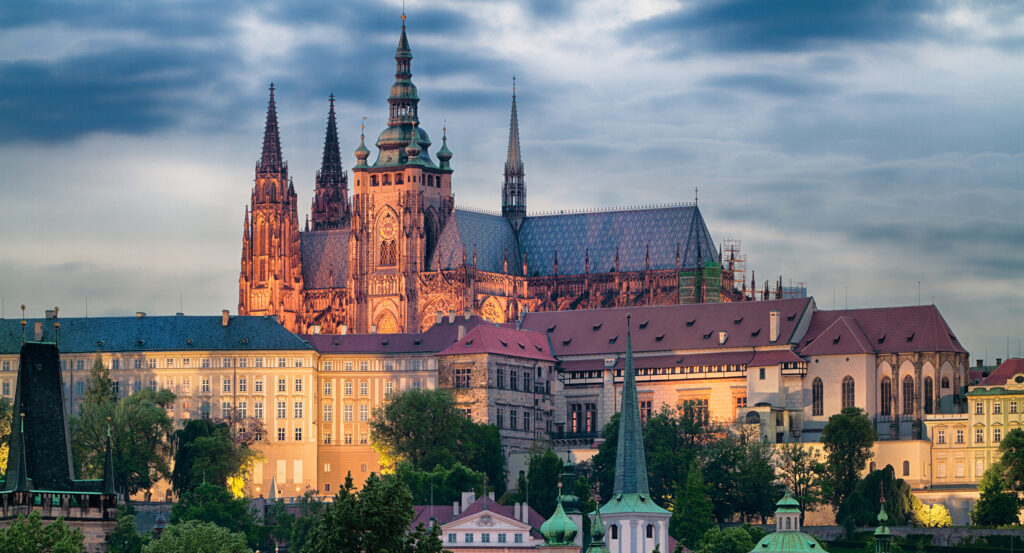
Top places to stay in Prague, Czech Republic.
Prague cultivated a distinguished hospitality tradition through centuries of Bohemian royal patronage, Central European commerce, and Habsburg imperial influence, with the architectural grandeur of its medieval streets, Baroque palaces, and nineteenth-century boulevards establishing the Czech capital as an enduring center of European cultural travel. Established along the Vltava River, Prague developed around the fortified settlements of Prague Castle and Vyšehrad, with medieval trading routes connecting Bohemia to the commercial centers of Germany, Austria, and Poland. The reign of Charles IV during the fourteenth century transformed the city into an imperial capital, bringing substantial investment in religious institutions, royal residences, and public infrastructure. The founding of Charles University in 1348 strengthened Prague's importance as a destination for scholars, diplomats, and ecclesiastical visitors, supporting a growing network of inns and lodging houses near its commercial streets and principal river crossings. During the Renaissance and Baroque periods, noble families commissioned elaborate palaces beneath Prague Castle, establishing traditions of ceremonial reception, formal courtyards, and richly decorated interiors that subsequently influenced prestigious accommodation. Prague's position within the Habsburg monarchy connected its aristocratic society with Vienna and the wider imperial economy, encouraging the development of increasingly sophisticated hospitality establishments as commercial travel expanded. The arrival of railway transportation during the nineteenth century transformed the city's accessibility, bringing industrialists, merchants, and international visitors into a rapidly modernizing capital. Wenceslas Square developed into a prestigious commercial boulevard, where substantial hotels reflected the prosperity of Bohemia's manufacturing and financial institutions. The transformation of Hotel Evropa during the early twentieth century, under architects Bedřich Bendelmayer and Alois Dryák, introduced a vivacious Art Nouveau façade that expressed Prague's growing confidence in its own architectural identity. The completion of Hotel Paříž in 1904, designed by Jan Vejrych, demonstrated the influence of French architectural fashions upon the city's emerging grand hotel culture, combining elaborate Gothic references with the decorative sophistication of the Belle Époque. The establishment of independent Czechoslovakia in 1918 brought a new political character to Prague, encouraging architectural experimentation and the development of modern metropolitan institutions. The Hotel Alcron, developed by Alois Krofta and opened in 1932, embodied the international ambitions of the First Czechoslovak Republic through its Art Deco interiors and contemporary standards of luxury accommodation. The Second World War and subsequent communist government transformed Prague's hospitality economy through nationalization and state administration, placing its historic hotels within a fundamentally different political and commercial system. International tourism continued under socialism, culminating in major developments such as the InterContinental Prague, completed in 1974 along the Vltava. The Velvet Revolution of 1989 restored the conditions for private investment and international hotel development, initiating extensive renovations of historic buildings whose architectural significance had endured through successive political transformations. The adaptation of former aristocratic residences, religious complexes, and commercial institutions subsequently established a distinctive contemporary luxury market grounded in architectural preservation. Prague's hospitality industry reflects the successive ambitions of imperial patrons, industrial entrepreneurs, modernist architects, and preservationists whose work transformed the city's historic buildings into exceptional settings for international accommodation.
Prague's accommodation geography reflects the organization of its medieval towns, the aristocratic districts surrounding Prague Castle, and the commercial expansion that transformed the city during the nineteenth century. Staré Město, or Old Town, forms the historic center of this landscape, where prestigious hotels occupy former merchant residences and substantial commercial buildings among Gothic churches, Renaissance façades, and the narrow streets surrounding Old Town Square. Centuries of reconstruction produced an unusually layered architectural environment, with vaulted ground floors, enclosed courtyards, and grand entrance passages incorporated into properties adapted for contemporary accommodation. The streets surrounding the Powder Tower and Municipal House preserve the transition between Prague's medieval commercial center and its more grand early twentieth-century architecture, providing distinguished settings for hotels connected to the city's historic cultural institutions. Josefov, the former Jewish Quarter, developed a contrasting architectural character through extensive redevelopment around the turn of the twentieth century, when broad avenues and elaborate apartment buildings transformed much of its medieval street network. The district's surviving synagogues and historic institutions preserve an essential dimension of Prague's cultural inheritance within an elegant urban environment. Across the Vltava, Malá Strana developed beneath Prague Castle as a prestigious residential quarter for Bohemian nobility, with Baroque palaces, former religious institutions, and landscaped gardens occupying winding streets between the river and the castle slopes. Its grand staircases, vaulted chambers, and enclosed courtyards provide particularly distinguished architectural settings for luxury accommodation. The Augustine hotel occupies part of a historic monastic complex near the Church of St. Thomas, illustrating the transformation of Prague's religious architecture into contemporary hospitality. Above Malá Strana, Hradčany retains the ceremonial character of the castle district, where substantial palaces, ecclesiastical buildings, and historic residences overlook the city's rooftops and church towers. Its elevated terraces and secluded gardens establish a residential environment closely connected to Prague's former courtly society. Nové Město, or New Town, presents a different architectural inheritance through the broad commercial spaces and substantial urban buildings that developed around Wenceslas Square. Although founded under Charles IV, the district acquired much of its metropolitan character during the nineteenth and early twentieth centuries, when hotels, theaters, department stores, and financial institutions introduced Neo-Renaissance, Art Nouveau, and modernist architecture along its principal boulevards. The streets surrounding Národní třída and the National Theatre connect this commercial landscape with the grand riverfront, supporting accommodation near the cultural institutions associated with the Czech national movement. Beyond the historic center, Vinohrady developed as an affluent residential district distinguished by landscaped squares, tree-lined avenues, and elaborately decorated apartment buildings constructed for Prague's expanding professional classes. Its spacious streets and neighborhood restaurants provide a refined setting for smaller hotels within an established residential environment. Karlín reflects the city's industrial expansion through its former manufacturing buildings, commercial premises, and nineteenth-century housing, much of which has been integrated into contemporary office, restaurant, and hospitality development. Holešovice preserves a complementary industrial character through substantial warehouses, factories, and cultural institutions occupying the northern reaches of the Vltava. These districts extend Prague's accommodation landscape beyond its historic palaces into neighborhoods shaped by manufacturing, commerce, and contemporary design. Along the river, prestigious hotels occupy prominent positions overlooking historic bridges, grand embankments, and the castle skyline, drawing upon the extraordinary relationship between Prague's topography and its architectural inheritance. The resulting hospitality geography offers a concentrated progression from medieval merchant houses and aristocratic palaces to metropolitan grand hotels, residential retreats, and contemporary accommodations within restored industrial buildings. Foresyte may earn a commission when you book.
Foresyte Travel's top five choices.
5. Aria Hotel Prague
Aria Hotel Prague occupies a group of historic buildings in Malá Strana beside the Vrtba Garden, among Prague's major Baroque gardens and part of the UNESCO-listed historic center. Architect and designer Rocco Magnoli developed the property around music as an organizing principle, assigning its floors to jazz, opera, classical and contemporary music and integrating an extensive music library into the hotel. The building opens directly into the terraced Vrtba Garden, created for Jan Josef, Count of Vrtba in the early eighteenth century with architectural work by František Maxmilián Kaňka and sculpture by Matthias Bernard Braun. That relationship joins a highly specific contemporary hotel concept with one of the most accomplished surviving Baroque garden compositions beneath Prague Castle.
4. Alchymist Grand Hotel and Spa
Alchymist Grand Hotel and Spa occupies a group of historic buildings in Malá Strana centered on the House at the Infant Jesus, whose architectural fabric incorporates Renaissance and Baroque development beneath Prague Castle. The property stands within a district transformed by aristocratic palace construction after the destructive fires that reshaped Malá Strana during the sixteenth century. Its restoration retained vaulted ceilings, painted ornament, carved woodwork and period architectural details, with the hotel deliberately extending the decorative traditions of the surrounding palace quarter through antique furnishings and elaborate interior finishes. The result places contemporary hospitality inside the dense architectural inheritance that made Malá Strana one of Prague's principal concentrations of Renaissance and Baroque urban fabric.
3. Augustine, a Luxury Collection Hotel, Prague
Augustine, a Luxury Collection Hotel, Prague incorporates seven historic buildings surrounding the functioning Augustinian monastery of St. Thomas in Malá Strana, whose religious community traces its presence on the site to the thirteenth century. Rocco Forte Hotels developed the property with architect Eva Jiřičná before its later integration into Marriott's Luxury Collection, adapting monastic structures that include cloisters, vaulted spaces and the former brewery associated with the Augustinian community. The complex preserves a direct physical relationship with St. Thomas Church, whose Baroque reconstruction involved architect Kilian Ignaz Dientzenhofer and whose artistic heritage includes altarpieces commissioned from Peter Paul Rubens. The hotel inhabits a living religious precinct whose medieval foundation, Baroque transformation and brewing tradition remain embedded in the architecture surrounding it.
2. Mandarin Oriental, Prague
Mandarin Oriental, Prague occupies the former Dominican monastery of St. Mary Magdalene in Malá Strana, a site whose religious history extends through medieval Prague and whose surviving structures accumulated Romanesque, Gothic, Renaissance and Baroque layers. The monastery ceased its religious function under Emperor Joseph II's eighteenth-century reforms, beginning a long succession of secular uses before its conversion into a hotel. Restoration exposed archaeological remains and preserved vaulted rooms, cloisters and historic masonry across the interconnected complex, with the spa established inside a former Renaissance chapel. The property concentrates several centuries of Prague architectural history inside a single adaptive-reuse project at the foot of Petřín Hill.
1. Four Seasons Hotel Prague
Four Seasons Hotel Prague occupies a Vltava riverfront site where three historic buildings from different architectural periods were joined with a contemporary structure near the eastern end of Charles Bridge. The ensemble incorporates Baroque, Classical and Renaissance Revival architecture, preserving the differing façades and interior proportions accumulated along this section of the Old Town riverbank. Architects incorporated the new construction into that inherited streetscape through sandstone, stucco and carefully controlled massing, allowing Prague Castle and the historic skyline across the Vltava to remain the dominant visual composition. The hotel's 2001 opening placed an international luxury property inside a deliberately layered architectural ensemble that reflects several major periods in Prague's urban development.
Where your story begins.
Foresyte Travel reveals places that feel extraordinary long before you arrive.
Enjoy editorial crafted for luxury travelers.
Foresyte may earn a commission when you book.