
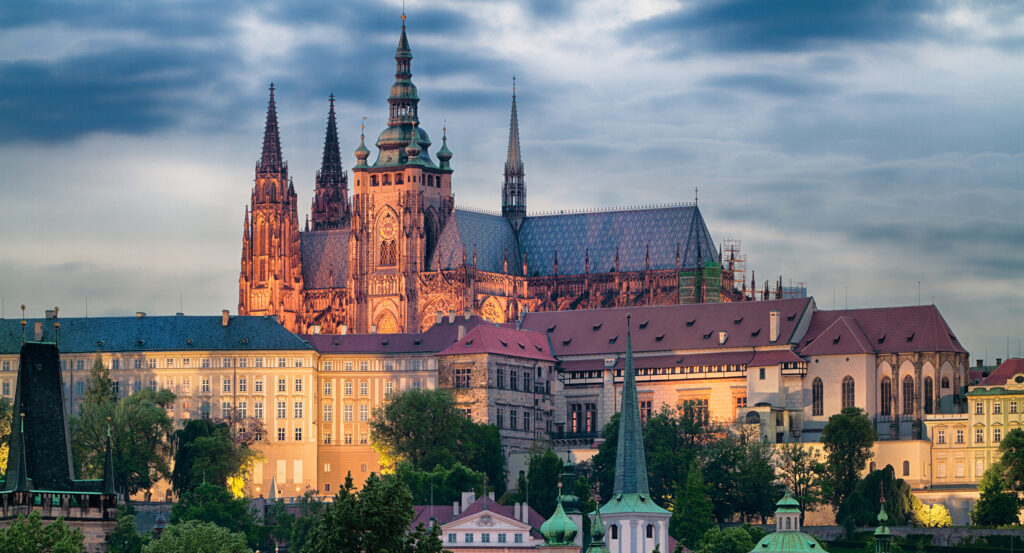
Why Prague Castle matters.
Prague Castle is a sprawling castle complex where Hradčany's royal heritage, Bohemian statehood, architectural mastery, and more than a thousand years of European history preserve the enduring seat of Czech sovereignty.
Set along Hradčanské náměstí near Ke Hradu and just steps from St. Vitus Cathedral, this vast castle complex unfolds through Gothic cathedrals, Romanesque foundations, Renaissance palaces, Baroque gardens, ceremonial courtyards, and fortified gateways where successive rulers shaped the political, cultural, and spiritual life of Bohemia. Stone towers, vaulted halls, royal apartments, sweeping terraces, and centuries of architectural evolution reveal a complex that reflects every major chapter of Czech history. Royal tradition, craftsmanship, and historical continuity define every courtyard and passage.
What defines Prague Castle.
Prague Castle is best known for serving as the seat of Bohemian kings, Holy Roman emperors, Habsburg rulers, Czechoslovak presidents, and the President of the Czech Republic since its foundation 880 by Prince Bořivoj I of the Přemyslid dynasty, developing across 70,000 square meters into the world's largest coherent castle complex while preserving more than eleven centuries of political, architectural, and cultural development. Established around the Church of the Virgin Mary during the early medieval period, the castle expanded through successive dynasties as each generation introduced new palaces, fortifications, churches, gardens, and ceremonial buildings reflecting changing artistic and political priorities. Construction of St. Vitus Cathedral began in 1344 under Emperor Charles IV following designs by French architect Matthias of Arras before Peter Parler introduced innovative Gothic vaulting, traceries, and structural techniques that profoundly influenced Central European architecture. The complex also preserves the Old Royal Palace, whose Vladislav Hall completed 1502 by Benedikt Rejt spans 62 meters with an intricate rib-vaulted ceiling engineered to accommodate coronation ceremonies, banquets, and mounted tournaments. Golden Lane, established during the late sixteenth century beneath the northern fortifications, housed castle guards, goldsmiths, craftsmen, and later writers including Franz Kafka, who briefly occupied House No. 22 during 1916 and 1917. The castle safeguards the Bohemian Crown Jewels, centuries of royal archives, medieval manuscripts, religious treasures, paintings, armor, and decorative arts while continuing to host presidential inaugurations, state ceremonies, diplomatic receptions, and official national events. Extensive conservation campaigns throughout the twentieth and twenty-first centuries have stabilized medieval masonry, restored decorative interiors, conserved stained glass, strengthened historic structures, and expanded archaeological research that continues revealing new evidence about the castle's earliest phases. Today Prague Castle remains the administrative seat of the Czech presidency and the centerpiece of Prague's UNESCO World Heritage Site.
Romanesque foundations, Gothic engineering, Renaissance refinement, and Baroque additions demonstrate how successive generations adapted the complex while preserving its role as the political and ceremonial heart of the Czech lands. Royal chapels, fortified walls, ceremonial halls, sculpted courtyards, stained glass, painted interiors, historic gardens, and carefully restored architectural details demonstrate more than a millennium of craftsmanship while supporting ongoing archaeological investigation, conservation science, and architectural research. Continuing structural preservation, collection stewardship, digital documentation, historical scholarship, and traditional restoration techniques ensure the castle remains among Europe's foremost expressions of royal architecture and state history. Architectural excellence, cultural stewardship, and centuries of royal tradition combine to create one of Europe's greatest historic complexes.
How Prague Castle fits.
Prague Castle works as the centerpiece of an exploration through Hradčany's royal and religious heritage.
Begin at St. Vitus Cathedral, where soaring Gothic architecture establishes the spiritual heart of the castle before exploring Prague Castle. Continue to Golden Lane, whose preserved houses provide insight into centuries of life within the castle walls. Conclude at Lobkowicz Palace, where distinguished art collections and family history provide a memorable finale celebrating another enduring chapter of Czech cultural heritage. The progression moves naturally from sacred architecture to royal history before concluding through one of the castle's historic palaces, revealing why Hradčany remains the historic heart of Prague.
Where your story begins.
Foresyte Travel reveals places that feel extraordinary long before you arrive.
Enjoy editorial crafted for luxury travelers.
Foresyte may earn a commission when you book.





































































































