
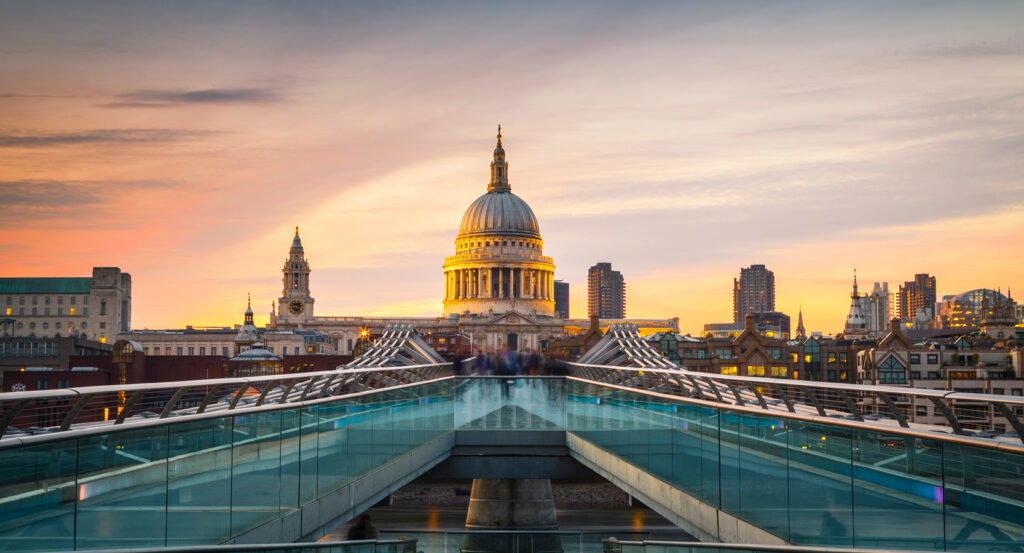
Perfect weekend in London, England.
London rose to prominence through its command of the River Thames, developing from a Roman trading settlement into the political capital of England and the commercial center of a maritime empire. The city's position at a navigable crossing in southeastern Britain connected inland agricultural territories with the North Sea, supporting the growth of trade and settlement long before the establishment of Roman Londinium during the first century CE. Roman engineers constructed defensive walls, roads, public baths, and port facilities, creating an administrative center that became one of the principal settlements of Roman Britain. Following the decline of Roman authority, Anglo-Saxon communities established Lundenwic west of the former Roman city, developing trading relationships across the North Sea. Alfred the Great restored the fortified settlement during the ninth century, strengthening its defensive position against Viking incursions. The Norman Conquest of 1066 brought a new ruling dynasty, whose military and administrative ambitions accelerated the construction of fortifications and religious institutions. Medieval London prospered through wool exports, merchant guilds, and financial relationships with continental Europe, gradually acquiring commercial privileges that strengthened the independence of the City of London. During the Tudor period, the expansion of English maritime commerce brought new wealth to the capital, culminating in the establishment of the East India Company in 1600. The Great Fire of 1666 destroyed extensive portions of the medieval settlement, creating an opportunity for architectural reconstruction under figures including Sir Christopher Wren. During the eighteenth century, London's expanding docks, banking houses, and commercial institutions supported Britain's growing overseas empire. The Industrial Revolution accelerated railway construction, manufacturing, and suburban expansion, making London the world's largest city during the nineteenth century. German bombing during the Second World War destroyed substantial residential and commercial areas, followed by reconstruction and major demographic changes associated with immigration from the Caribbean, South Asia, Africa, and continental Europe. The capital subsequently developed into a global center of finance, publishing, higher education, and international diplomacy, retaining the architectural inheritance of successive monarchies and commercial generations.
British theatrical innovation found one of its greatest centers in London, where commercial playhouses, royal patronage, and generations of playwrights transformed the development of English-language drama. William Shakespeare established his career within the capital's Elizabethan theatrical community, producing works that explored political ambition, dynastic conflict, personal relationships, and the complexities of human behavior. The Globe Theatre, constructed in Southwark in 1599, became closely associated with Shakespeare's company and the flourishing of public performance along the southern bank of the Thames. Christopher Marlowe and Ben Jonson contributed to the dramatic achievements of the same period, developing literary traditions that influenced European theater for centuries. London's intellectual history subsequently expanded through writers including Charles Dickens, whose novels examined industrialization, poverty, and the social divisions of Victorian society. The British Library preserves major collections of manuscripts, printed books, maps, and historical objects, including literary manuscripts associated with some of Britain's most celebrated authors. Tate Britain encompasses centuries of British painting and sculpture, with works by J. M. W. Turner demonstrating the innovative treatment of light and atmosphere that influenced modern landscape painting. London's musical history developed through institutions associated with classical composition and performance, including the career of George Frideric Handel, who settled in the capital in 1712. During the twentieth century, the city became a center of British rock, punk, and contemporary popular music, with David Bowie, The Clash, and numerous other performers contributing to movements that reshaped international popular culture. London's culinary traditions developed through centuries of agricultural commerce, maritime trade, and immigration, incorporating ingredients and preparations from across Britain and the wider world. Traditional specialties include roast beef with Yorkshire pudding, steak and kidney pie, fish and chips, and afternoon tea accompanied by sandwiches, scones, and pastries. South Asian communities established an influential restaurant culture through Indian, Pakistani, Bangladeshi, and Sri Lankan cooking, introducing regional curries, tandoori preparations, and specialist breads to neighborhoods throughout the capital. Caribbean immigration contributed jerk cooking, patties, and richly seasoned stews, and later arrivals from East Asia, Africa, and the Middle East expanded the city's culinary range. Contemporary London restaurants build upon these foundations through seasonal British produce, classical European techniques, and ambitious interpretations of international cuisines. London's extraordinary concentration of historical architecture, theatrical achievement, literary institutions, and neighborhood dining traditions gives a weekend in the capital a depth that few cities equal.
Three day itinerary.
Day 1: London Eye
London Eye is best known for converting a temporary millennium project into a defining element of London's modern riverfront. Architects David Marks and Julia Barfield developed the observation wheel after entering a competition for a structure marking the new millennium, continuing independently after the competition produced no winner. Engineers Arup helped realize a 135-meter wheel supported from one side by an immense A-frame and tensioned through bicycle-wheel principles. Major components traveled along the Thames before the structure was assembled horizontally over the river and raised gradually into position. The London Eye opened in 2000 and permanently altered the South Bank skyline, adding contemporary engineering to a river corridor historically dominated by government, railway, and cultural architecture.
Day 1: Core by Clare Smyth
Core by Clare Smyth is best known for establishing Clare Smyth as the first British woman to lead a restaurant awarded three MICHELIN stars. Smyth grew up on a farm in Northern Ireland and developed her career through kitchens including Alain Ducasse's Le Louis XV before becoming chef patron at Restaurant Gordon Ramsay. She opened Core in Notting Hill in 2017, constructing its cuisine around British ingredients whose familiarity belies the technical precision applied to them. Potatoes, carrots, scallops, lamb, and other products associated with the British landscape became foundations for highly refined compositions grounded in producers and regional provenance. Three MICHELIN stars placed Core at the summit of British fine dining and established Smyth's independent restaurant as a defining institution of contemporary London gastronomy.
Day 2: Tower of London
Tower of London is best known for concentrating nearly a millennium of English monarchy, imprisonment, warfare, and ceremony within a fortified complex beside the Thames. William the Conqueror began the White Tower in the late eleventh century as an assertion of Norman power over London, using massive stone construction to define the surrounding city. Successive monarchs expanded the fortress with concentric defensive walls, residential quarters, chapels, and administrative buildings. Anne Boleyn and Catherine Howard were imprisoned and executed within its precincts, and the Tower subsequently became inseparable from the violent politics of Tudor succession. The Crown Jewels added another dimension to its royal function, preserving objects used in coronation ceremonies within a fortress whose architecture records successive transformations of the English state.
Day 2: Gymkhana
Gymkhana is best known for translating the social world of Indian clubs into one of London's most accomplished expressions of contemporary Indian cooking. Karam Sethi opened the Mayfair restaurant in 2013, drawing its name and atmosphere from the private gymkhana clubs established across the Indian subcontinent during the colonial period. The kitchen developed around tandoor and sigri cooking, game, richly structured curries, regional preparations, and spices handled with exceptional precision. Sethi built the restaurant within the JKS Restaurants group founded with his siblings Jyotin and Sunaina, extending a family enterprise that became deeply influential in London dining. MICHELIN awarded Gymkhana two stars, placing an Indian restaurant among the highest-rated dining rooms in Britain and reinforcing London's central position in the international development of Indian fine dining.
Day 2: Buckingham Palace
Buckingham Palace is best known for transforming an eighteenth-century aristocratic house into the principal London residence of the British sovereign. The Duke of Buckingham commissioned Buckingham House in 1703, and George III acquired the property in 1761 for Queen Charlotte. George IV subsequently enlisted John Nash to convert the house into a palace, beginning an ambitious expansion continued under Edward Blore after Nash's dismissal. Queen Victoria became the first sovereign to make Buckingham Palace her official London residence in 1837. The familiar east front facing The Mall emerged from later nineteenth-century expansion and received its present Portland stone appearance during the reign of George V. State ceremonies, investitures, audiences, and major national occasions subsequently made the palace a principal architectural stage of the British monarchy.
Day 2: St. JOHN
St. JOHN is best known for Fergus Henderson's profound influence on modern British cooking through an uncompromising engagement with whole animals and traditional ingredients. Henderson and Trevor Gulliver opened the Smithfield restaurant in 1994 inside a former smokehouse near London's historic meat market. Henderson developed a stripped-back cuisine around offal, game, braises, pies, bone marrow, seasonal vegetables, and other elements of British cooking that had largely disappeared from fashionable restaurants. His 1999 book Nose to Tail Eating carried that philosophy far beyond London and influenced a generation of chefs internationally. The restaurant received a MICHELIN star and became one of the defining institutions of Britain's late twentieth-century culinary revival, demonstrating the gastronomic potential of ingredients and preparations deeply embedded in the country's food history.
Day 3: The Wolseley
The Wolseley is best known for occupying one of Piccadilly's most extraordinary adaptive-reuse interiors. Architect William Curtis Green designed the building in the 1920s as a London showroom for Wolseley Motors, giving the automobile company an expansive setting of marble floors, arches, columns, and sweeping staircases. The commercial experiment failed, and Barclays subsequently occupied the building as a bank for decades. Restaurateurs Chris Corbin and Jeremy King transformed the former banking hall into The Wolseley in 2003, preserving its theatrical scale and much of its architectural character. Grand European café traditions shaped the restaurant's all-day operation, making breakfast, afternoon tea, and formal service parts of a continuous institution whose significance rests as heavily on London architectural history as on hospitality.
Day 3: Big Ben
Big Ben is best known for joining Victorian Gothic architecture with one of the world's most recognizable systems of public timekeeping. Charles Barry designed the Palace of Westminster after fire destroyed much of the old parliamentary complex in 1834, and Augustus Welby Northmore Pugin supplied critical Gothic detailing for its clock tower. Clockmaker Edward John Dent and his son Frederick completed the mechanism developed from Edmund Beckett Denison's specifications, including an innovative gravity escapement that protected timekeeping from external forces acting on the hands. The Great Bell first sounded in 1859 and became popularly known as Big Ben, a name subsequently applied colloquially to the tower itself. Renamed Elizabeth Tower in 2012, the structure underwent an extensive conservation completed in the twenty-first century.
Day 3: Westminster Abbey
Westminster Abbey is best known for serving as the ceremonial church of the English and British monarchy across nearly a millennium. Edward the Confessor established a major Romanesque abbey at Westminster and was buried there after its consecration in 1065. William the Conqueror's coronation the following year began a tradition that made the church the setting for virtually every subsequent English and British coronation. Henry III rebuilt the abbey in the Gothic style during the thirteenth century, creating an architectural setting intended to honor Edward's shrine and rival the great churches of continental Europe. Later additions included Henry VII's elaborate Lady Chapel, and burials and memorials to monarchs, scientists, writers, musicians, and statesmen transformed the abbey into an extraordinary physical record of British institutional and cultural history.
Day 3: The Ledbury
The Ledbury is best known for Brett Graham's transformation of a Notting Hill restaurant into one of the most decorated kitchens in modern British dining. The Australian-born chef developed his career in Sydney before moving to Britain, where his work with Philip Howard at The Square provided a foundation in ingredient-driven contemporary European cooking. Graham opened The Ledbury in 2005 and built its cuisine around exceptional British produce, game, seafood, vegetables, and increasingly close relationships with farmers and suppliers. The restaurant earned two MICHELIN stars before closing during the pandemic, then returned in 2022 with a redesigned dining room and renewed culinary direction. MICHELIN awarded The Ledbury a third star in 2024, completing one of the most consequential restaurant revivals in recent London dining history.
Where your story begins.
Foresyte Travel reveals places that feel extraordinary long before you arrive.
Enjoy editorial crafted for luxury travelers.
Foresyte may earn a commission when you book.







































































































