
Why The British Museum matters.
The British Museum is a vast encyclopedic institution where Bloomsbury's intellectual character meets Enlightenment collecting, Greek Revival architecture and collections spanning human cultures across millennia.
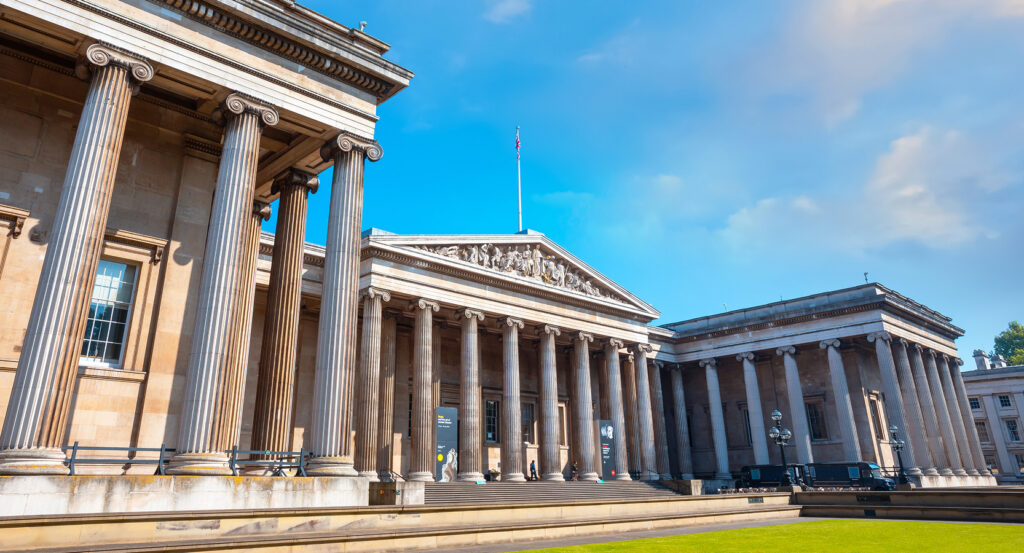
Set along Great Russell Street near Montague Street and just steps from Bedford Square, the museum occupies an immense quadrangular complex whose south front presents Sir Robert Smirke's Greek Revival architecture through forty-three temple-inspired columns, a triangular pediment and an expansive entrance stair. Smirke began the present building in 1823 with the King's Library wing, using cast-iron structural elements, concrete floors and Portland-stone facing before the completed quadrangle received the Royal Institute of British Architects' Gold Medal in 1853. Movement through the complex establishes the primary encounter as galleries devoted to cultures across Africa, Asia, Europe, the Americas and the ancient Mediterranean repeatedly open into the Queen Elizabeth II Great Court, Foster + Partners' two-acre covered courtyard surrounding the circular Reading Room. A glass-and-steel roof assembled from thousands of individually shaped panes creates a second architectural register above that nineteenth-century core, exposing changing views of Sydney Smirke's domed library as circulation wraps around its cylindrical exterior. The result is a museum where Robert Smirke's neoclassical quadrangle, Sydney Smirke's Victorian Reading Room and Foster + Partners' millennial intervention turn successive ideas about collecting, scholarship and public access into architecture.
What defines The British Museum.
The British Museum is best known for originating with Sir Hans Sloane's immense collection and developing under the 1753 British Museum Act into a national institution bringing antiquities, natural history, manuscripts, books and works from cultures across the world under one public foundation. Sloane died that year after assembling more than 71,000 objects, including 32,000 coins and medals, a vast library and a 334-volume herbarium, and his will offered the collection to the nation for £20,000 paid to his heirs. Parliament accepted his terms, raised the purchase money through a national lottery and joined Sloane's holdings with the Cotton and Harley libraries to establish the Museum on 7 June 1753. Montagu House became its first home, opening to ticketed members of the public in 1759 before growing collections progressively overwhelmed the seventeenth-century mansion. Major acquisitions rapidly changed the institution's archaeological importance: antiquities ceded after the British defeat of French forces in Egypt entered the Museum in 1802 with the Rosetta Stone among them, and Parliament purchased Lord Elgin's collection of Parthenon sculptures in 1816 following investigation by a Select Committee. George IV's donation of George III's library in 1823 supplied another major collection and helped trigger construction of the present building, with the 300-foot King's Library becoming its first completed wing. Montagu House was progressively demolished as Smirke's quadrangle advanced, and the south portico completed the principal building in 1852. A museum founded around an Enlightenment collection had expanded through parliamentary acquisition, royal libraries, warfare, excavation, donation and imperial-era collecting into an institution whose holdings also expose the contested historical conditions under which museums accumulated objects across the eighteenth and nineteenth centuries.
The library created an equally consequential intellectual institution inside the museum, culminating in Antonio Panizzi's proposal to fill the quadrangle's central courtyard with a circular reading room. Sydney Smirke designed the structure, construction began in 1854 and the Reading Room opened on 2 May 1857 with a 42.6-metre diameter dome assembled through cast iron, concrete, glass and papier-mâché. Iron bookstacks surrounding it contained three linear miles of bookcases and twenty-five miles of shelving, turning the formerly open courtyard into an immense machine for storing and retrieving printed knowledge. Karl Marx worked there during the preparation of Capital, and later readers included Bram Stoker, Arthur Conan Doyle and Lenin, whose reader registration used the name Jacob Richter. The library department transferred to the new British Library building at St. Pancras in 1997, releasing the courtyard for a competition that attracted more than 130 submissions and selected Foster + Partners. The resulting £100 million Great Court reopened the quadrangle under its sweeping roof on 6 December 2000, increasing the Museum's usable area by 40 percent and allowing free movement around the main floor for the first time in more than 150 years. Panizzi's library and Foster + Partners' intervention transformed the same central void twice, first into a nineteenth-century center of scholarship and later into the principal circulation space of the modern museum.
How The British Museum fits.
The British Museum works as the anchor for a daytime exploration through three nearby institutions connecting architectural collecting, eighteenth-century child welfare and two centuries of organized freethought across Bloomsbury and Holborn.
Begin at Sir John Soane's Museum, where architect John Soane progressively transformed three adjoining houses at Lincoln's Inn Fields into a domestic laboratory for architecture and collecting. Soane acquired and rebuilt Number 12 beginning in 1792, reconstructed Number 13 in phases from 1807 and added Number 14 during 1823 and 1824, filling the interconnected interiors with architectural fragments, sculpture, paintings, models, books and drawings. Appointment as Professor of Architecture at the Royal Academy in 1806 encouraged him to arrange the collection for students, and the house increasingly operated as what contemporaries called an Academy of Architecture, embedding teaching within Soane's experiments with light, spatial compression and classical form. Continue to Foundling Museum, whose institutional ancestry begins with Thomas Coram's long campaign for a hospital serving abandoned infants and the Royal Charter granted by George II in 1739. The first thirty children entered the Foundling Hospital in 1741, and William Hogarth subsequently encouraged artists to donate works, helping create an early public art gallery within the charitable institution; George Frideric Handel supported the Hospital through performances of Messiah and left it a manuscript score. The organization cared for thousands of children across more than two centuries before its surviving art, archival and musical collections became the foundation of the museum at Brunswick Square. Conclude at Conway Hall, operated by a society whose ancestry reaches a dissident congregation established in 1787 and whose beliefs moved through Universalism and Unitarianism toward a humanist position by the end of the nineteenth century. William Johnson Fox became minister in 1817, the congregation built South Place Chapel in 1824 and Stanton Coit's leadership accompanied adoption of the South Place Ethical Society name in 1888. Frederick Herbert Mansford designed the present headquarters after construction began in 1928, creating dedicated spaces for lectures, concerts, social gatherings and a library before its public opening on 23 September 1929. The progression moves from Soane converting his own architecture and collections into a teaching environment through Coram, Hogarth and Handel joining philanthropy with art into a dissenting congregation that developed a permanent home for humanist education, extending Bloomsbury's concentration of knowledge through three radically different models of collecting, learning and public culture.
Where your story begins.
Foresyte Travel reveals places that feel extraordinary long before you arrive.
Enjoy editorial crafted for luxury travelers.
Foresyte may earn a commission when you book.














































































































