Fun facts about Kyoto, Japan.
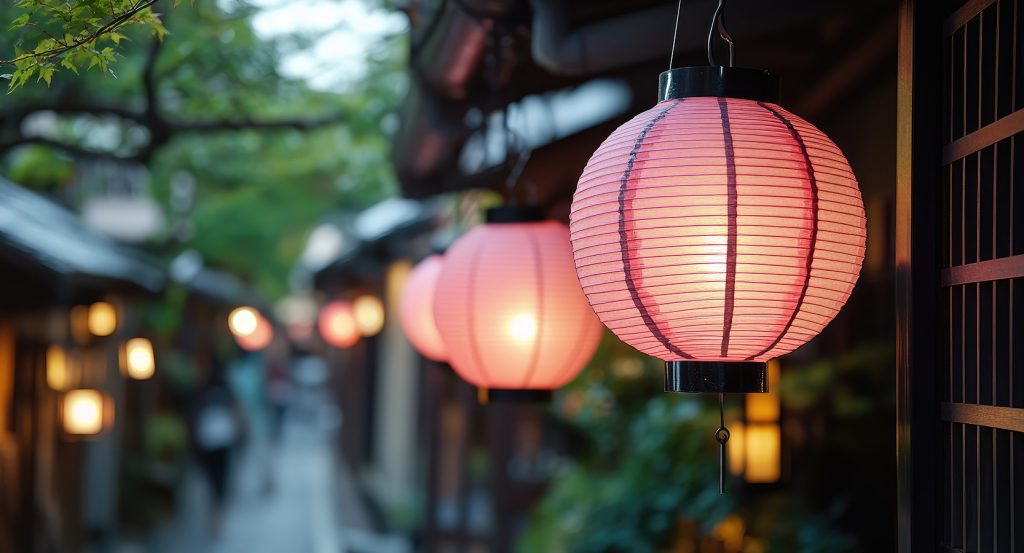
Kyoto extends across a broad inland basin surrounded by wooded mountains on three sides, with the Kamo, Katsura, and Uji river systems shaping a landscape of historic neighborhoods, temple precincts, and carefully composed gardens. The city's original grid remains legible through its central streets, reflecting the geometric organization of the Heian capital and the successive adaptations of medieval and early modern urban development. The Kyoto Imperial Palace occupies an extensive landscaped precinct within Kyoto Gyoen National Garden, preserving the ceremonial architecture and spatial organization associated with the imperial court. Its traditional wooden buildings, expansive courtyards, and carefully proportioned rooflines express architectural principles developed through centuries of Japanese aristocratic patronage. Eastward, the Higashiyama foothills contain an exceptional concentration of Buddhist temples, Shinto shrines, and historic pedestrian streets. Kiyomizu-dera rises above the wooded slopes through its expansive wooden stage, supported by an intricate structure of timber pillars and beams. The temple's elevated position provides expansive views across Kyoto, establishing a dramatic relationship between religious architecture and the surrounding landscape. Nearby, the streets of Sannenzaka and Ninenzaka preserve traditional townhouses, tiled roofs, and narrow stone-paved passages associated with the historic pilgrimage routes of eastern Kyoto. The Yasaka Pagoda rises above this urban environment through a five-story wooden structure that has become one of the district's most recognizable landmarks. Farther north, Ginkaku-ji presents a contrasting architectural composition through restrained wooden buildings, moss gardens, and carefully arranged sand landscapes associated with the aesthetics of Zen Buddhism. The Philosopher's Path follows a canal beneath flowering cherry trees, connecting temple precincts through a quiet residential landscape along the eastern foothills. Across the city, Kinkaku-ji occupies a landscaped garden centered on a reflective pond, with its celebrated Golden Pavilion presenting an elegant combination of architectural forms and gilded exterior surfaces. Nearby, Ryōan-ji preserves one of Japan's most influential dry-landscape gardens, where carefully positioned stones and raked gravel create a composition of remarkable spatial restraint. Western Kyoto introduces another distinctive landscape through Arashiyama, where wooded mountains rise above the Katsura River and historic temples occupy the surrounding slopes. The Togetsukyō Bridge spans the river beneath the mountain backdrop, connecting traditional streets with gardens and temple grounds. The nearby bamboo grove creates a striking pedestrian corridor through towering stands of bamboo, reflecting the region's longstanding relationship with cultivated woodland landscapes. In southern Kyoto, Fushimi Inari Taisha extends across the slopes of Mount Inari through a vast network of shrine buildings and pathways lined with vermilion torii gates. The gates, donated by individuals and businesses, create a continuous ceremonial route through wooded mountain terrain. Kyoto's traditional residential architecture remains particularly visible through the machiya, narrow wooden townhouses whose internal courtyards, lattice façades, and flexible domestic spaces reflect the historic organization of merchant and artisan life. The Gion district preserves important examples of this urban tradition through its timber buildings, intimate streets, and established entertainment quarters. Kyoto's architectural distinction arises from the sustained integration of religious monuments, aristocratic gardens, traditional housing, and a mountain landscape that has shaped the city's spatial organization since its imperial foundation.
Japanese cultural traditions reached a defining level of refinement in Kyoto, where court literature, Buddhist philosophy, traditional theater, ceramics, textile production, and ceremonial arts developed through centuries of aristocratic and religious patronage. The Heian court established one of the most influential literary environments in East Asian history, particularly through the development of Japanese-language prose and poetry. Murasaki Shikibu composed The Tale of Genji during the early eleventh century, creating a sophisticated exploration of courtly relationships, political ambition, and resonant complexity that became a foundational work of Japanese literature. Sei Shōnagon's The Pillow Book preserved another distinctive perspective on aristocratic life through observations of social behavior, seasonal beauty, and the aesthetic conventions of the imperial court. Kyoto's Buddhist institutions contributed substantially to the development of Japanese philosophy and religious practice, particularly through the expansion of Tendai, Shingon, and Zen traditions. The introduction and institutional growth of Zen Buddhism encouraged influential approaches to meditation, garden design, calligraphy, and artistic discipline. The Japanese tea ceremony acquired particular sophistication through the work of Sen no Rikyū during the sixteenth century, emphasizing carefully controlled movement, modest materials, and the aesthetic principles associated with wabi. Kyoto became an important center of tea culture through specialized artisans producing ceramics, bamboo utensils, lacquerware, and architectural environments designed for ceremonial gatherings. The city's ceramic traditions developed through workshops associated with Kiyomizu ware and other regional styles, producing vessels distinguished by refined glazes, decorative painting, and careful attention to form. Nishijin textiles established another internationally influential craft tradition through elaborate silk weaving, with artisans producing brocades and fabrics used in kimono, ceremonial clothing, and decorative arts. Kyoto's performing arts heritage includes Noh theater, whose formalized movement, masks, and musical accompaniment developed through medieval aristocratic and religious patronage. The city's traditional entertainment districts preserved the professional culture of geiko and maiko, whose training encompasses classical dance, music, conversation, and ceremonial hospitality. Gion became particularly associated with these traditions, supporting performances and seasonal events that preserve established forms of Japanese artistic expression. The annual Gion Matsuri, originating in the ninth century, developed into one of Japan's most celebrated festivals through elaborate processions, expansive floats, and neighborhood participation. The festival's richly decorated yamaboko floats reflect centuries of textile craftsmanship, merchant patronage, and ceremonial organization. Kyoto's culinary traditions developed through the refinement of seasonal ingredients and Buddhist dietary practices, particularly through kaiseki dining and shōjin ryōri. Kaiseki emphasizes the relationship between presentation, seasonality, and carefully balanced courses, reflecting aesthetic principles closely associated with the tea ceremony. The city's longstanding traditions of tofu production, pickled vegetables, and delicate confectionery draw upon the surrounding region's agricultural resources and historic food culture. Nishiki Market preserves a concentrated environment of specialist food merchants, connecting contemporary culinary life with generations of local commerce. Kyoto's contemporary cultural institutions include major museums, universities, and artistic organizations that sustain traditional craftsmanship and encourage modern experimentation. The Kyoto City KYOCERA Museum of Art and the Kyoto National Museum contribute to the preservation and interpretation of Japanese artistic heritage, with exhibitions connecting historical traditions to contemporary cultural production. Kyoto's cultural significance rests upon the exceptional continuity of literary, religious, artistic, and culinary practices that have shaped Japanese civilization through centuries of disciplined refinement and creative transformation.
Five fascinations.
5. Kyoto's streets preserve the logic of an imperial capital planned more than 1,200 years ago.
Kyoto became Japan's imperial capital in 794 when Emperor Kanmu established Heian-kyō on the site. Its planners created an orderly grid of broad avenues and smaller streets influenced by Chinese capital planning, particularly Chang'an of the Tang dynasty. Although centuries of rebuilding transformed the structures occupying those blocks, the underlying geometry remained fundamental to Central Kyoto. Modern addresses and navigation still reflect this unusually persistent urban structure. Moving through Kyoto means traveling across a street pattern whose origins reach directly to the creation of the imperial city in the eighth century.
4. Kinkaku-ji's famous Golden Pavilion is a reconstruction from the 1950s.
The shimmering pavilion at Kinkaku-ji appears inseparable from medieval Kyoto, yet the structure standing today dates to 1955. The original pavilion was created for shogun Ashikaga Yoshimitsu in the late fourteenth century and survived for centuries before a novice monk deliberately burned it in 1950. Reconstruction followed the historic design, restoring the three-story building overlooking its reflective pond and eventually applying extensive gold leaf to its upper levels. One of Kyoto's most recognizable monuments captures both the city's medieval cultural legacy and its repeated ability to reconstruct important architecture after catastrophic loss.
3. Kyoto's Fushimi Inari shrine became famous for gates donated individually by worshippers.
Fushimi Inari Taisha is the principal shrine associated with Inari, the Shinto deity connected with rice, prosperity, and commercial success. Its celebrated tunnels of vermilion torii developed through a tradition in which individuals and businesses donated gates as expressions of gratitude or hopes for prosperity. Thousands now line pathways ascending sacred Mount Inari, with inscriptions identifying donors and dates visible on the reverse sides. The extraordinary landscape was not conceived as a single expansive installation. It accumulated incrementally through generations of devotion, turning countless individual offerings into one of Japan's most recognizable architectural experiences.
2. Kyoto contains a temple garden whose fifteen stones are impossible to see simultaneously from the traditional viewing area.
Ryōan-ji contains one of Japan's most celebrated dry landscape gardens, an austere composition of fifteen stones arranged in groups across carefully raked gravel. From conventional viewpoints along the temple veranda, one stone remains concealed behind another. The garden's designer and precise intended meaning remain uncertain, encouraging centuries of interpretation surrounding its composition, perspective, and symbolism. Its extraordinary power comes from remarkably limited materials: stone, gravel, moss, walls, and controlled sightlines. Kyoto turned visual restraint into one of the world's most influential expressions of Japanese garden design.
1. Kyoto was largely spared the destruction that transformed many Japanese cities during World War II.
Kyoto entered the final stages of World War II with an extraordinary concentration of temples, shrines, palaces, gardens, traditional neighborhoods, and works of art accumulated across more than a millennium. The city escaped the extensive incendiary bombing that devastated numerous Japanese urban centers, preserving an exceptional portion of its historic fabric. Kyoto was also considered during American planning for the atomic bomb before being removed from the target list. Its survival left postwar Japan with an unparalleled concentration of architectural and cultural heritage, making the modern city an extraordinary physical bridge across successive eras of Japanese history.
Where your story begins.
Foresyte Travel reveals places that feel extraordinary long before you arrive.
Enjoy editorial crafted for luxury travelers.
Foresyte may earn a commission when you book.