
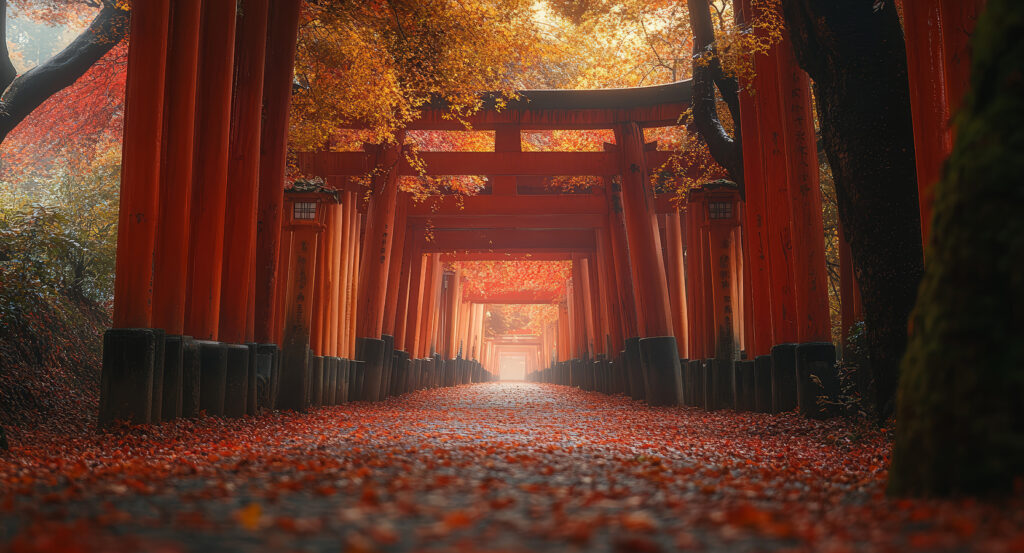
Why Fushimi Inari Taisha matters.
Fushimi Inari Taisha (Fushimi Inari Shrine) in Kyoto is one of Japan's most sacred and cinematic landmarks, a mountain of vermilion gates where spirituality and symbolism intertwine beneath the forest canopy.
Dedicated to Inari, the Shinto god of rice, prosperity, and good fortune, this shrine has captivated pilgrims and travelers alike for centuries. From the moment you pass beneath its first towering torii, a sense of transformation begins. Thousands of these gates, each donated by individuals or businesses seeking blessings, line the serpentine path that winds up Mount Inari. The repetition of color, form, and rhythm creates an almost hypnotic passage, a journey through devotion itself. As sunlight filters through the lacquered wood, it paints the path in shifting shades of gold and red, as if the mountain itself were alive with energy. Stone fox statues, or kitsune, appear throughout, messengers of Inari, often holding keys to rice granaries in their mouths, symbols of abundance and protection. The further you climb, the quieter it becomes, until the sound of the city fades completely. Here, among mossy shrines and whispering pines, Fushimi Inari becomes what it truly is: a place not just to see, but to feel, a sacred rhythm between human prayer and the patience of the earth.
What defines Fushimi Inari Taisha.
Fushimi Inari is Kyoto's oldest and most visited shrine, yet its meaning runs far deeper than the beauty of its gates.
It was founded in 711 A.D., long before Kyoto became Japan's imperial capital, and has served as the head shrine for thousands of smaller Inari sanctuaries across the nation. The famous senbon torii, “thousands of gates”, began appearing during the Edo period, each one inscribed with the name of its donor and the date of dedication. Today, more than 10,000 gates climb the mountain in tiers, symbolizing gratitude and renewal. The ascent to the summit, 4 kilometers long, is a spiritual pilgrimage that passes through sub-shrines, tea houses, and tranquil lookouts. The smaller shrines scattered along the way often house miniature torii left by worshippers, personal prayers left in tangible form. Beyond rice and commerce, Inari's protection extends to agriculture, industry, and creativity itself, making this shrine an emblem of human perseverance. The architecture, too, reflects layers of devotion, from the grand Romon Gate, built in the 16th century by the samurai Toyotomi Hideyoshi, to the intimate Okusha Hohaisho halfway up the mountain, where worshippers offer thanks before continuing their climb. Few realize that the shrine's vermilion pigment has a practical purpose: it contains mercury oxide, once believed to ward off decay and evil. This balance of spiritual and practical, myth and material, defines Fushimi Inari's enduring legacy as a place where prayer meets the tangible world.
How Fushimi Inari Taisha fits.
To experience Fushimi Inari in Kyoto as more than a photo stop, you have to walk it, slowly, deliberately, and with openness to what unfolds along the way.
Start early, ideally at sunrise, when the light ignites the torii in warm hues and the crowds have yet to gather. Enter through the Romon Gate and take a moment at the main hall to make a small offering or ring the bell in gratitude before beginning your ascent. The lower paths are the most photographed, but as you continue upward past the Yotsutsuji intersection, the path narrows and the energy shifts. Here, the forest grows denser, and the sound of cicadas replaces the chatter of visitors. Pause at the small tea house overlooking Kyoto, a view that reveals both the city's expanse and the spiritual height you've reached. If you climb all the way to the summit at the Ichinomine shrine, you'll find rows of miniature torii, offerings left by pilgrims who've completed their journey. Descending, take time to notice the details you missed, the weathered inscriptions, the moss clinging to stone, the quiet rhythm of footsteps echoing through the gates. Nearby, the Fushimi district offers another layer of tradition, with sake breweries and local eateries where you can unwind over kitsune udon, noodles topped with sweet fried tofu, said to be a favorite of Inari's fox spirits. Visiting Fushimi Inari isn't just an act of sightseeing; it's a discussion between body and spirit, where every step upward feels like a prayer, and every glance back reminds you that beauty, like faith, is something you walk toward, one gate at a time.
Where your story begins.
Foresyte Travel reveals places that feel extraordinary long before you arrive.
Enjoy editorial crafted for luxury travelers.
Foresyte may earn a commission when you book.

















































































































