Top places to stay in Chicago, Illinois.
Chicago established a commanding tradition of American hospitality through Great Lakes commerce, the expansion of transcontinental railroads, and the architectural ambition that followed the Great Fire of 1871, becoming a center of grand urban luxury, international conventions, and influential modern design. Established as a trading settlement near the southwestern shore of Lake Michigan, Chicago developed around the strategic connection between the Great Lakes and the Mississippi River watershed, attracting merchants, industrialists, and travelers whose activities supported an expanding network of inns and commercial hotels. The completion of the Illinois and Michigan Canal in 1848 and the rapid expansion of railway transportation established Chicago as a major national distribution center, creating substantial demand for accommodation among commercial travelers, manufacturers, financiers, and international visitors. The Great Chicago Fire of 1871 destroyed much of the central business district, initiating an extraordinary period of reconstruction that encouraged experimentation with fire-resistant materials, steel-frame construction, and increasingly ambitious commercial architecture. The opening of the Palmer House in 1873, developed by entrepreneur Potter Palmer following the destruction of his original hotel, established a prestigious institution within the rebuilt downtown and contributed to the emergence of State Street as a center of metropolitan commerce. The World's Columbian Exposition of 1893 accelerated hotel construction and international tourism, attracting millions of visitors to an architectural performance whose expansive exhibition buildings strengthened Chicago's reputation as a center of American urban innovation. The opening of the Auditorium Building in 1889, designed by Dankmar Adler and Louis Sullivan, introduced an extraordinary combination of theater, offices, and hotel accommodation, demonstrating the potential of large-scale mixed-use development within the expanding commercial center. The Blackstone Hotel, completed in 1910 to designs by Marshall and Fox, established another prestigious institution along Michigan Avenue, attracting political leaders, performers, and prominent figures associated with the city's commercial and cultural institutions. The opening of the Drake Hotel in 1920, also designed by Marshall and Fox, reinforced the emergence of North Michigan Avenue as a fashionable hospitality corridor connecting the commercial district with the prestigious residential neighborhoods surrounding Lake Michigan. The completion of the Stevens Hotel in 1927, subsequently renamed the Conrad Hilton and later the Hilton Chicago, introduced one of the world's largest hotel developments, reflecting Chicago's importance as a destination for national conventions and major commercial gatherings. The opening of the original Allerton Hotel in 1924 and the completion of the InterContinental Chicago building in 1929 contributed to the architectural character of the Grand Mile through substantial high-rise structures incorporating elaborate decorative programs and distinctive silhouettes. During the twentieth century, Chicago's position as a center of finance, manufacturing, transportation, and professional conventions supported a substantial concentration of grand hotels near the Loop, Michigan Avenue, and the city's principal railway terminals. The transformation of the former IBM Building into The Langham, Chicago in 2013 introduced contemporary luxury accommodation within a landmark modernist skyscraper designed by Ludwig Mies van der Rohe. The subsequent restoration of historic commercial towers and development of architecturally ambitious riverfront properties extended Chicago's hospitality landscape into a new generation of urban landmarks, preserving the city's longstanding relationship between architectural innovation, commercial prosperity, and prestigious metropolitan accommodation.
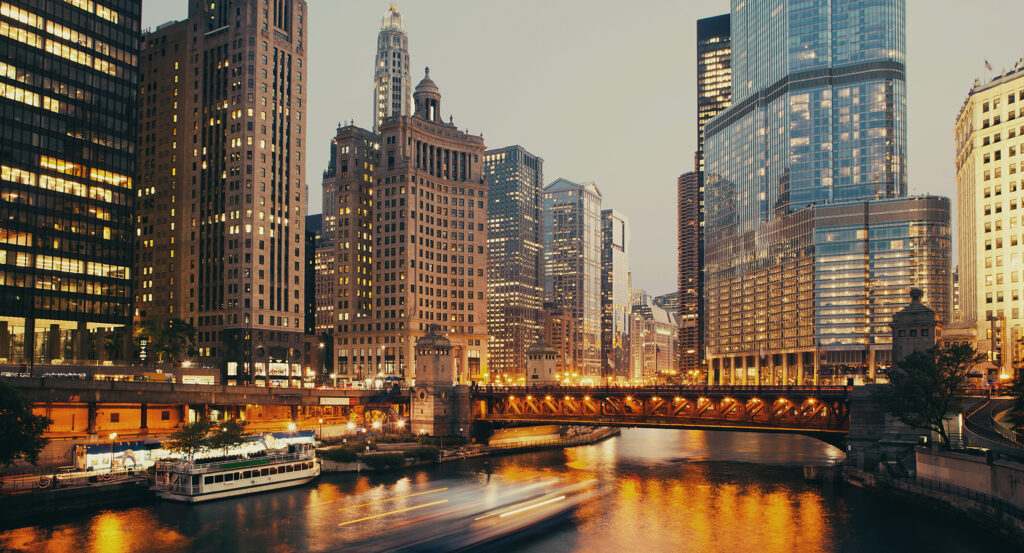
Chicago's hotels mirror the historic concentration of commercial activity within the Loop, the development of Michigan Avenue as an expansive cultural and retail corridor, and the transformation of former industrial waterfront districts into contemporary residential and hospitality neighborhoods. The Loop occupies the architectural and commercial center of this landscape, where substantial hotels stand among historic skyscrapers, expansive theaters, and the financial institutions surrounding LaSalle Street and State Street. The district's built environment incorporates early steel-frame commercial structures, Chicago School office buildings, Beaux-Arts landmarks, and substantial twentieth-century towers, creating an accommodation setting closely connected to the city's architectural inheritance. The Palmer House occupies a prominent position near State Street and Monroe Street, with its richly decorated interiors and substantial commercial surroundings reflecting the prosperity of Chicago's historic retail district. The adjoining streets surrounding Millennium Park and the Art Institute of Chicago support prestigious hotels overlooking landscaped public spaces and the expansive cultural institutions of Grant Park. The Chicago Athletic Association Hotel occupies a restored 1893 building designed by Henry Ives Cobb, whose Venetian Gothic façade and historic club interiors contribute an unusually distinctive architectural setting overlooking Millennium Park. North of the Chicago River, the Grand Mile developed along North Michigan Avenue as the city's principal luxury shopping and hospitality corridor, where grand hotels and contemporary properties occupy substantial buildings near international fashion houses, department stores, and major cultural institutions. The southern portion of the avenue combines historic commercial landmarks with modern high-rise architecture, including the former Medinah Athletic Club building occupied by InterContinental Chicago Grand Mile, whose elaborate decorative program reflects the architectural eclecticism of the late 1920s. Farther north, the Gold Coast developed as a prestigious residential district during the late nineteenth century, when affluent families established substantial mansions and apartment buildings along the streets surrounding Lake Michigan. The Drake Hotel occupies a distinguished position near Oak Street Beach, connecting the expansive architecture of North Michigan Avenue with the residential elegance of the neighboring Gold Coast. The surrounding streets retain historic townhouses, prewar apartment buildings, and established luxury properties associated with Chicago's commercial and social elite. River North developed from a district of warehouses, manufacturing buildings, and commercial premises into a concentration of contemporary hotels, restaurants, galleries, and design institutions, with substantial properties occupying former industrial structures and modern towers near the Chicago River. The adjoining riverfront districts surrounding Wacker Drive combine expansive office architecture with prestigious waterfront accommodation, including hotels overlooking the bridges, promenades, and architectural landmarks of the Chicago Riverwalk. Streeterville developed through the transformation of former lakeshore land into a densely built residential and commercial neighborhood, supporting luxury hotels near Navy Pier, Northwestern Memorial Hospital, and the cultural institutions surrounding the eastern end of Michigan Avenue. South of the Loop, the South Loop preserves a substantial concentration of historic printing houses, commercial warehouses, and former industrial buildings, creating a contrasting accommodation environment near Museum Campus and the southern approaches to Grant Park. The historic Prairie Avenue district retains architectural associations with Chicago's nineteenth-century industrial fortunes, whose substantial residential commissions contributed to the development of the surrounding neighborhoods. Farther west, Fulton Market and the West Loop developed from wholesale food distribution and manufacturing districts into internationally recognized centers of contemporary dining, design, and commercial development. Former meatpacking buildings, brick warehouses, and industrial structures provide distinctive settings for boutique hotels and contemporary accommodations integrated into the neighborhood's expanding restaurant and creative communities. Wicker Park and Bucktown contribute a more intimate residential environment through their historic commercial streets, substantial nineteenth-century houses, and independent cultural institutions, supporting smaller design-oriented properties within established neighborhoods. Hyde Park presents a separate hospitality geography on the South Side through its relationship with the University of Chicago, the Museum of Science and Industry, and the architectural legacy of the World's Columbian Exposition, with accommodations connected to academic institutions and the landscaped environment surrounding Jackson Park. These geographic distinctions establish a hospitality landscape extending from expansive Loop hotels and prestigious Michigan Avenue landmarks to restored athletic clubs, industrial warehouse conversions, contemporary riverfront properties, and neighborhood-oriented accommodations within Chicago's architecturally diverse urban fabric. Foresyte may earn a commission when you book.
Foresyte Travel's top five choices.
5. The Ritz-Carlton, Chicago
The Ritz-Carlton, Chicago occupies Water Tower Place, the transformative 1975 mixed-use development that helped redirect high-end retail and residential activity toward North Michigan Avenue. Architect Edward D. Dart designed the immense reinforced-concrete tower above a vertical shopping center, and the complex became the tallest reinforced-concrete building in the world upon completion. The hotel opened as part of this unusual combination of hospitality, residences and multilevel retail, embedding it within a project that materially altered the commercial trajectory of the Grand Mile. Water Tower Place gives The Ritz-Carlton a direct place in Chicago's postwar urban history, when ambitious mixed-use construction helped strengthen North Michigan Avenue as one of the country's principal metropolitan shopping corridors.
4. Waldorf Astoria Chicago
Waldorf Astoria Chicago originated as the Elysian, a $280 million hotel and residential development conceived by David Pisor for the Gold Coast and designed by Chicago architect Lucien Lagrange. Lagrange drew from the grand residential architecture of 1920s Paris, composing a limestone-clad tower around colonnades, spires and a cobblestone motor court that extends the European architectural character long associated with the surrounding neighborhood. The property opened as the Elysian in 2009 before an investment group acquired it and Hilton converted the hotel to the Waldorf Astoria name in 2012, ending plans to develop Elysian into a broader hospitality brand. That succession transformed an independent Chicago luxury venture into the city's expression of Hilton's historic Waldorf Astoria portfolio while preserving Lagrange's distinctly residential conception.
3. Four Seasons Hotel Chicago
Four Seasons Hotel Chicago occupies the upper portion of 900 North Michigan Avenue, the 66-story mixed-use tower completed in 1988 by Kohn Pedersen Fox and Perkins & Will during a major period of vertical development along the Grand Mile. KPF stacked retail, offices, hotel functions and residences within a single composition whose six-story shopping atrium rises toward the hotel's principal arrival level. Four Seasons opened the property in 1989 during the company's expanding American presence, establishing its Chicago address inside a building conceived from inception as an unusually complex vertical city. The hotel forms part of an important late-twentieth-century chapter in North Michigan Avenue's development, when large mixed-use towers extended Chicago's architectural tradition through increasingly intricate combinations of commercial, residential and hospitality functions.
2. The Langham, Chicago
The Langham, Chicago occupies the lower floors of the former IBM Building, the final American skyscraper designed by Ludwig Mies van der Rohe and one of the culminating works of his career. IBM commissioned Mies in 1966, and the completed tower expressed his International Style principles through prismatic massing, black anodized aluminum, bronze-tinted glass and a structural system engineered for the substantial technological demands of the computer company. Chicago designated the building an official city landmark in 2008, followed by its addition to the National Register of Historic Places in 2010, before Mies's grandson Dirk Lohan oversaw the conversion of its lower floors for The Langham's 2013 opening. The adaptation placed contemporary hospitality inside a protected work of twentieth-century architecture while retaining the building's expansive riverfront plaza, glass-enclosed lobby and disciplined Miesian structure.
1. The Peninsula Chicago
The Peninsula Chicago became Hongkong and Shanghai Hotels' third United States property when it opened just off North Michigan Avenue in 2001, extending a hotel lineage rooted in the 1928 Peninsula Hong Kong into the American Midwest. Elkus Manfredi Architects designed the purpose-built hotel above an existing retail podium, drawing elements of its massing from the Hong Kong flagship through projecting wings, a central tower composition and an elevated two-story arrival lobby. BAMO developed the interiors as the project translated Peninsula's Asian institutional character into a new Chicago building, supported by a development investment of $150 million. The opening gave one of Asia's oldest hotel companies a permanent architectural presence on the Grand Mile and completed a significant stage of its American expansion following New York and Beverly Hills.
Where your story begins.
Foresyte Travel reveals places that feel extraordinary long before you arrive.
Enjoy editorial crafted for luxury travelers.
Foresyte may earn a commission when you book.