Why Four Seasons Hotel Chicago matters.
Four Seasons Hotel Chicago is a distinguished hotel where the Gold Coast's residential prestige meets Kohn Pedersen Fox's pioneering vertical mixed-use architecture, placing the hotel high within 900 North Michigan beneath the tower's illuminated crown and above one of the Grand Mile's defining commercial complexes.
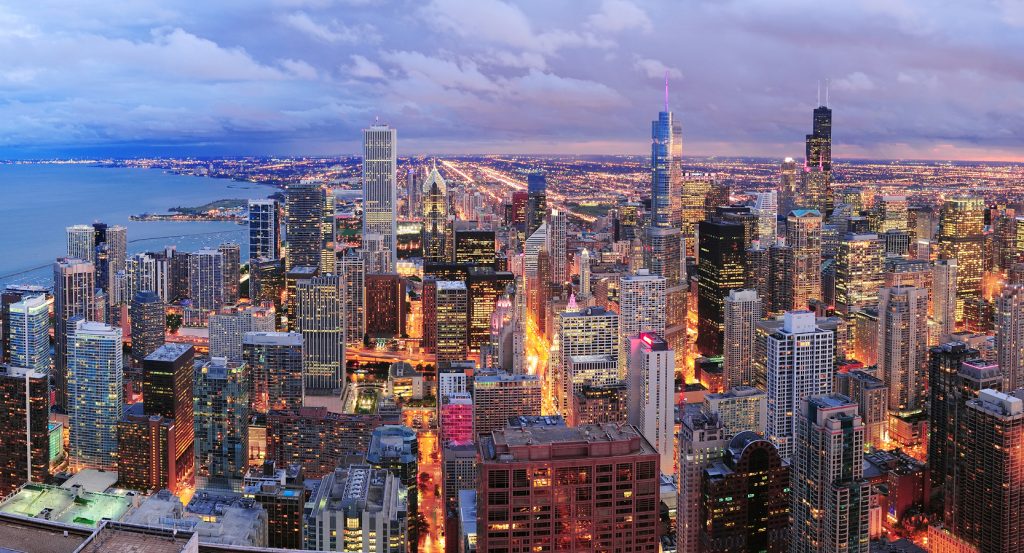
Set along East Delaware Place near North Michigan Avenue and just steps from Seneca Park, the hotel occupies the Gold Coast's southeastern threshold between Michigan Avenue's retail corridor, Delaware Place's residential towers and the high-rise blocks extending east toward Lake Shore Drive and Lake Michigan. Cream limestone and green-tinted glass organize 900 North Michigan through an expansive base, vertically striated middle and four illuminated corner pavilions that give the tower a recognizable crown. Hotel interiors occupy elevated levels within the mixed-use structure, lifting principal outlooks above neighboring buildings toward Lake Michigan and the dense skyline surrounding North Michigan Avenue. Arrival unfolds vertically through the building, separating the street-level entrance from principal hotel spaces positioned high above the retail complex and reinforcing the skyscraper's deliberate stacking of distinct functions. The result is a hotel whose elevated position, framed lake views and integration into a landmark mixed-use tower make vertical movement through Chicago fundamental to its physical character.
What defines Four Seasons Hotel Chicago.
Four Seasons Hotel Chicago is best known for opening in March 1989 within 900 North Michigan Avenue, the 66-story skyscraper that became an influential early demonstration of large-scale vertical mixed-use development. Urban Investment & Development Company commissioned the complex, and Kohn Pedersen Fox designed it with Perkins & Will as associate architect. Completed in 1988, the project stacked a major retail center, offices, hotel accommodations and private residences within a single 871-foot composition on the Grand Mile. KPF organized the exterior into a clearly articulated base, middle and crown, drawing from the Chicago frame and Chicago window as historical precedents for the tower's postmodern architecture. Four illuminated corner pavilions terminate the structure, giving the enormous mixed-use building a distinctive nighttime silhouette above the northern portion of Michigan Avenue. The hotel opened the following spring as Four Seasons accelerated its American expansion and increasingly pursued management roles inside mixed-use developments. Its position inside 900 North Michigan connected that corporate strategy with a building KPF subsequently recognized as an early prototype for vertically combining otherwise independent urban functions. AAA awarded the hotel Five Diamond status beginning in 1990, establishing a sustained luxury recognition almost immediately after opening. Mobil Travel Guide, the predecessor of Forbes Travel Guide, elevated the property to Five-Star status in 1996, giving the hotel another major distinction during its first decade. The hotel subsequently passed its thirtieth anniversary still operating under the same Four Seasons character established at opening, an unusual continuity within a downtown lodging market characterized by frequent rebranding. Four Seasons Hotel Chicago links the late-1980s American expansion of Four Seasons with a Chicago skyscraper that helped demonstrate how retail, offices, lodging and residences could function as separate destinations within one vertically integrated development.
Rottet Studio reshaped the hotel's contemporary design through its largest reconstruction since opening, beginning in November 2019 and ultimately extending through completion of the pool and spa program in 2023. Lauren Rottet and Richard Riveire directed a brighter composition across 23,000 square feet of principal public areas, replacing the darker chocolate, cream and rosewood palette associated with earlier generations of the property. Gray and white marble established the renewed lobby floor, with walls removed to create a broader Grand Hall connecting reception, social areas, meeting spaces and the stair ascending toward the ballroom. Unit Five Studio suspended 5,000 gold-tinted aluminum leaves overhead, creating a large reflective installation whose shifting surfaces respond to daylight and movement through the room. Shashi Caudill assembled artwork for the renewed interiors, adding a curated visual layer to the marble, pale woods and reflective metals developed across the public spaces. Adorn emerged from the reconstruction with 23-foot windows, raised ceilings and a white, beige and sea-blue palette derived from the colors visible toward Lake Michigan. A chandelier assembled from 1,000 pieces of glass anchors the restaurant bar, introducing another concentrated field of reflected light within the seventh-floor composition. McHugh Construction executed the yearlong principal reconstruction, and GI Stone sourced and installed 20,000 square feet of stone, including material selected from an Italian quarry to match the existing grand staircase. Rottet Studio continued the transformation into the wellness floors, completing the redesigned pool and spa in June 2023 and bringing the multiyear program to its final major phase. Interior Design recognized the renewed property with its 2022 Best of Year award for Domestic Chain Hotel, giving the extensive reconstruction a major design distinction more than three decades after the hotel first opened.
How Four Seasons Hotel Chicago fits.
Four Seasons Hotel Chicago works as the anchor for an outing connecting a Prairie School residence shaped by Frank Lloyd Wright's early experimentation, a nineteenth-century mansion preserving Chicago's elite domestic culture and a lakefront institution created to advance the study of Latin American art.
Begin at Emil Bach House, designed by Frank Lloyd Wright in 1915 for Emil Bach, president of Chicago's Bach Brick Company. Wright conceived the compact residence late in his Prairie period, organizing the structure around geometric masses, horizontal planes and a carefully controlled relationship between interior rooms and enclosed exterior gardens. The house belongs to a small group of Wright residences built after his return from Europe and demonstrates his movement toward increasingly abstract geometric compositions. Chicago designated the property a municipal landmark in 1977, and a later restoration recovered the architectural clarity of Wright's original design after decades of alteration. Continue to Clarke-Ford House Museum, built in 1836 for merchant Henry B. Clarke and his wife Caroline. The Greek Revival residence survived multiple relocations as Chicago expanded around it, preserving a domestic structure erected when the city was still in its earliest period of urban development. Bishop Louis Henry Ford and his family later occupied the house, adding another significant chapter to a building whose history spans radically different periods of Chicago life. Its surviving interiors and collections connect early settlement, nineteenth-century domestic culture and Black religious leadership within a single historic residence. Conclude at National Museum of Mexican Art, founded by educator and cultural advocate Carlos Tortolero in 1982 and opened in Harrison Park in 1987. The institution developed one of the country's largest collections devoted to Mexican art, encompassing ancient traditions, folk practices, modernism and contemporary work across both sides of the United States-Mexico border. Artists represented across its holdings extend from major twentieth-century figures to Chicano and contemporary creators whose work broadens conventional definitions of Mexican art. Free admission and extensive cultural programming established the museum as both a major collecting institution and an enduring component of Pilsen's artistic life. The progression moves from Emil Bach House's disciplined Prairie School geometry through Clarke-Ford House Museum's survival across nearly two centuries of Chicago development and culminates at National Museum of Mexican Art, where an institution founded in the 1980s built an expansive permanent home for Mexican and Mexican American artistic production.
Where your story begins.
Foresyte Travel reveals places that feel extraordinary long before you arrive.
Enjoy editorial crafted for luxury travelers.
Foresyte may earn a commission when you book.