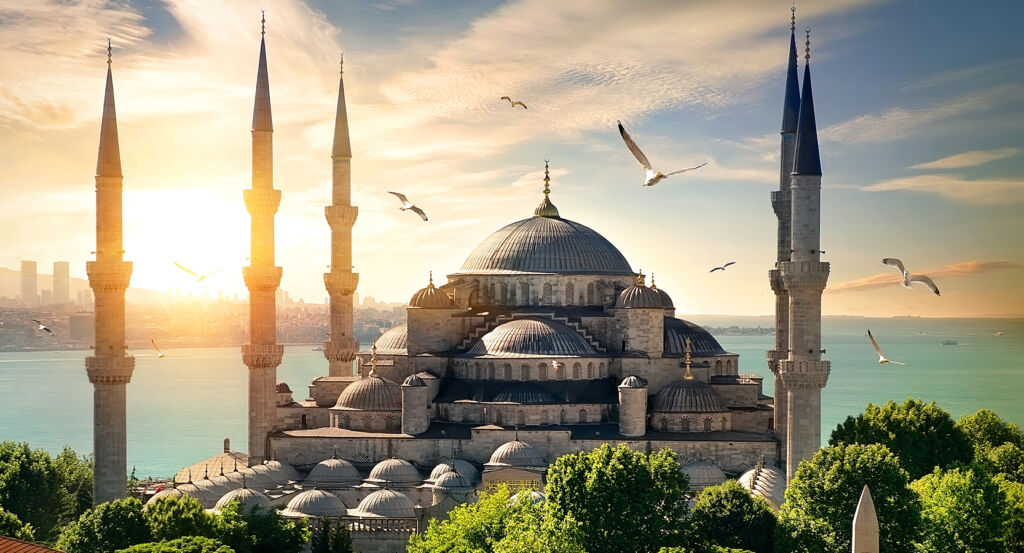
Perfect weekend in Istanbul, Türkiye.
Istanbul's position between Europe and Asia shaped more than two millennia of imperial government, maritime commerce, religious scholarship, and cultural exchange, establishing the city as one of the most historically consequential centers of the Mediterranean world. Situated along the Bosphorus, where the Black Sea connects with the Sea of Marmara, the settlement originated as the Greek colony of Byzantion during the seventh century BCE. Its strategic location attracted successive powers, including the Roman Empire, whose emperor Constantine I transformed the city into an imperial capital in 330 CE. Renamed Constantinople, it became the political and religious center of the Eastern Roman Empire, supporting extraordinary developments in Byzantine architecture, theology, and administration. The reign of Justinian I during the sixth century brought extensive imperial construction and the codification of Roman law, strengthening Constantinople's influence throughout the Mediterranean. The Fourth Crusade resulted in the city's capture and extensive plundering in 1204, followed by the restoration of Byzantine government in 1261. Ottoman forces under Sultan Mehmed II conquered Constantinople in 1453, beginning a new imperial era that transformed its political institutions, religious landscape, and commercial relationships. Under Süleyman the Magnificent, the Ottoman Empire reached a period of exceptional territorial expansion and architectural patronage, with the imperial architect Mimar Sinan developing an influential body of religious and civic buildings. The dissolution of the Ottoman Empire following the First World War and the establishment of the Republic of Turkey in 1923 transferred national political authority to Ankara. Istanbul nevertheless retained its importance as Turkey's principal commercial metropolis and an international center of historical preservation, scholarship, and cultural production.
Istanbul's cultural inheritance encompasses Byzantine mosaics, Ottoman calligraphy, classical music, literary innovation, and a culinary tradition shaped by centuries of exchange across three continents. The Istanbul Archaeological Museums preserve extensive collections of ancient sculpture, ceramics, inscriptions, and archaeological objects associated with civilizations throughout Anatolia and the eastern Mediterranean. The Museum of Turkish and Islamic Arts houses important examples of Islamic calligraphy, illuminated manuscripts, textiles, and decorative craftsmanship, including historical carpets produced across Anatolia and neighboring regions. Ottoman court culture supported distinguished traditions of miniature painting, manuscript illumination, ceramics, and architectural decoration, with İznik tile production achieving international recognition during the sixteenth and seventeenth centuries. Istanbul's literary heritage includes the novelist Orhan Pamuk, whose works examine the city's historical transformations, personal memory, and relationships between Ottoman traditions and modern Turkish society. The Istanbul Music Festival, established in 1973, became an important institution for classical performance, bringing international orchestras, soloists, and chamber ensembles to the city. Turkish culinary traditions draw upon Anatolian agriculture, Black Sea seafood, Aegean olive oil, and the culinary practices of communities once connected through the Ottoman Empire. Specialties including hünkar beğendi, imam bayıldı, traditional meze, and regional kebabs demonstrate the influence of palace cooking and domestic traditions. The city's confectionery heritage encompasses baklava, lokum, and milk-based desserts, accompanied by longstanding customs surrounding Turkish coffee and tea. A perfect weekend in Istanbul brings together Byzantine and Ottoman history, diverse waterfront neighborhoods, centuries of cultural patronage, and the exceptional gastronomy of a metropolis connecting Europe and Asia.
Three day itinerary.
Day 1: Hagia Sophia
Hagia Sophia is best known for transforming the architectural possibilities of the late Roman world through the immense domed church commissioned by Emperor Justinian I. Anthemius of Tralles and Isidore of Miletus designed the sixth-century structure around a central dome carried through pendentives onto massive supporting piers, creating an interior whose scale exceeded earlier Byzantine churches. Justinian dedicated the building in 537, establishing it as the principal cathedral of Constantinople and a ceremonial center of the Byzantine Empire. Ottoman forces captured Constantinople under Mehmed II in 1453, after which Hagia Sophia became an imperial mosque and acquired minarets, Islamic calligraphy, and successive architectural reinforcements. Mimar Sinan strengthened the structure during the Ottoman period, extending its influence into the development of imperial mosque architecture. Hagia Sophia captures nearly fifteen centuries of Byzantine engineering, Orthodox Christianity, Ottoman conquest, Islamic architecture, and the political history of Istanbul.
Day 1: Neolokal
Neolokal is best known for Maksut Aşkar's reinterpretation of Anatolian culinary traditions through ingredients, techniques, and foodways threatened by changing patterns of agriculture and consumption. Aşkar built the restaurant around the regional diversity of Türkiye, drawing from grains, vegetables, dairy, seafood, meat, fermentation, and preservation traditions developed across Anatolia. Historical preparations enter the kitchen as foundations for contemporary dishes whose structure preserves connections to producers and regional communities. Neolokal occupies SALT Galata within the former Ottoman Bank headquarters, joining its culinary exploration of Turkish inheritance to a building deeply connected with the economic transformation of the late Ottoman Empire. The restaurant established Aşkar as one of Istanbul's central figures in the movement to carry Anatolian food traditions into contemporary fine dining.
Day 2: Topkapı Palace
Topkapı Palace is best known for serving as the administrative and dynastic center of the Ottoman Empire during the centuries when its power expanded across southeastern Europe, western Asia, and North Africa. Mehmed II began constructing the palace after the conquest of Constantinople, establishing an imperial precinct on the promontory overlooking the Bosphorus, Golden Horn, and Sea of Marmara. Successive sultans expanded its courtyards, council chambers, kitchens, treasuries, pavilions, and private apartments as Ottoman government developed around the palace household. The Imperial Council conducted state affairs within the complex, and the Harem became a highly structured institution tied directly to dynastic succession and court politics. Collections of manuscripts, arms, porcelain, jewels, ceremonial objects, and sacred relics accumulated through conquest, diplomacy, patronage, and imperial ceremony. Topkapı physically organized the government, household, wealth, and ritual authority of one of the early modern world's most powerful empires.
Day 2: Pandeli
Pandeli is best known for preserving Istanbul's historic restaurant culture above the Spice Bazaar in Eminönü. The restaurant grew from the work of Pandeli Çobanoğlu, an Anatolian Greek who arrived in Istanbul around the beginning of the twentieth century and developed a reputation through his cooking before establishing the dining room associated with his name. Turquoise İznik-style tiles cover the vaulted interior, creating one of the city's most recognizable historic restaurant spaces above the market's dense commercial passages. Eggplant, lamb, seafood, vegetables, pastries, and preparations drawing from Ottoman, Greek, and Turkish traditions give the kitchen a culinary foundation shaped by Istanbul's former cosmopolitan communities. Pandeli survived enormous political and demographic changes around the old imperial capital, preserving a rare connection between the city's market culture and its twentieth-century restaurant history.
Day 2: The Blue Mosque
The Blue Mosque is best known for the six minarets and immense cascade of domes that established one of the supreme architectural statements of the Ottoman capital. Sultan Ahmed I commissioned the mosque during the early seventeenth century, entrusting its design to Sedefkâr Mehmed Agha, a pupil within the architectural tradition established by Mimar Sinan. The complex rose opposite Hagia Sophia beside the former Byzantine Hippodrome, placing Ottoman imperial architecture in deliberate proximity to the grand inheritance of Constantinople. Thousands of İznik tiles cover the interior with floral and geometric patterns dominated by blue, turquoise, and green. A vast central dome, semidomes, piers, windows, courtyards, and subsidiary structures organized worship and charitable functions on an imperial scale. The mosque represents the mature synthesis of Ottoman engineering, İznik ceramic production, royal patronage, and Istanbul's centuries-long architectural engagement with Hagia Sophia.
Day 2: TURK FATİH TUTAK
TURK FATIH TUTAK is best known for Fatih Tutak's ambitious reconstruction of Turkish culinary memory through contemporary fine-dining technique. Tutak developed his career across international kitchens before returning to Türkiye and making the foods of Anatolia the central subject of his flagship restaurant. Fermentation, fire, preservation, dairy, grains, seafood, vegetables, and preparations rooted in regional households provide the technical and cultural foundations for his tasting menus. Individual dishes draw strength from Turkish food traditions without reducing them to static reproductions, allowing ingredients and methods associated with different regions to enter a highly controlled modern format. The restaurant occupies the summit of Istanbul's contemporary fine-dining hierarchy and has become a major international expression of Türkiye's extraordinary regional culinary depth.
Day 3: Seraf Vadi
Seraf Vadi is best known for treating Anatolian regional cooking as a serious culinary discipline built around traditional ingredients, patient preparation, and the immense geographical diversity of Türkiye. The kitchen draws from recipes and products associated with southeastern, eastern, central, and western Anatolia, giving grains, pulses, vegetables, yogurt, meat, spices, breads, and preserved ingredients substantial cultural specificity. Long cooking, wood fire, fermentation, stone ovens, and techniques associated with domestic and regional kitchens provide the food with a foundation extending beyond metropolitan Istanbul. Breakfast traditions occupy an especially rich place within Turkish food culture through cheeses, olives, breads, eggs, preserves, honey, vegetables, and dairy products produced across distinct landscapes. Seraf gives that agricultural and regional inheritance a polished Istanbul setting, connecting the modern metropolis with the food traditions of Anatolia.
Day 3: Basilica Cistern
Basilica Cistern is best known for transforming Roman engineering into an immense subterranean reservoir beneath the historic center of Constantinople. Justinian I commissioned the cistern during the sixth century as part of the water infrastructure supplying the Great Palace and surrounding imperial district. Hundreds of marble columns support brick vaults above a chamber capable of storing vast quantities of water delivered through aqueduct systems extending beyond the city. Builders reused architectural material from earlier Roman structures, producing variations in column shafts and capitals across the interior. Two grand Medusa heads were incorporated as column bases, demonstrating the pragmatic reuse of ancient sculptural material within Byzantine construction. The cistern exposes the hydraulic infrastructure beneath imperial Constantinople, revealing the engineering systems that sustained a densely populated capital behind its celebrated churches, palaces, and fortifications.
Day 3: Grand Bazaar
Grand Bazaar is best known for developing into one of the great covered commercial complexes of the Ottoman world from the mercantile institutions established after the conquest of Constantinople. Mehmed II created a bedesten near the center of the new Ottoman capital to concentrate trade in valuable textiles and goods, providing the nucleus around which surrounding streets and markets expanded. Additional hans, workshops, covered lanes, and specialized trading areas progressively created an immense commercial district populated by merchants and artisans. Jewelry, carpets, textiles, metalwork, leather, ceramics, spices, and other goods circulated through networks connecting Istanbul with Anatolia, the Balkans, the Mediterranean, the Black Sea, and Asian trade routes. Fires and earthquakes repeatedly damaged the market, prompting reconstruction across successive Ottoman periods. The Grand Bazaar preserves the spatial organization of commerce that helped make Istanbul one of the principal trading capitals between Europe and Asia.
Day 3: Arkestra
Arkestra is best known for Cenk Debensason's cosmopolitan cooking within a restored villa in Etiler. Debensason developed his culinary career abroad before returning to Istanbul with an approach shaped by French technique and the international restaurant culture of major European cities. Seafood, meat, vegetables, fermentation, sauces, and ingredients carrying Asian and European influences enter compositions defined by technical precision and concentrated flavor. The restaurant extends beyond the dining room into a broader creative environment built around food, music, and design, giving the property an unusually distinctive position within contemporary Istanbul. Arkestra's rise into the MICHELIN-recognized upper tier established Debensason among the chefs driving Istanbul's modern culinary expansion beyond the historic peninsula and Bosphorus dining traditions.
Where your story begins.
Foresyte Travel reveals places that feel extraordinary long before you arrive.
Enjoy editorial crafted for luxury travelers.
Foresyte may earn a commission when you book.