
Why Hagia Sophia Grand Mosque matters.
Hagia Sophia Grand Mosque is a sixth-century domed sanctuary where Sultanahmet's imperial heritage meets the architectural ambitions of Justinian I, the religious institutions of Byzantine Constantinople and the Ottoman transformations that shaped Istanbul's sacred architecture.
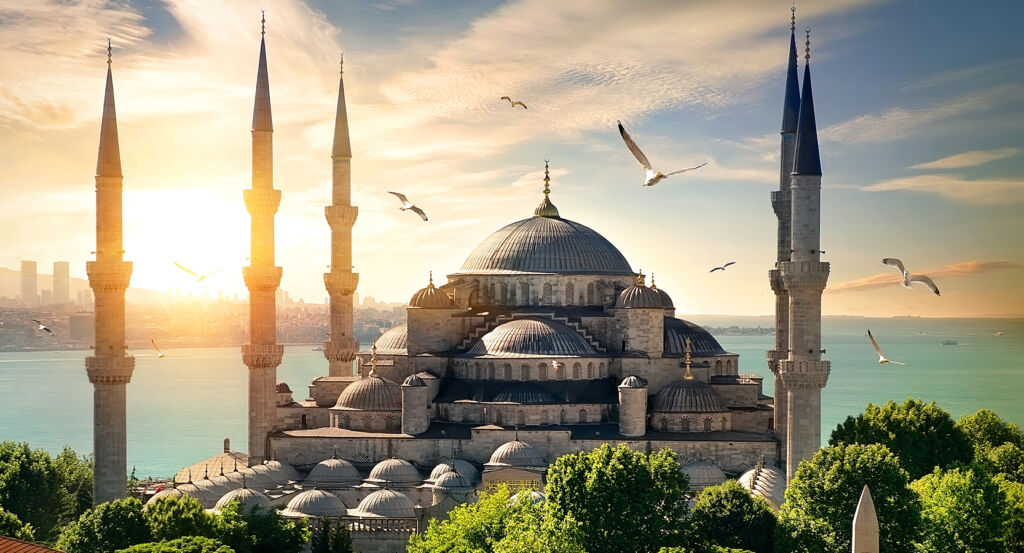
Standing on the eastern side of Sultanahmet Square above the southern approaches to the Golden Horn, the mosque occupies a raised historic precinct between the former Byzantine ceremonial center and the descending streets of Cankurtaran, where its central dome and four Ottoman minarets define the surrounding masonry buildings. Massive exterior buttresses support the principal structure, whose brick walls and stone additions preserve successive construction campaigns. Semidomes descend from the central roofline, creating a stepped architectural composition above the surrounding courtyards. Imperial tombs, fountains and ancillary religious buildings occupy portions of the adjoining enclosure. The result is a religious complex whose physical fabric preserves the transition between Byzantine imperial Christianity and Ottoman Islamic patronage.
What defines Hagia Sophia Grand Mosque.
Hagia Sophia Grand Mosque is best known for its immense sixth-century dome and its successive functions as a Byzantine cathedral, Ottoman imperial mosque, museum and mosque. The site previously contained a church commissioned under Constantius II and dedicated in 360. That building was destroyed during disturbances in 404, prompting a replacement completed under Theodosius II in 415. The second church was destroyed during the Nika revolt of January 532, when unrest threatened the reign of Emperor Justinian I. Justinian commissioned an entirely new sanctuary, appointing Anthemius of Tralles and Isidore of Miletus to develop an architectural design of exceptional structural ambition. Construction began in 532, employing extensive imperial resources and craftsmen drawn from different regions of the Byzantine Empire. The church was consecrated on December 27, 537, establishing the principal cathedral of Constantinople. Its dome partially collapsed following earthquakes in the sixth century, and Isidore the Younger directed reconstruction that raised its profile and strengthened the supporting structure. Hagia Sophia became the ceremonial church of Byzantine emperors and the seat of the patriarch of Constantinople, placing it at the center of imperial religious authority. The Fourth Crusade brought the Latin occupation of Constantinople in 1204, during which the cathedral suffered extensive plunder and became a Latin Catholic church. Byzantine control returned in 1261, followed by restoration campaigns addressing structural deterioration and damaged decoration. Following the Ottoman conquest of Constantinople in 1453, Sultan Mehmed II converted the building into an imperial mosque. Ottoman rulers subsequently commissioned minarets, structural reinforcements and religious furnishings, adapting the sanctuary to Islamic worship. Sultan Selim II supported major stabilization work under architect Mimar Sinan during the sixteenth century. The Turkish Republic converted the building into a museum in 1935 following a cabinet decision issued in 1934. A presidential decree restored its designation as a mosque in 2020, and Muslim congregational worship resumed that July.
Anthemius of Tralles and Isidore of Miletus organized the sanctuary around a central dome carried by four immense piers and a system of arches and pendentives. The pendentives transfer the dome's circular base onto the square arrangement of its principal supports, allowing the central space to extend beneath an uninterrupted vaulted canopy. Forty windows encircle the dome's base, introducing daylight above the interior galleries and marble-covered walls. The main dome measures 31 meters in diameter, establishing a spatial arrangement that influenced subsequent Byzantine and Ottoman religious architecture. Eastern and western semidomes extend the central volume along the building's longitudinal axis, with smaller vaults distributing structural loads toward the perimeter. Marble revetments incorporate colored stone assembled into symmetrical panels, preserving the decorative ambitions of Justinian's imperial commission. Byzantine mosaics survive in several locations, including the apse image of the Virgin and Child and imperial portraits in the upper galleries. The Deësis mosaic depicts Christ accompanied by the Virgin Mary and John the Baptist, preserving a major example of late Byzantine religious art. Ottoman additions introduced a mihrab oriented toward Mecca, a minbar for sermons and a muezzin's platform associated with congregational prayer. Large circular calligraphic medallions bearing the names of Allah, Muhammad and prominent figures of early Islam were installed during nineteenth-century restoration work. The Fossati brothers directed that campaign under Sultan Abdülmecid I between 1847 and 1849, strengthening the structure and repairing decorative surfaces. The building's interior contains architectural and artistic contributions associated with both Byzantine Christianity and Ottoman Islam, preserving distinct religious traditions within a shared architectural enclosure.
How Hagia Sophia Grand Mosque fits.
Hagia Sophia Grand Mosque works as the Byzantine and Ottoman religious centerpiece for an Istanbul outing connecting imperial water infrastructure, archaeological collections and the ceremonial architecture of the historic peninsula.
Begin at Basilica Cistern, the subterranean reservoir constructed during the reign of Justinian I to supply water to Constantinople's imperial precinct. Its vaulted interior contains 336 marble columns arranged in twelve rows, supporting a substantial brick ceiling above the water basin. The columns incorporate capitals and shafts drawn from different architectural traditions, including reused elements associated with earlier Roman buildings. Two column bases carved with Medusa heads preserve examples of ancient sculpture incorporated into Byzantine infrastructure. Raised walkways provide access through the illuminated interior, revealing the engineering required to maintain the city's water supply. Continue to Istanbul Archaeological Museums, the institutional complex occupying historic buildings near the entrance to Gülhane Park. The museums developed during the nineteenth century as Ottoman authorities assembled archaeological collections associated with territories governed by the empire. Osman Hamdi Bey directed the institution's development and commissioned architect Alexandre Vallaury to design its principal neoclassical building. The collections contain the Alexander Sarcophagus, discovered at Sidon in 1887, alongside ancient sculpture, inscriptions and archaeological objects associated with Anatolia and the eastern Mediterranean. The complex also includes the Museum of the Ancient Orient and the Tiled Kiosk, preserving distinct architectural and archaeological collections. Conclude at Little Hagia Sophia Mosque, the former Church of Saints Sergius and Bacchus constructed during the sixth century under Justinian I. Its central octagonal space and surrounding ambulatory preserve an early Byzantine architectural arrangement associated with experiments in domed church construction. The building became a mosque during the Ottoman period, acquiring religious furnishings and architectural additions suited to Islamic worship. Its surviving interior incorporates marble columns, carved capitals and an inscription band associated with the original imperial dedication. The progression moves from Byzantine hydraulic engineering through the archaeological collections of the Ottoman capital and culminates at an early Justinianic sanctuary, connecting Hagia Sophia Grand Mosque with the infrastructure and religious architecture of imperial Constantinople.
Where your story begins.
Foresyte Travel reveals places that feel extraordinary long before you arrive.
Enjoy editorial crafted for luxury travelers.
Foresyte may earn a commission when you book.





































































































