
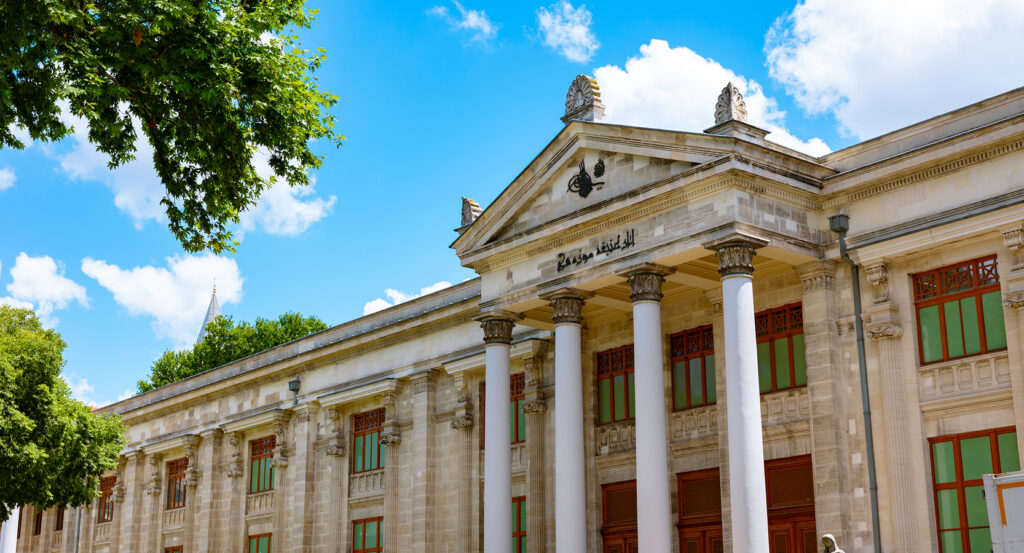
Why Istanbul Archaeological Museums matters.
Istanbul Archaeological Museums is a celebrated museum complex where Cankurtaran's imperial heritage, archaeological discovery, scholarly research, and the civilizations of the ancient world are preserved within one of the world's earliest purpose-built archaeology museums.
Set along Osman Hamdi Bey Yokuşu near Soğukçeşme Street and just steps from Topkapı Palace, this expansive museum complex unfolds through neoclassical galleries, sculpture halls, ancient sarcophagi, cuneiform tablets, and meticulously curated collections where the histories of Mesopotamia, Anatolia, Egypt, Greece, Rome, and the Ottoman Empire converge across millennia. Grand colonnades, restored exhibition spaces, and internationally significant antiquities reveal generations of archaeological scholarship dedicated to understanding the civilizations that shaped the eastern Mediterranean. History, discovery, and cultural preservation define every gallery.
What defines Istanbul Archaeological Museums.
Istanbul Archaeological Museums is best known for becoming one of the world's first purpose-built archaeological museum complexes after Osman Hamdi Bey founded the Imperial Museum and commissioned architect Alexandre Vallaury to design the principal Archaeology Museum, which opened in 1891 and established the Ottoman Empire's leading center for archaeology, conservation, and the scientific study of antiquities while preserving more than one million artifacts spanning over five thousand years of human history. The museum complex comprises the Archaeology Museum, the Museum of the Ancient Orient, and the Tiled Kiosk Museum, together presenting collections documenting Mesopotamian, Anatolian, Egyptian, Persian, Phoenician, Greek, Roman, Byzantine, and Ottoman civilizations through one of the most comprehensive archaeological holdings anywhere in the world. Osman Hamdi Bey, celebrated as an archaeologist, painter, museum director, and the architect of the 1884 Ottoman Antiquities Regulation, transformed archaeological practice across the empire by prohibiting the export of newly excavated antiquities and establishing modern standards for excavation, cataloguing, conservation, and public stewardship. Among the institution's most celebrated treasures are the Alexander Sarcophagus, discovered in the Royal Necropolis of Sidon in 1887; the Treaty of Kadesh, recognized as the earliest surviving international peace treaty; the Tablet of the Epic of Gilgamesh; the Siloam Inscription from ancient Jerusalem; Babylon's Lion Processional reliefs; extensive collections of Hittite inscriptions, Phoenician artifacts, Classical sculpture, ancient coinage, funerary monuments, and royal inscriptions recovered through excavations across the former Ottoman Empire. Alexandre Vallaury's Neoclassical design incorporates Corinthian columns, balanced façades, and purpose-built galleries created specifically for archaeological display, reflecting the museum philosophy emerging across Europe during the late nineteenth century. Continuing excavations, conservation laboratories, scientific analysis, collection digitization, provenance research, and international academic partnerships reinforce the institution's position as one of the world's leading centers for archaeological scholarship and cultural preservation.
Purpose-built exhibition architecture, carefully conserved collections, and generations of archaeological research reveal how scientific excavation transformed understanding of the ancient Near East and Mediterranean civilizations. Finely carved sarcophagi, inscribed tablets, marble sculpture, architectural fragments, funerary monuments, and meticulously documented artifacts illuminate the political, religious, artistic, and technological achievements of societies spanning thousands of years while demonstrating the continuing evolution of archaeological science. Ongoing conservation, archaeological fieldwork, material analysis, collection research, and museum innovation ensure these irreplaceable collections remain at the forefront of international historical scholarship. Archaeological discovery, academic excellence, and cultural stewardship combine to create one of the world's foremost museum experiences.
How Istanbul Archaeological Museums fits.
Istanbul Archaeological Museums works as the centerpiece of an exploration through Cankurtaran's imperial and historical treasures.
Begin at Topkapı Palace, where centuries of Ottoman imperial history establish the setting before exploring Istanbul Archaeological Museums and their globally significant collections. Continue to Hagia Irene, whose early Byzantine architecture deepens appreciation for the site's layered historical significance. Conclude at Gülhane Park, where landscaped gardens and historic pathways provide a memorable finale overlooking the former grounds of the Ottoman imperial palace. The progression moves naturally from imperial authority to archaeological discovery before concluding through one of Istanbul's oldest public parks, revealing why Cankurtaran remains one of the city's most historically significant districts.
Where your story begins.
Foresyte Travel reveals places that feel extraordinary long before you arrive.
Enjoy editorial crafted for luxury travelers.
Foresyte may earn a commission when you book.





































































































