
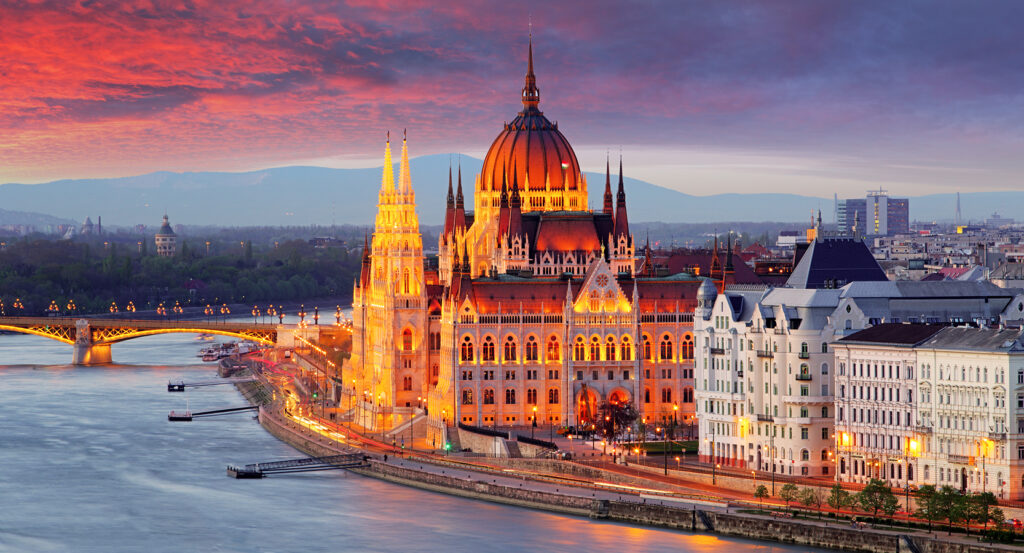
Perfect weekend in Budapest, Hungary.
Budapest's emergence as the capital of Hungary developed through nearly two millennia of Roman settlement, medieval kingship, Ottoman occupation, and Habsburg imperial expansion. Situated along the Danube River, the city occupies a geographical crossroads connecting the Carpathian Basin with the commercial routes of Central and Southeastern Europe. The Romans established Aquincum during the first century CE, developing a substantial military and administrative settlement on the western bank of the river. Following the arrival of the Magyars in the Carpathian Basin during the late ninth century, the surrounding region became part of the emerging Hungarian state. Buda acquired particular importance during the medieval period, especially under King Matthias Corvinus, whose Renaissance court attracted humanist scholars, architects, and artists from across Europe. Ottoman forces captured Buda in 1541, beginning more than a century of Turkish administration that introduced new religious buildings, commercial institutions, and bathing traditions. Habsburg forces reconquered the city in 1686, initiating extensive reconstruction and the expansion of Baroque architecture. During the nineteenth century, Hungarian nationalism and industrialization transformed the neighboring settlements of Buda, Pest, and Óbuda into increasingly interconnected centers of political and economic activity. Their formal unification in 1873 created Budapest, which subsequently flourished as the second capital of Austria-Hungary. The city's twentieth-century history encompassed Nazi occupation, the persecution and murder of Hungarian Jews, Soviet military intervention, and the Hungarian Revolution of 1956. The restoration of democratic government in 1989 opened another chapter in the development of Hungary's historic capital.
Budapest's cultural reputation rests upon distinguished traditions of classical composition, literature, architecture, scientific scholarship, and Hungarian gastronomy. Franz Liszt, among the nineteenth century's most influential pianists and composers, founded the institution that became the Liszt Ferenc Academy of Music in 1875, contributing to the professional development of Hungarian musical education. Béla Bartók and Zoltán Kodály subsequently advanced modern composition through their exploration of Hungarian and neighboring folk music traditions, influencing musical scholarship and performance internationally. The Hungarian National Museum, founded in 1802, preserves extensive collections devoted to the country's archaeology, political history, and cultural inheritance. The Museum of Applied Arts, designed by Ödön Lechner and Gyula Pártos, became an important example of Hungarian Art Nouveau architecture through its elaborate ceramics, ornamental forms, and distinctive roofline. Budapest's literary heritage includes writers such as Sándor Márai and Magda Szabó, whose works explored Hungarian society, personal relationships, and the political transformations of the twentieth century. The city's culinary traditions draw upon the agricultural resources of the Great Hungarian Plain, freshwater fish from the Danube basin, and centuries of exchange with neighboring Central European cultures. Paprika became a central ingredient in Hungarian cooking, contributing to preparations including gulyás, paprikás csirke, and traditional fish soup. Other specialties include töltött káposzta, layered potato dishes, and pastries associated with the former Habsburg territories. Hungary's wine regions, particularly Tokaj, Eger, and Villány, contribute distinctive varieties and longstanding viticultural traditions to the capital's dining culture. A perfect weekend in Budapest brings together royal history, Danube-side architecture, musical heritage, and the sophisticated culinary traditions of Central Europe.
Three day itinerary.
Day 1: Széchenyi Chain Bridge
Széchenyi Chain Bridge is best known for creating the first permanent crossing between Buda and Pest, advancing the physical integration that ultimately produced modern Budapest. Count István Széchenyi championed the project as part of his wider campaign to modernize Hungary's transportation and economy. English engineer William Tierney Clark designed the suspension bridge, with Adam Clark directing construction across the Danube. Its completion in 1849 connected communities that would formally unite with Óbuda in 1873. Retreating German forces destroyed the bridge during the final months of World War II, leaving only its piers standing across the river. Reconstruction culminated in its reopening in 1949, exactly a century after the original completion, preserving a structure inseparable from Budapest's emergence as a unified capital.
Day 1: Stand Étterem
Stand Étterem is best known for Tamás Széll and Szabina Szulló's elevation of Hungarian cuisine through exceptional ingredients, disciplined technique, and sophisticated reinterpretations of national dishes. Széll became one of Hungary's most internationally recognized chefs after winning the European final of the Bocuse d'Or in Budapest in 2016. Stand followed as the pair's flagship restaurant, placing Hungarian culinary inheritance at the center of an exacting tasting-menu format. Paprika, freshwater fish, vegetables, game, poultry, fermentation, and deeply constructed sauces ground the cooking in the Carpathian Basin. Traditional preparations acquire extraordinary refinement through Széll's command of contemporary technique. Two MICHELIN stars place Stand alone at the summit of Budapest's MICHELIN hierarchy.
Day 2: Fisherman's Bastion
Fisherman’s Bastion is best known for transforming the medieval defenses of Castle Hill into one of Budapest's defining works of late nineteenth-century historicism. Frigyes Schulek designed the Neo-Romanesque complex during the extensive reconstruction of neighboring Matthias Church around the Hungarian Millennium. Construction beginning in 1895 replaced utilitarian fortifications with arcades, stairways, terraces, and seven conical towers representing the Magyar tribes associated with the conquest of the Carpathian Basin. Its elevated position above the Danube established expansive sightlines toward Pest and the Hungarian Parliament Building. The name preserves an association with the fishermen historically connected to this section of the castle defenses. Fisherman's Bastion converted military terrain into an architectural expression of Hungarian national character during the Austro-Hungarian era.
Day 2: TATI Farm to Table Restaurant
TATI Farm to Table Restaurant is best known for connecting contemporary Budapest dining directly with agricultural production through its farm in Biatorbágy. Fruit and vegetables grown by the restaurant enter a kitchen structured around seasonality and the agricultural foundations of Hungarian cooking. Meat, fish, and plant-based preparations incorporate traditional recipes into modern compositions whose ingredients retain a clear connection to their origins. Natural, biodynamic, and organic wines extend that regional emphasis into the beverage program. The farm relationship gives TATI an unusually concrete expression of provenance within the capital's restaurant landscape. MICHELIN includes the restaurant within its Budapest selection and specifically classifies it for farm-to-table dining, validating its retention in a premier itinerary built around distinct expressions of Hungarian culture.
Day 2: Széchenyi Thermal Bath
Széchenyi Thermal Bath is best known for monumentalizing Budapest's geothermal bathing culture within an immense Neo-Baroque complex in City Park. Győző Czigler designed the original bath, which opened in 1913 as the first major thermal establishment on the Pest side of the Danube. Expansion during the 1920s added its great outdoor pools and substantially enlarged the complex under Imre Francsek. Thermal water drawn from deep beneath Budapest supplies pools operating at different temperatures, exploiting geological conditions that made bathing institutions fundamental to the city across centuries. Domes, colonnades, sculpture, yellow facades, and symmetrical courtyards transformed therapeutic infrastructure into ceremonial architecture. Széchenyi represents the grand municipal culmination of a bathing tradition rooted simultaneously in geology, medicine, recreation, and Budapest's extraordinary concentration of thermal springs.
Day 2: SALT
SALT is best known for Szilárd Tóth's transformation of Hungarian rural food traditions through wild plants, fermentation, preservation, and ingredients drawn directly from farms, gardens, woods, and fields. Tóth roots the restaurant in the culinary inheritance of northeastern Hungary, extending techniques associated with domestic preservation into intricate contemporary preparations. Foraged herbs and berries join house-produced butter, lardo, Mangalitsa ham, fermented vegetables, fruits, and other preserved ingredients across the tasting menu. Classic Hungarian recipes provide foundations for compositions assembled in direct view of the dining room. The kitchen's work extends from ingredient cultivation and foraging through preservation and final preparation, creating an unusually complete relationship with the Hungarian landscape. Salt holds one MICHELIN star and a MICHELIN Green Star.
Day 3: Gerlóczy Kávéház
Gerlóczy Kávéház is best known for translating Budapest's historic café tradition into the intimate scale of a quiet downtown square. The surrounding Belváros district preserves the dense street pattern and nineteenth-century architecture of Pest's historic commercial center, giving the café a markedly different character from the expansive coffee palaces associated with the city's grand boulevards. Breakfast draws on Central European café culture through eggs, breads, pastries, preserves, coffee, and composed morning dishes. Street-facing tables connect the meal directly with the urban rituals that made cafés essential meeting places across Budapest. Gerlóczy earns retention through atmosphere, cultural specificity, and its position within a city where extended café life became an institution tied to writers, journalists, artists, and everyday metropolitan society.
Day 3: Central Market Hall
Central Market Hall is best known for monumentalizing Budapest's late nineteenth-century modernization through a purpose-built center for urban food commerce. Samu Pecz designed the vast brick-and-steel structure near the Pest end of Liberty Bridge as part of a municipal effort to reorganize food distribution under cleaner and more controlled conditions. The market opened in 1897 during the extraordinary building campaign that transformed Budapest after unification. Its immense iron roof spans rows of merchants beneath colorful Zsolnay tiles that give the exterior a distinctly Hungarian architectural character. Produce, meat, paprika, sausages, dairy products, preserved foods, and other staples connect the hall directly with the agricultural regions supplying the capital. The Great Market Hall transformed everyday provisioning into civic architecture at the height of Budapest's emergence as a major European metropolis.
Day 3: St. Stephen's Basilica
St. Stephen’s Basilica is best known for monumentalizing Hungary's first king within the religious architecture of the nineteenth-century capital. József Hild began the church in a Neoclassical style before structural failure and his death shifted responsibility to Miklós Ybl, who substantially redesigned the building and its immense dome. József Kauser completed the project after Ybl's death, bringing decades of construction to an end in 1905. The basilica takes its name from Stephen I, whose reign established the Christian Kingdom of Hungary around the beginning of the eleventh century. His mummified right hand, the Holy Right, became the church's most important relic and a potent symbol of Hungarian statehood. The basilica joins dynastic memory, Catholic identity, expansive engineering, and Budapest's transformation into a national capital.
Day 3: Borkonyha Winekitchen
Borkonyha Winekitchen is best known for joining contemporary Hungarian cooking with a deep exploration of the country's wine regions. Chef Ákos Sárközi built the kitchen around Hungarian ingredients interpreted through modern technique, allowing freshwater fish, meat, vegetables, seasonal products, and concentrated sauces to retain clear connections with national culinary traditions. Wine occupies an equally consequential position, drawing the dining room into Hungary's extraordinary viticultural geography across Tokaj, Somló, Eger, Villány, Szekszárd, and other regions. Differences in volcanic soils, climate, grape varieties, and winemaking traditions give that cellar unusual range within a single country. Borkonyha holds one MICHELIN star, giving the final dinner a sophisticated synthesis of Hungarian cuisine and viticulture.
Where your story begins.
Foresyte Travel reveals places that feel extraordinary long before you arrive.
Enjoy editorial crafted for luxury travelers.
Foresyte may earn a commission when you book.







































































































