
Perfect weekend in New Mexico.
Santa Fe's extraordinary historical significance emerges from more than four centuries as a colonial capital, its enduring Pueblo cultural heritage, and its central role in the artistic traditions of the American Southwest. Situated at the southern foothills of the Sangre de Cristo Mountains, the city occupies a high-desert landscape inhabited for thousands of years by Indigenous peoples whose agricultural, architectural, and ceremonial traditions shaped the region long before European colonization. Spanish colonists established Santa Fe as the capital of Nuevo México in 1610 under Governor Pedro de Peralta, making it among the oldest European-founded capitals in the continental United States. The settlement became an administrative and commercial center along the northern frontier of New Spain, connecting Indigenous communities, Spanish settlements, and trading routes extending toward Mexico City. The Pueblo Revolt of 1680, led by Po'pay of Ohkay Owingeh, expelled Spanish colonial authorities from New Mexico and represented one of the most consequential Indigenous resistance movements in North American history. Spanish forces reconquered Santa Fe in 1692 under Diego de Vargas, beginning another period of colonial administration that continued until Mexican independence in 1821. The Santa Fe Trail, established as a major commercial route during the nineteenth century, connected the city with Missouri and expanded trade between Mexico and the United States. Following the Mexican-American War, Santa Fe came under American control in 1846, eventually becoming the capital of New Mexico when the territory achieved statehood in 1912. The city's historical importance rests upon this convergence of Indigenous sovereignty, Spanish colonial institutions, Mexican commerce, and American territorial expansion.
Santa Fe's artistic reputation developed through the convergence of Pueblo craftsmanship, Hispanic religious traditions, modernist experimentation, and generations of painters and writers drawn to the high-desert landscape. The New Mexico Museum of Art, established in 1917, became an important institution for Southwestern painting, sculpture, and photography, supporting artists whose work explored the region's landscapes and cultural traditions. Georgia O'Keeffe developed a profound artistic relationship with northern New Mexico, producing paintings of desert architecture, geological formations, and natural objects that became central to American modernism. The Georgia O'Keeffe Museum preserves an extensive collection of her work and contributes to the interpretation of her artistic career. The Museum of International Folk Art, founded by Florence Dibell Bartlett in 1953, houses an extensive collection of traditional artistic objects from cultures throughout the world. Santa Fe's musical heritage includes the Santa Fe Opera, established by John Crosby in 1956, whose open-air theater became internationally celebrated for its productions and mountain setting. The city's culinary traditions combine Pueblo agricultural knowledge, Hispanic cooking, and ingredients cultivated across northern New Mexico. Blue corn, beans, squash, piñon nuts, and locally grown chile peppers form the foundation of regional specialties including posole, tamales, enchiladas, and green chile stew. New Mexico's distinctive red and green chile preparations remain central to the region's culinary heritage, connecting contemporary restaurants with centuries of agricultural and family traditions. A perfect weekend in Santa Fe brings together Indigenous history, colonial architecture, American modernist art, and the exceptional culinary heritage of the high desert.
Three day itinerary.
Day 1: The Cathedral Basilica of St. Francis of Assisi
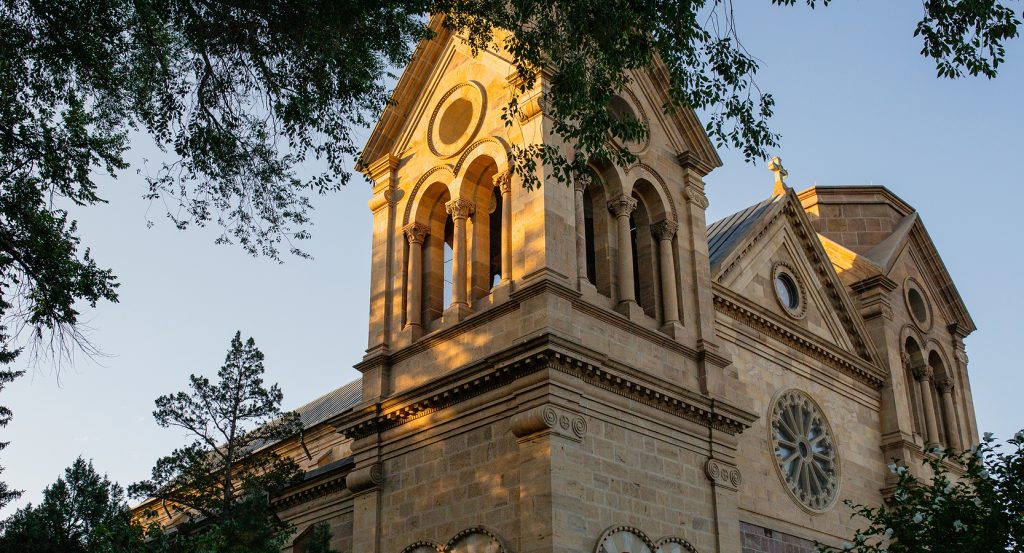
The Cathedral Basilica of St. Francis of Assisi is best known for bringing Romanesque Revival architecture into the heart of a city defined by centuries of Spanish and Pueblo building traditions. Archbishop Jean-Baptiste Lamy commissioned the cathedral during the nineteenth century as Santa Fe became the center of an expanding Catholic diocese in the American Southwest. French architect Antoine Mouly designed the stone structure with rounded arches, paired towers, and an expansive facade that departed dramatically from the adobe architecture surrounding the Plaza. Construction incorporated an earlier adobe church, La Parroquia, whose surviving chapel preserves a connection with the site's colonial religious history. The cathedral was dedicated to Saint Francis of Assisi, and its development reflected the transformation of Catholic institutions following the incorporation of New Mexico into the United States. Its masonry mass remains one of Santa Fe's clearest architectural records of the cultural changes that reshaped the territorial capital during the nineteenth century.
Day 1: Geronimo
Geronimo is best known for establishing sophisticated fine dining within one of Canyon Road's historic adobe buildings. The restaurant occupies the Borrego House, an eighteenth-century structure associated with Gerónimo López, whose name the restaurant adopted. Thick adobe walls and traditional architectural proportions place the dining rooms within the residential fabric that predates Canyon Road's emergence as Santa Fe's principal gallery corridor. The kitchen draws from Southwestern ingredients and international fine-dining technique through game, seafood, vegetables, chiles, sauces, and carefully composed preparations. Geronimo's longevity has given it unusual institutional weight in a restaurant market shaped by continual interaction among Indigenous, Hispanic, Mexican, and broader American culinary traditions. Its union of historic adobe architecture and ambitious cooking makes it one of Santa Fe's most enduring destination restaurants.
Day 2: Loretto Chapel Museum
Loretto Chapel Museum is best known for its Gothic Revival architecture and the extraordinary helix staircase connecting the nave with the choir loft. Archbishop Jean-Baptiste Lamy brought the Sisters of Loretto to Santa Fe during the nineteenth century to establish a school for girls, and the chapel developed as part of their educational complex. Antoine Mouly and his son Projectus drew heavily from French Gothic church architecture, producing pointed arches, buttresses, stained glass, and a steeply articulated structure dramatically different from Santa Fe's adobe traditions. The wooden staircase rises through two complete turns without a conventional central support, making its carpentry the building's defining technical feature. Stories surrounding the unidentified craftsman who constructed it subsequently became embedded in Santa Fe folklore. The chapel preserves the intersection of Catholic education, French architectural influence, craftsmanship, and religious legend in territorial New Mexico.
Day 2: The Compound Restaurant
The Compound Restaurant is best known for connecting contemporary American cooking with the artistic and architectural history of Canyon Road. Designer Alexander Girard transformed the property during the 1960s, applying the visual intelligence that made him a major figure in twentieth-century textile, furniture, and interior design. Adobe walls, courtyards, fireplaces, and restrained interiors place the restaurant within the architectural traditions that define Santa Fe's historic residential districts. The kitchen developed a fine-dining character grounded in seasonal ingredients, Southwestern products, meats, seafood, vegetables, and disciplined sauces. Decades of operation made The Compound an enduring component of Canyon Road as the surrounding neighborhood evolved into one of the country's densest concentrations of galleries. Its significance lies in the convergence of modern design, Santa Fe architecture, and serious restaurant culture within a single historic compound.
Day 2: Santa Fe Plaza
Santa Fe Plaza is best known for serving as the political and commercial center of Santa Fe since the Spanish colonial period. Pedro de Peralta established the city as the capital of Nuevo México in 1610, organizing its core around a central public square consistent with Spanish colonial planning principles. The Palace of the Governors occupied the plaza's northern edge as the seat of colonial authority and subsequently served governments under Spanish, Mexican, and American rule. Trade routes converged there, including the Santa Fe Trail after its opening to international commerce in 1821, turning the plaza into an exchange point among Indigenous communities, Hispano residents, Mexican merchants, and American traders. Political upheaval, territorial expansion, commerce, and civic ceremony repeatedly unfolded around the same open space. The plaza remains the physical center of a capital whose governmental history spans four centuries and multiple sovereign powers.
Day 2: Sazón
Sazón is best known for Fernando Olea's sophisticated exploration of Mexican culinary traditions through the ingredients, chiles, and historical connections linking Mexico with New Mexico. Born in Mexico City, Olea developed a deeply personal cooking style in Santa Fe around complex sauces, regional Mexican techniques, and the controlled layering of spice, sweetness, acidity, and heat. Mole occupies a central position in his work, with individual preparations demonstrating the enormous range possible through combinations of chiles, seeds, nuts, fruits, spices, and aromatics. Olea created his signature New Mexican soup from ingredients reflecting the culinary exchange between his birthplace and adopted home. The James Beard Foundation named him Best Chef: Southwest in 2022, giving national recognition to a body of cooking deeply connected to the centuries-old movement of ingredients and culinary traditions between Mexico and New Mexico.
Day 3: Dolina Bakery & Café
Dolina Bakery & Café is best known for Annamaria Brezna's integration of Central European baking traditions with the ingredients and breakfast culture of Santa Fe. Brezna brought Slovak culinary influences into a daytime restaurant centered on scratch baking, breakfast, lunch, and pastry. Cakes, strudels, breads, eggs, grains, vegetables, and seasonal ingredients connect the café's Southwestern setting with techniques and flavors rooted in Central European home cooking. Baking gives the restaurant its strongest cultural signature, particularly through pastries whose layered doughs, fruit, nuts, and dairy carry traditions rarely represented in New Mexican dining. Dolina broadens Santa Fe's culinary geography beyond the Hispanic, Indigenous, and Mexican traditions most closely associated with the city, giving its morning dining culture a distinctive immigrant perspective.
Day 3: Bandelier National Monument
Bandelier National Monument is best known for preserving ancestral Pueblo settlements within the volcanic canyons and mesas of the Pajarito Plateau. Ancestral Pueblo people occupied the region for centuries, building masonry pueblos on canyon floors and enlarging natural openings within the soft volcanic tuff to create rooms known as cavates. Frijoles Canyon contains the remains of Tyuonyi, a large circular pueblo whose architecture reflects the complex communal life that developed there. Volcanic eruptions from the Valles Caldera created the tuff formations into which many dwellings were constructed, binding human settlement directly to the region's geological history. Petroglyphs, agricultural landscapes, ceremonial spaces, and architectural remains preserve enduring connections between the plateau and Pueblo communities whose descendants continue to maintain cultural relationships with the region.
Day 3: Kasha-Katuwe Tent Rocks National Monument
Kasha-Katuwe Tent Rocks National Monument is best known for its cone-shaped formations created by the erosion of volcanic deposits on the Pajarito Plateau. Explosive eruptions from the Jemez volcanic field deposited layers of pumice, ash, and tuff across the region millions of years ago. Water and wind subsequently carved those deposits into narrow canyons and steep formations, leaving harder caprocks protecting portions of the softer material beneath them. The resulting tent-shaped cones rise in dense clusters whose forms expose differences in the resistance of individual volcanic layers. Kasha-Katuwe means “white cliffs” in the Keres language of Cochiti Pueblo, whose people maintain deep cultural connections to the surrounding landscape. The monument joins striking volcanic geology to an Indigenous cultural geography extending far beyond the boundaries of the protected terrain.
Day 3: La Boca
La Boca is best known for James Campbell Caruso's concentration on Spanish tapas and the shared culinary traditions of the Mediterranean. Caruso built the restaurant around small plates whose scale permits a broad progression through seafood, vegetables, cured meats, cheeses, legumes, spices, and preparations shaped by Spain's regional cuisines. Sherry, Spanish wine, olive oil, saffron, paprika, and preserved products reinforce a culinary structure rooted in the Iberian Peninsula. Caruso's approach brought tapas into Santa Fe as a serious chef-driven format, giving the city a sustained connection to Spanish food culture beyond the colonial history embedded throughout New Mexico. La Boca links contemporary Santa Fe dining with the Iberian culinary traditions that form one component of the region's unusually complex cultural inheritance.
Where your story begins.
Foresyte Travel reveals places that feel extraordinary long before you arrive.
Enjoy editorial crafted for luxury travelers.
Foresyte may earn a commission when you book.







































































































