Why Geronimo matters.
Geronimo is a distinguished American fine-dining restaurant where Canyon Road's historic adobe architecture and internationally recognized art district meet Eric DiStefano's culinary legacy, Sllin Cruz's globally influenced cooking and one of Santa Fe's most enduring traditions of sophisticated hospitality.
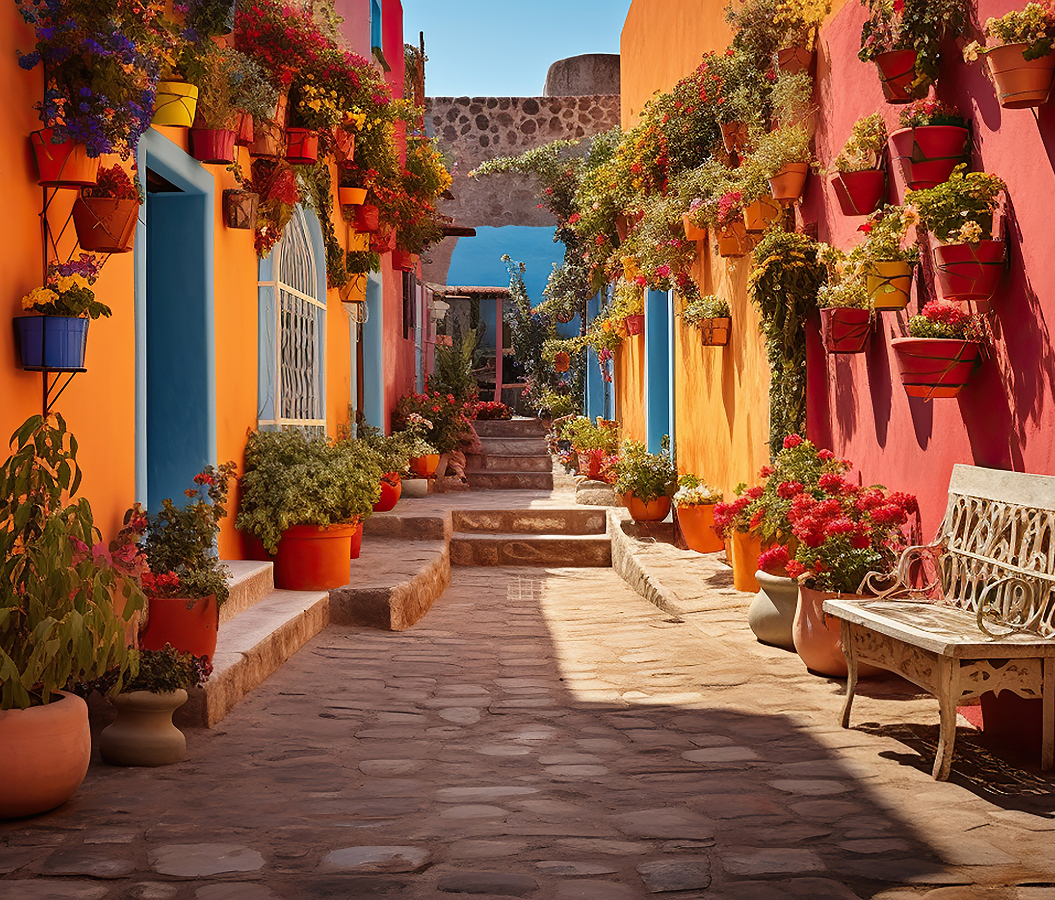
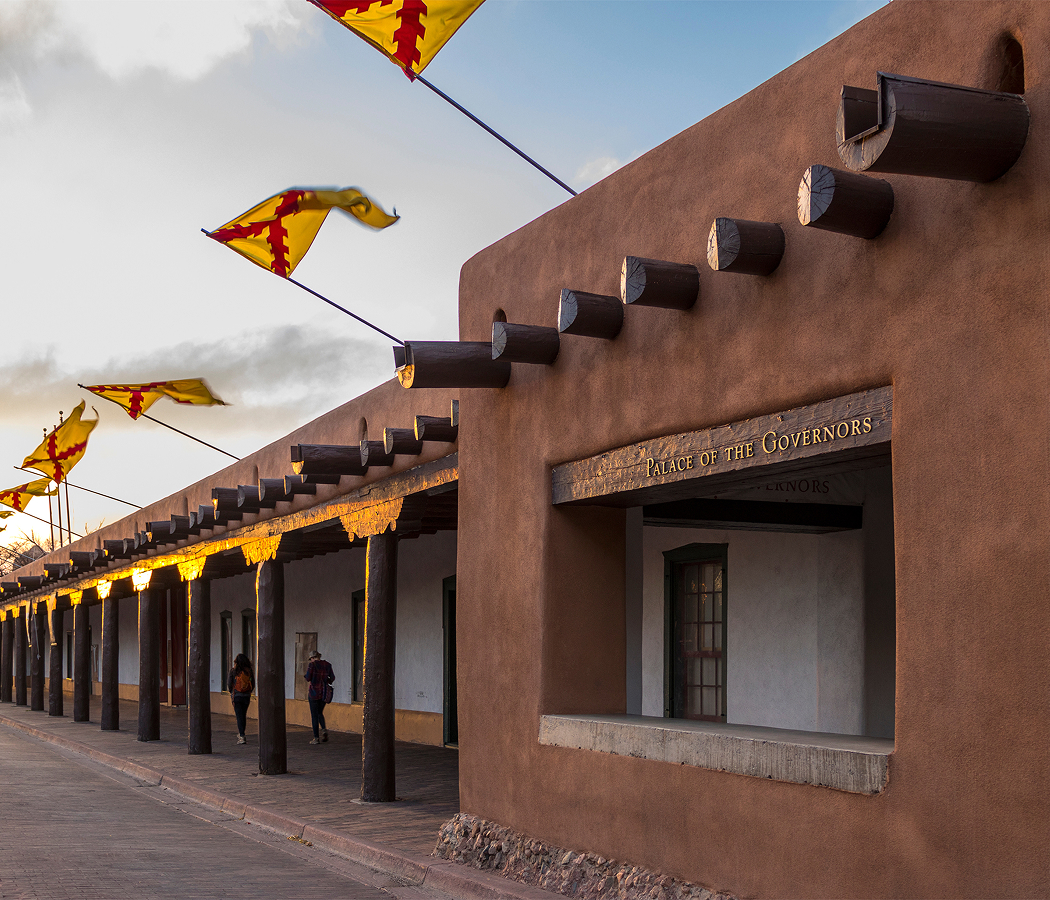
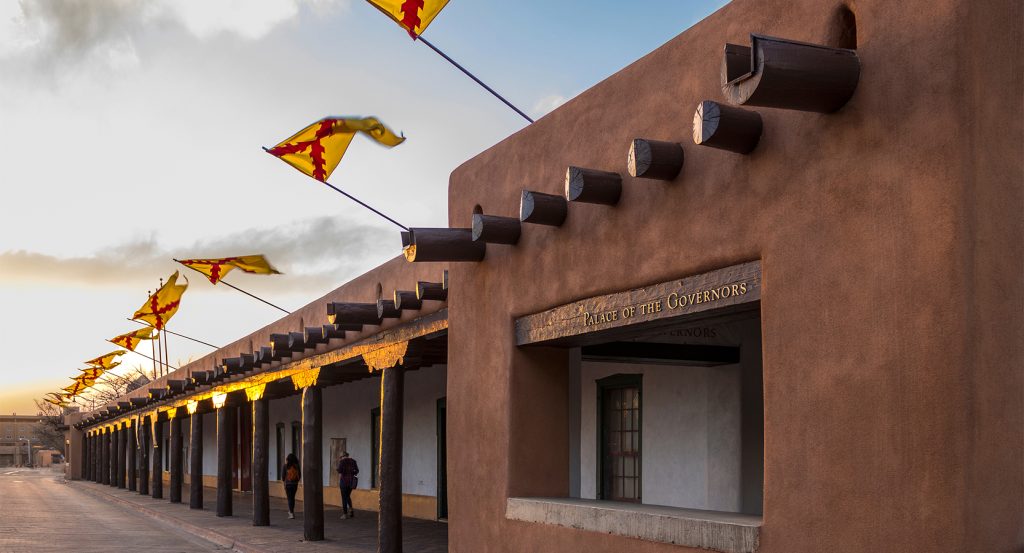
Positioned along Canyon Road near the intersection with Delgado Street and a short walk from the galleries surrounding Acequia Madre, the restaurant occupies a historic residential corridor east of Santa Fe Plaza, between the established arts district, the neighborhood's traditional adobe compounds and the foothills of the Sangre de Cristo Mountains. Its eighteenth-century building features thick adobe walls, exposed wooden vigas, whitewashed interiors and intimate dining rooms organized around the original domestic architecture. Kiva fireplaces, leather seating and subdued lighting establish an elegant setting, with carefully positioned tables preserving the individual character of the building's historic rooms. A long covered portal extends along the street-facing exterior, providing seasonal outdoor dining beneath substantial wooden columns and a traditional roof structure. The result is a restaurant whose preserved domestic architecture, refined interiors and prominent position among Canyon Road's galleries connect contemporary fine dining with Santa Fe's architectural heritage.
What defines Geronimo.
Geronimo is best known for transforming a historic Canyon Road residence into one of New Mexico's most acclaimed fine-dining restaurants, connecting the preservation of Santa Fe's architectural heritage with the development of contemporary American cuisine in the Southwest. Its building, traditionally associated with Geronimo Lopez and commonly dated to 1756, originated during Santa Fe's Spanish colonial period, when the surrounding area consisted of agricultural properties and residential compounds beyond the central plaza. The property subsequently became associated with Rafael Borrego, who acquired it in 1839 and whose family maintained ownership into the early twentieth century. During the nineteenth century, the Borrego family introduced Territorial-style architectural elements, including the extended columned portal that continues to distinguish the building's exterior. In 1928, preservationist Margretta Stewart Dietrich acquired the property and commissioned architect and adobe restoration specialist Kate Chapman to rehabilitate the historic residence. Dietrich had previously participated in the women's suffrage movement in Nebraska and subsequently became involved in Native American rights and architectural preservation in New Mexico. Her investment helped protect an important example of Santa Fe's domestic architectural heritage during a period of increasing interest in the city's historic building traditions. The property entered the restaurant industry during the twentieth century, accommodating Three Cities of Spain in the 1960s and subsequently Alfonso's before the establishment of Geronimo. Restaurateur Cliff Skoglund opened Geronimo during the early 1990s, naming the restaurant for the historic association between the property and Geronimo Lopez. Chris Harvey joined the establishment as a waiter in 1992, beginning a professional relationship that eventually brought him into ownership and long-term leadership. A decisive transformation followed in 1996 when chef Eric DiStefano assumed responsibility for the kitchen, introducing a sophisticated culinary program influenced by his experience in New York restaurants and classical European cooking. DiStefano had developed his professional background through demanding metropolitan kitchens, including Restaurant Daniel, bringing a level of technical refinement that substantially elevated Geronimo's reputation. His arrival prompted significant investment in the dining room, with Harvey and his partners upgrading furnishings and service standards to complement the kitchen's increasingly ambitious cooking. The restaurant developed a reputation for inventive combinations of Southwestern ingredients, Asian influences and classical French techniques, establishing an approach that became closely associated with Santa Fe's contemporary fine-dining culture. DiStefano subsequently earned a James Beard Award nomination and became associated with Coyote Cafe, extending his influence across two of the city's prominent restaurants. Geronimo's recognition expanded through AAA Four Diamond and Mobil/Forbes Four Star distinctions, together with national rankings from OpenTable and Tripadvisor. DiStefano selected Sllin Cruz as his culinary successor, establishing continuity between the restaurant's formative culinary achievements and its subsequent development. Following DiStefano's death in 2016, Cruz assumed the principal responsibility for the kitchen, preserving its established culinary direction through a changing seasonal menu. Harvey's continued ownership and Cruz's culinary leadership sustained the restaurant's reputation through successive changes in Santa Fe's hospitality industry. Geronimo's significance rests on this combination of historic preservation, professional succession and culinary ambition, establishing a restaurant whose reputation developed through the transformation of a centuries-old residence into a nationally recognized fine-dining institution.
Sllin Cruz's cooking develops Geronimo's established Global Eclectic approach through the interaction of classical European technique, Southwestern ingredients and carefully selected influences from Asian culinary traditions. The kitchen's defining characteristic is its ability to combine these traditions through precise cooking and balanced accompaniments, creating preparations whose complexity develops from the relationship between familiar ingredients and distinctive seasonings. Tellicherry-rubbed elk tenderloin provides a particularly recognizable expression of this approach, connecting a substantial game meat associated with the American West with the aromatic intensity of Indian black pepper. A brandied mushroom sauce contributes richness and earthy depth, complementing the meat's distinctive flavor through a classical European reduction. The preparation demonstrates the restaurant's commitment to substantial proteins accompanied by sauces whose complexity supports the principal ingredient. Green miso sea bass introduces a complementary Pacific influence, using fermented soybean seasoning to develop savory depth within a preparation grounded in careful fish cookery. The miso contributes concentrated umami, allowing the natural richness of the fish to develop alongside the sauce's fermented character. Hot Mexican white prawns extend the restaurant's international repertoire through a preparation that combines seafood with assertive seasoning and a delicate rice-based accompaniment. Their presentation reflects the kitchen's interest in contrasting textures and culinary traditions, connecting the sweetness of shellfish with the aromatic qualities of carefully developed sauces. Vegetable-centered preparations contribute a separate dimension through seasonal produce, including roasted beets accompanied by goat cheese, pistachios and bitter greens. The combination develops sweetness, acidity and contrasting textures, demonstrating the importance of balance within the restaurant's broader culinary program. Seasonal changes allow the kitchen to incorporate additional regional ingredients, preserving a relationship with the agricultural conditions and changing harvests of the Southwest. The wine program complements these preparations through selections from established European regions and international producers, with attention to the contrasting requirements of seafood, game and richly developed sauces. Geronimo's culinary distinction emerges from this sustained integration of classical technique and international influences, establishing a recognizable fine-dining approach that has developed through successive generations of culinary leadership.
How Geronimo fits.
Geronimo works as the dining culmination of an exploration connecting Canyon Road's historic residential architecture, contemporary artistic production and Santa Fe's Pueblo Revival religious architecture, placing the restaurant within the preservation and cultural development of the city's eastern historic district.
Begin at El Zaguán, the historic adobe residence and garden associated with Santa Fe Trail merchant James L. Johnson and the subsequent development of the city's architectural preservation movement. Johnson acquired the property during the 1850s and expanded the original residence into a substantial family compound, incorporating additional rooms, service structures and cultivated gardens. The property entered a new chapter in 1928 when preservationist Margretta Stewart Dietrich purchased it and engaged Kate Chapman to direct its restoration and enlargement. In 1979, a corporation established by architect John Gaw Meem transferred the property to the Historic Santa Fe Foundation, which subsequently established its headquarters and exhibition spaces within the compound. Its preserved architectural elements and garden provide a direct introduction to the domestic traditions that shaped Canyon Road before its development as an arts district. Continue to ViVO Contemporary Gallery, the Canyon Road institution dedicated to contemporary artists working in Santa Fe and the surrounding region. Its exhibition program encompasses painting, printmaking, handmade paper, sculpture, mixed media and kiln-formed glass, bringing together artists whose practices extend across traditional and experimental materials. The gallery's distinctive programming includes Giving Voice to Image, an annual collaboration pairing visual artists with local poets. Participating poets develop original works in response to artists' studio practices, with the resulting poems and artworks presented together in a dedicated exhibition and accompanying publication. The program establishes a connection between Santa Fe's visual arts community and its literary traditions, extending Canyon Road's cultural significance beyond conventional gallery exhibitions. Conclude at Cristo Rey Church, the substantial Pueblo Revival parish church designed by architect John Gaw Meem and completed in 1940. Commissioned during the episcopate of Archbishop Rudolph Gerken, the church was conceived as a major religious building for Santa Fe's eastern neighborhoods and as a commemorative project associated with the four-hundredth anniversary of Francisco Vázquez de Coronado's expedition. Its expansive adobe architecture incorporates traditional regional building forms on a scale that distinguishes it within the city's ecclesiastical landscape. The interior contains the Reredos of Our Lady of Light, a carved stone altar screen completed in 1761 for the former military chapel on Santa Fe Plaza. Its relocation preserved an important work of Spanish colonial religious sculpture, connecting the twentieth-century church with the artistic and devotional traditions of eighteenth-century New Mexico. The progression connects Canyon Road's preserved domestic architecture with contemporary artistic collaboration and concludes at a major work of Pueblo Revival ecclesiastical design, establishing the broader cultural setting surrounding Geronimo.
Where your story begins.
Foresyte Travel reveals places that feel extraordinary long before you arrive.
Enjoy editorial crafted for luxury travelers.
Foresyte may earn a commission when you book.