Why Santa Fe Plaza matters.
Santa Fe Plaza is a historic civic square where Downtown Santa Fe's Spanish colonial foundations meet four centuries of political change, Indigenous commerce and public traditions that have shaped New Mexico's capital since 1610.
Positioned at the center of Santa Fe's historic district between Palace Avenue, San Francisco Street, Lincoln Avenue and Old Santa Fe Trail, the plaza occupies a landscaped city block surrounded by adobe commercial buildings, shaded portals and streets following the original Spanish colonial settlement pattern. Mature trees shelter intersecting walkways, benches and a central commemorative monument. The surrounding buildings contain shops, galleries, restaurants and institutions housed within structures of varying ages. Its open lawns and paved gathering areas accommodate public ceremonies, seasonal markets and cultural performances. The result is a compact civic landscape where the city's colonial street plan, architectural preservation and continuing public traditions remain directly connected.
What defines Santa Fe Plaza.
Santa Fe Plaza is best known for serving as the political and commercial center of Santa Fe since the establishment of the Spanish colonial capital in 1610. Spanish governor Pedro de Peralta founded the settlement as the administrative center of Nuevo México, organizing its principal public square around the conventions of Spanish colonial town planning. The plaza provided space for government ceremonies, military gatherings, commercial exchange and religious observances. Its location became central to the developing network of streets, residences and public institutions surrounding the colonial capital. Pueblo communities had occupied northern New Mexico for centuries before Spanish settlement, maintaining extensive agricultural, trading and ceremonial networks. Spanish colonization introduced new political and religious institutions, creating conflicts over labor, land and Indigenous religious practices. The Pueblo Revolt of 1680, led by Po'pay of Ohkay Owingeh, expelled Spanish colonial authorities from northern New Mexico. Santa Fe became a center of Pueblo resistance during the uprising, and Spanish control was interrupted for twelve years. Diego de Vargas led the Spanish return in 1692, initiating a renewed period of colonial administration and settlement. Following Mexican independence in 1821, Santa Fe became part of the new Mexican republic. The opening of the Santa Fe Trail that year strengthened commercial connections between New Mexico and Missouri, bringing American merchants and imported goods into the plaza's trading economy. Commercial activity expanded through the exchange of textiles, manufactured products, livestock and regional agricultural goods. During the Mexican-American War, General Stephen Watts Kearny entered Santa Fe in August 1846 and asserted American military control over New Mexico. The Treaty of Guadalupe Hidalgo in 1848 transferred the territory to the United States, introducing a new period of political administration. Santa Fe remained the territorial capital as commercial development and migration reshaped the surrounding district. New Mexico achieved statehood in 1912, confirming Santa Fe's position as the state capital. The twentieth century brought substantial preservation efforts that protected the plaza's historic urban character and encouraged the development of the city's distinctive regional architectural style. Its continuing use for public gatherings, cultural celebrations and civic ceremonies preserves the square's longstanding role within New Mexico's political and social history.
Santa Fe's historic preservation movement shaped the plaza's present appearance through architectural standards that reinforced the city's Pueblo and Spanish colonial building traditions. The surrounding district contains structures characterized by earth-toned plaster, projecting wooden vigas, recessed windows and shaded portals. These elements draw upon construction practices developed across northern New Mexico through centuries of Indigenous and Hispanic architectural exchange. The plaza's Central Soldiers' Monument was erected in 1868 to commemorate Union soldiers and military campaigns associated with territorial New Mexico. Its inscriptions became the subject of longstanding controversy because of language concerning Indigenous peoples. The obelisk was damaged during demonstrations in 2020, leaving its future a subject of public debate. The surrounding landscaped square contains mature shade trees, grassy areas and paved walkways connecting its principal entrances. A central bandstand accommodates musical performances and community programming during seasonal events. The annual Santa Fe Indian Market brings Indigenous artists and collectors into the surrounding downtown streets, extending the city's commercial traditions through contemporary Native American artistic production. Organized by the Southwestern Association for Indian Arts, the event became one of the country's most important gatherings devoted to Indigenous art. The Santa Fe Fiesta, rooted in commemorations of the Spanish return during the 1690s, has long occupied an important place in the city's public calendar. Its historical interpretation has also generated debate concerning colonial conquest and Indigenous experiences. Seasonal celebrations introduce concerts, dances, markets and public ceremonies into the surrounding civic district. The plaza's commercial frontages accommodate jewelry, textiles, pottery and other works associated with New Mexico's artistic communities. Its location within a preserved colonial street network encourages pedestrian movement between civic institutions, religious buildings and commercial courtyards. The combination of historical continuity, architectural preservation and active public use establishes the plaza as the central gathering place of New Mexico's capital.
How Santa Fe Plaza fits.
Santa Fe Plaza works as the historical anchor for a Santa Fe outing connecting Spanish colonial government, nineteenth-century Catholic architecture and the regional art movement that shaped the city's twentieth-century development.
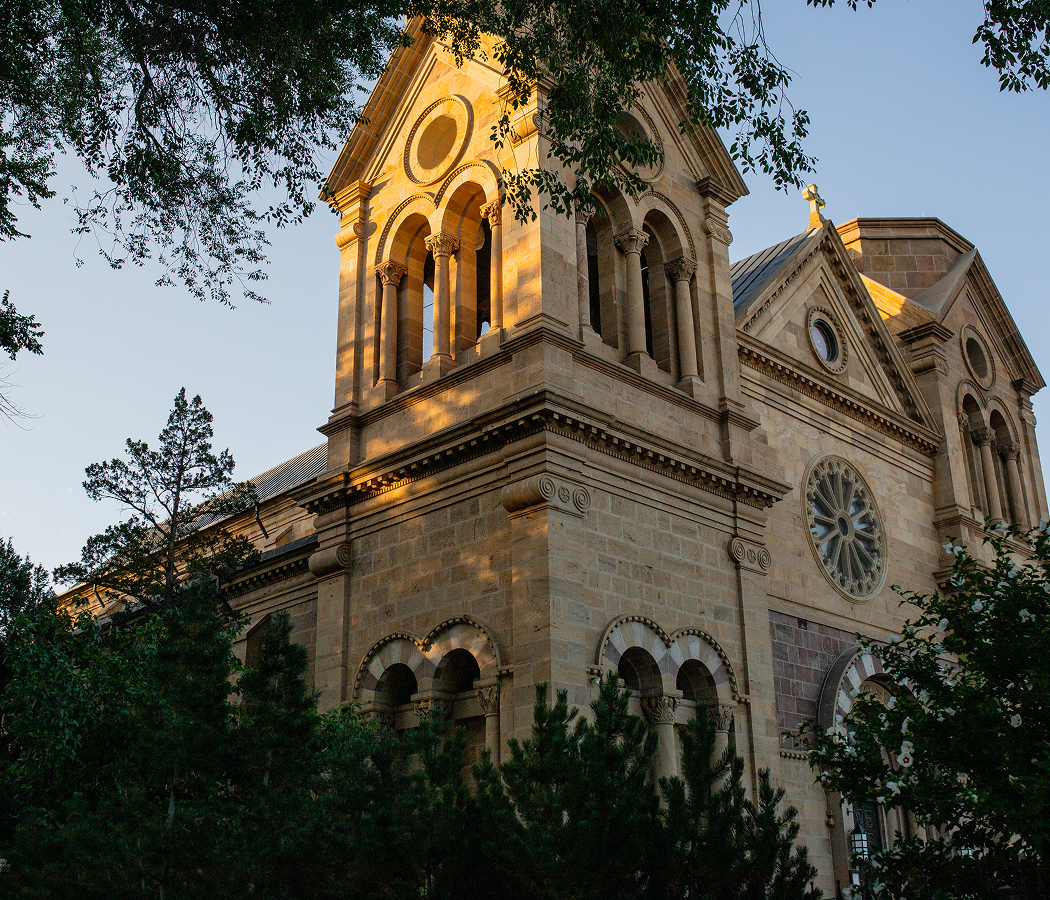
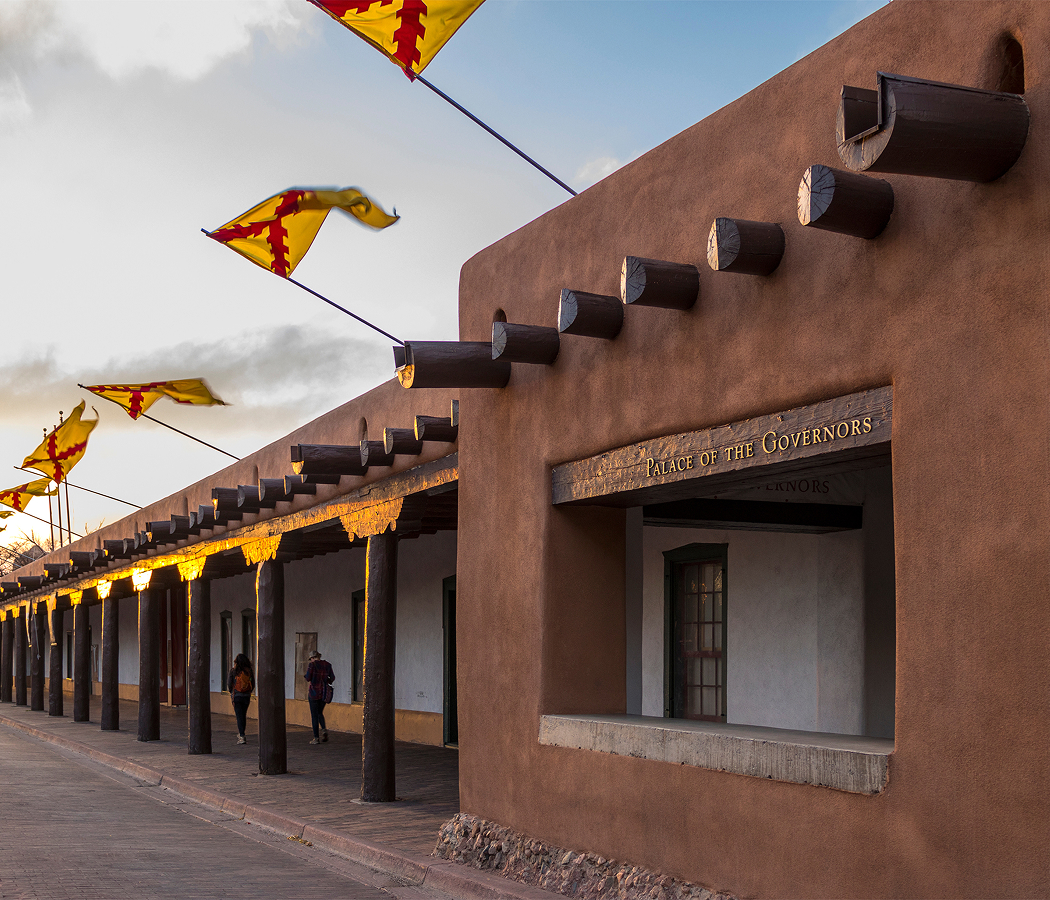
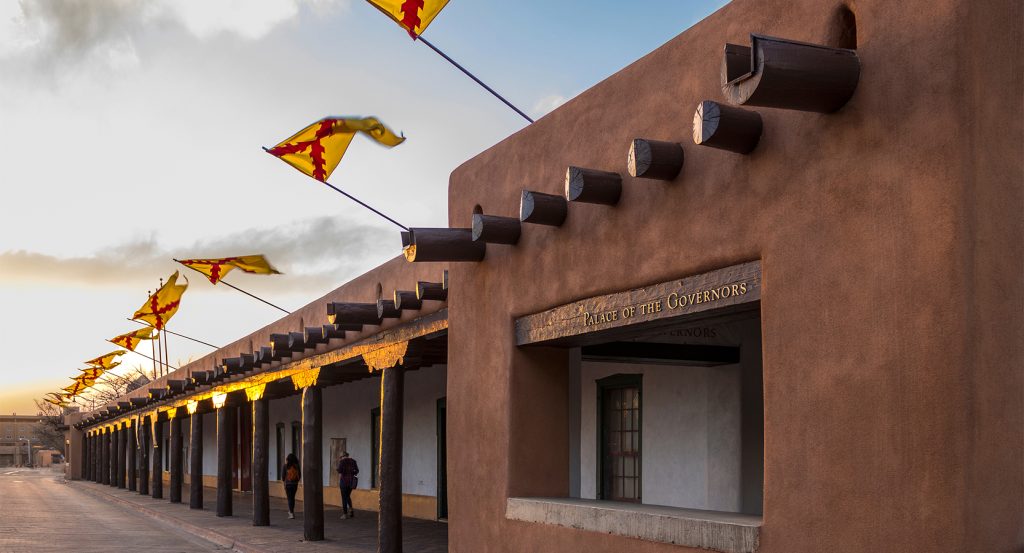
Begin at Palace of the Governors, the long adobe building occupying the plaza's northern frontage. Constructed in 1610, the palace served successive Spanish, Mexican and American territorial governments, making it among the oldest surviving public buildings in the United States. Its shaded portal preserves a characteristic feature of northern New Mexico's colonial architecture. The building later became part of the New Mexico History Museum complex, connecting its former administrative function with the interpretation of regional history. Native American artisans sell handmade jewelry and crafts beneath the portal through an established program supporting Indigenous artistic traditions. Continue to The Cathedral Basilica of St. Francis of Assisi, the Romanesque Revival church situated east of the square. Construction began in 1869 under Bishop Jean-Baptiste Lamy, whose ecclesiastical ambitions introduced a substantial French-inspired stone cathedral into the predominantly adobe city. Architect Antoine Mouly contributed to the design, incorporating rounded arches, paired towers and stained-glass windows. The cathedral preserves La Conquistadora, a historic Marian statue associated with seventeenth-century Catholic New Mexico. Its interior also contains Lamy's remains, maintaining a direct association with the nineteenth-century development of the regional archdiocese. Conclude at New Mexico Museum of Art, the Pueblo Revival institution situated northwest of the plaza. Completed in 1917 and designed by Isaac Rapp, the building incorporates architectural forms inspired by the region's Pueblo and Spanish colonial traditions. Its permanent collections examine the development of art in New Mexico, including painting, photography and sculpture associated with the Santa Fe and Taos artistic communities. The museum's courtyard and decorative architectural details preserve an influential example of the regional revival movement. Its exhibitions connect the city's historical preservation with the artistic activity that strengthened Santa Fe's cultural reputation during the twentieth century. The progression moves from Palace of the Governors' colonial administration through The Cathedral Basilica of St. Francis of Assisi's ecclesiastical history and culminates at New Mexico Museum of Art's regional collections, connecting Santa Fe Plaza with the institutions that shaped the capital's political, religious and artistic development.
Where your story begins.
Foresyte Travel reveals places that feel extraordinary long before you arrive.
Enjoy editorial crafted for luxury travelers.
Foresyte may earn a commission when you book.