
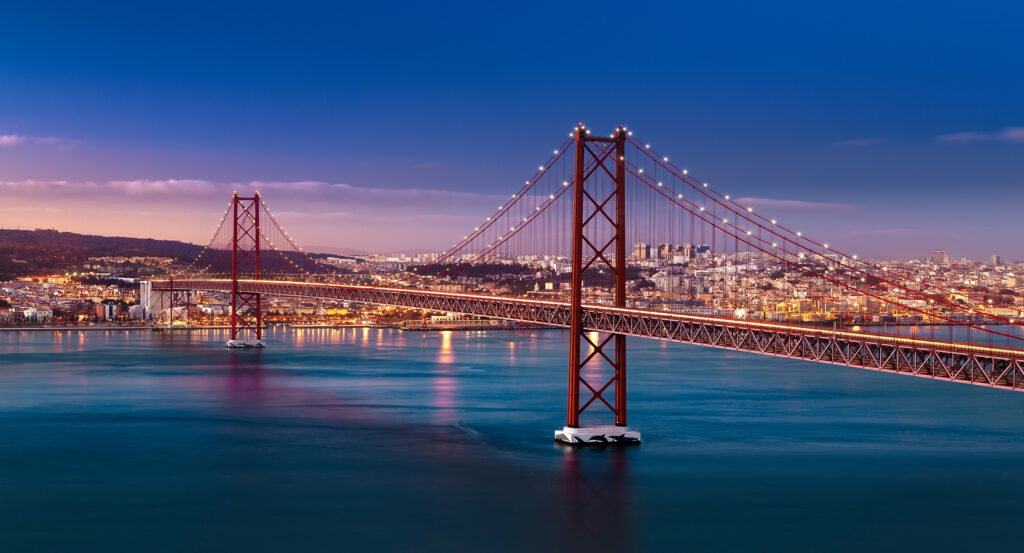
Perfect weekend in Lisbon, Portugal.
Lisbon's position overlooking the Tagus estuary shaped more than two millennia of maritime commerce, political ambition, and cultural exchange, establishing Portugal's capital as one of Europe's most historically influential Atlantic cities. Originally settled by communities connected to the ancient Mediterranean trading world, Lisbon developed into the Roman municipality of Olisipo, whose commercial importance rested upon access to the Atlantic and the agricultural resources of the surrounding region. Following periods of Visigothic rule, the city came under Muslim administration in 714, developing into an important commercial and cultural center of Al-Andalus. Afonso Henriques captured Lisbon in 1147 during the Christian reconquest of Portugal, beginning a period of royal investment and commercial expansion that culminated in its emergence as the kingdom's principal political center. During the fifteenth and sixteenth centuries, Lisbon became the administrative headquarters of Portugal's overseas empire, coordinating maritime expeditions and commercial enterprises across Africa, Asia, and the Americas. Vasco da Gama's voyage to India in 1497 opened a direct maritime route between Europe and the Indian Ocean, strengthening Lisbon's position within international commerce. Imperial wealth financed extensive architectural commissions and artistic patronage, although Portugal's overseas expansion also depended upon conquest, colonial exploitation, and the enslavement of African peoples. The earthquake of November 1, 1755, devastated substantial portions of Lisbon, prompting a reconstruction program directed by Sebastião José de Carvalho e Melo, the Marquis of Pombal. The resulting urban reforms introduced rational street planning, standardized building designs, and innovative structural techniques that became influential achievements of eighteenth-century European reconstruction.
Lisbon's artistic traditions extend through maritime craftsmanship, literature, decorative arts, music, and a culinary heritage shaped by Portugal's Atlantic connections. The Museu Nacional do Azulejo preserves an extensive collection of Portuguese ceramic tiles, tracing the development of decorative techniques influenced by Islamic craftsmanship, Renaissance design, and Baroque artistic patronage. The Museu Calouste Gulbenkian houses an internationally significant collection assembled by the Armenian-born collector Calouste Sarkis Gulbenkian, encompassing Egyptian antiquities, Islamic decorative arts, European painting, and works by René Lalique. Lisbon's literary achievements include the poetry of Luís de Camões, whose sixteenth-century epic Os Lusíadas became a foundational work of Portuguese literature, and Fernando Pessoa, whose innovative use of literary heteronyms transformed twentieth-century European poetry. Fado developed through Lisbon's nineteenth-century popular culture, combining expressive vocal performance with Portuguese guitar accompaniment and poetic compositions concerned with longing, memory, and human relationships. Amália Rodrigues brought the genre to international audiences during the twentieth century, becoming one of Portugal's most influential performers. Lisbon's culinary traditions draw upon Atlantic seafood, olive oil, regional vegetables, and centuries of exchange with Portugal's former overseas territories. Bacalhau preparations, grilled sardines, seafood rice, and traditional pastries occupy established places within the city's food culture, accompanied by wines from the Douro, Alentejo, and surrounding Portuguese regions. A perfect weekend in Lisbon brings together maritime history, distinctive hillside neighborhoods, Portuguese artistic achievements, and Atlantic gastronomy in a capital shaped by centuries of international exchange.
Three day itinerary.
Day 1: Alfama
Alfama is best known for preserving the steep medieval street pattern of Lisbon beneath São Jorge Castle and above the Tagus River. The quarter's name derives from the Arabic al-hamma, reflecting the centuries of Islamic rule that profoundly shaped Lisbon before Afonso Henriques captured the city in 1147. Narrow lanes, stairways, courtyards, fountains, churches, and compact houses developed across terrain poorly suited to later geometric planning. Alfama survived the catastrophic 1755 earthquake more completely than the lower districts subsequently reconstructed under the Marquês de Pombal, preserving an urban structure with origins predating modern Lisbon. The quarter later became deeply associated with fado through taverns and communities where the musical form developed as an expression of Lisbon's working-class culture. Alfama compresses Islamic inheritance, medieval urbanism, maritime history, religious architecture, and fado into the city's most consequential surviving historic district.
Day 1: Belcanto
Belcanto is best known for José Avillez's transformation of Portuguese culinary traditions into one of Lisbon's defining contemporary fine-dining institutions. Avillez assumed control of the historic Chiado restaurant in 2012 after developing his technique through Portuguese and international kitchens, including work with Ferran Adrià at elBulli. His cooking draws from Portugal's Atlantic fisheries, agricultural regions, traditional preparations, and maritime history through tasting menus constructed with modern technique and theatrical precision. Belcanto occupies a building near the Teatro Nacional de São Carlos, embedding the restaurant within the cultural architecture of Chiado. Its ascent helped position contemporary Portuguese cooking within the highest tier of European gastronomy and established Avillez as one of the chefs most closely associated with Lisbon's twenty-first-century culinary resurgence.
Day 2: Jerónimos Monastery
Jerónimos Monastery is best known for monumentalizing Portugal's maritime expansion through the extraordinary stonework of the Manueline architectural style. King Manuel I commissioned the monastery near the beginning of the sixteenth century on the site of a chapel associated with sailors departing from Belém. Construction was financed partly through wealth generated by Portugal's expanding overseas trade as voyages linked Lisbon with Africa, India, Asia, and Brazil. Diogo de Boitaca and João de Castilho shaped an architectural complex dense with maritime motifs, botanical carving, royal symbolism, elaborate portals, and soaring vaulted spaces. Vasco da Gama and Luís de Camões are entombed within the church, binding the monument to both Portuguese exploration and the literary mythology surrounding it. Jerónimos stands as the architectural culmination of the wealth, ambition, religion, and global expansion that transformed Portugal during the Age of Discovery.
Day 2: Feitoria
Feitoria is best known for translating Portugal's landscapes and products into contemporary fine dining beside the Tagus in Belém. The restaurant's culinary character draws from the country's Atlantic seafood, vegetables, meats, herbs, preserved ingredients, and regional products through technically exact compositions. Its location beside the river places the dining room within the Lisbon district most closely associated with Portugal's maritime expansion, giving the cuisine an unusually consequential geographical setting. The name itself recalls the feitorias, trading posts through which Portuguese merchants organized commerce across an expanding network of Atlantic, African, and Asian routes. Feitoria connects modern Portuguese gastronomy with a waterfront whose historical relationship with trade, navigation, and cultural exchange permanently altered the country's cuisine.
Day 2: Belém Tower
Belém Tower is best known for transforming military architecture into one of the supreme expressions of Portugal's Manueline style at the entrance to Lisbon's historic harbor. King Manuel I commissioned the fortified tower during the early sixteenth century as part of a defensive system protecting the Tagus approach to the capital. Francisco de Arruda combined late Gothic military forms with sculpted maritime ornament, royal heraldry, rope motifs, armillary spheres, and architectural details influenced by Portugal's encounters beyond Europe. The structure originally stood farther from the riverbank, surrounded by water before changes to the shoreline altered its physical setting. Gun positions in the lower bastion defended the navigation channel used by vessels entering Lisbon. Belém Tower joins artillery engineering, royal propaganda, maritime commerce, and architectural experimentation at the geographical threshold of imperial Lisbon.
Day 2: CURA
CURA is best known for contemporary Portuguese cooking built around the disciplined transformation of seasonal ingredients at Four Seasons Hotel Ritz Lisbon. The kitchen works across seafood, vegetables, meats, fermentation, sauces, and carefully controlled textures to construct tasting menus with Portugal as their culinary foundation. Ingredient provenance gives the restaurant a geographical reach extending from the Atlantic coastline into the country's farms, forests, and agricultural regions. Its setting within the historic Ritz places contemporary gastronomy inside a hotel conceived during the Estado Novo period as an ambitious expression of Portuguese luxury and international hospitality. CURA holds a MICHELIN star in Portugal's 2026 selection, placing it among the restaurants advancing Lisbon's increasingly sophisticated interpretation of Portuguese products.
Day 3: Confeitaria Nacional
Confeitaria Nacional is best known for preserving nearly two centuries of Lisbon pastry culture from its historic premises near Praça da Figueira. Baltazar Roiz Castanheiro founded the confectionery in 1829, establishing an institution that subsequently became a supplier to the Portuguese royal household. Portuguese egg-yolk confectionery, laminated doughs, cakes, breads, and traditional sweets connect its counters to techniques shaped through convent kitchens and Lisbon's long commercial history. The house became particularly associated with bolo-rei, the Portuguese Christmas cake whose form and ingredients entered the country through nineteenth-century European confectionery culture. Generations of the founding family maintained the business through monarchy, revolution, dictatorship, and democratic Portugal. Confeitaria Nacional gives a morning meal unusual historical depth through a pastry institution embedded in the commercial center of Lisbon since the reign of Miguel I.
Day 3: Castelo de São Jorge
Castelo de São Jorge is best known for occupying the fortified summit from which successive rulers controlled Lisbon and the Tagus estuary. Archaeological evidence on the hill reaches deep into antiquity, and the fortified complex acquired particular importance under Islamic rule as the defensive center of al-Ushbuna. Afonso Henriques captured Lisbon in 1147 with assistance from northern European crusaders during the broader Christian conquest of the Iberian Peninsula. Portuguese monarchs subsequently developed the citadel as a royal residence, making the hill a center of political authority before the court shifted toward the riverfront. Earthquakes, changing military technology, and later institutional uses altered the complex across centuries before twentieth-century reconstruction reshaped its surviving walls and towers. The castle captures Lisbon's succession of ancient settlement, Islamic fortification, medieval conquest, monarchy, and modern preservation on the city's commanding hilltop.
Day 3: LX Factory
LX Factory is best known for transforming a nineteenth-century industrial complex beneath the Ponte 25 de Abril into one of Lisbon's principal centers of adaptive reuse. Companhia de Fiação e Tecidos Lisbonense established textile manufacturing on the site at Alcântara during the industrial expansion that reshaped Lisbon's western waterfront. Printing, food processing, and other industries subsequently occupied portions of the complex as Alcântara developed around factories, docks, rail infrastructure, and working-class communities. Surviving brick buildings, workshops, industrial interiors, and circulation spaces later became studios, shops, restaurants, offices, bookstores, and cultural venues. The conversion preserved substantial elements of the manufacturing environment while introducing new economic uses into a district long defined by production and transportation. LX Factory captures Lisbon's transition from industrial waterfront city to a metropolitan economy increasingly built around design, culture, hospitality, and creative enterprise.
Day 3: Henrique Sá Pessoa
Henrique Sá Pessoa is best known for the chef's contemporary interpretation of Portuguese cuisine through techniques developed across an international career. Sá Pessoa trained at Le Cordon Bleu in London before working in kitchens abroad and returning to Portugal, where his cooking became increasingly focused on the products and culinary traditions of his native country. Seafood, rice, vegetables, meat, broths, sauces, and Portuguese regional ingredients form the foundation for compositions shaped by classical discipline and influences gathered beyond Portugal. His flagship restaurant entered a new chapter in 2026 under his own name after the evolution of Alma, concentrating the chef's character more explicitly within the dining room. The restaurant holds two MICHELIN stars in the 2026 Portuguese selection, placing Sá Pessoa alongside Lisbon's most consequential contemporary chefs.
Where your story begins.
Foresyte Travel reveals places that feel extraordinary long before you arrive.
Enjoy editorial crafted for luxury travelers.
Foresyte may earn a commission when you book.







































































































