
Why Jerónimos Monastery matters.
Jerónimos Monastery is a historic Manueline monastery where Belém's maritime heritage meets the royal ambitions of Manuel I, the religious foundations of Portugal's overseas expansion and an architectural achievement that gave enduring form to the wealth and artistic craftsmanship of the Age of Discoveries.
Standing on Praça do Império beside Rua de Belém, the monastery occupies an extensive site north of the Tagus waterfront, where its elongated limestone façade faces formal gardens and broad public spaces near the historic river approaches once used by Portuguese expeditions departing Lisbon. Ornate portals interrupt the building's horizontal composition, introducing sculpted figures, pinnacles and intricate stone tracery. The church and adjoining cloisters form a connected architectural complex organized around ceremonial spaces and enclosed courtyards. Pale limestone surfaces reveal the precision of the masonry and the unusually elaborate decorative program. The result is an imposing religious complex whose architecture preserves the political, artistic and spiritual ambitions of sixteenth-century Portugal.
What defines Jerónimos Monastery.
Jerónimos Monastery is best known for its exceptional Manueline architecture and its foundation under King Manuel I during the period when Portuguese maritime expeditions established trading connections across Africa, Asia and the Indian Ocean. The site previously accommodated the Hermitage of Santa Maria de Belém, associated with the Order of Christ and the religious needs of sailors departing Lisbon. Vasco da Gama and his expedition spent time in prayer at the hermitage before sailing toward India in 1497. Following da Gama's successful return in 1499, Manuel I advanced plans for a substantial religious complex commemorating the achievements of Portuguese navigation. Construction began in 1501 or 1502, supported by royal revenues associated with expanding overseas commerce. The king entrusted the monastery to the Order of Saint Jerome, whose monks maintained religious services and offered spiritual assistance to travelers. Architect Diogo de Boitaca directed the earliest construction phase, establishing the principal organization of the church and monastic buildings. His work introduced architectural elements combining late Gothic forms with the ornamental characteristics that subsequently defined the Manueline style. João de Castilho assumed a leading role during the following decades, developing the elaborate stonework of the cloisters and the church's structural system. The construction program incorporated the work of sculptors and master masons whose decorative carvings drew upon religious imagery, royal symbolism and maritime references. Diogo de Torralva contributed to later phases, continuing the development of the architectural complex during the sixteenth century. The monastery's construction extended across several generations, producing a building that incorporated changing artistic influences within a coherent religious institution. The complex survived the earthquake of 1755 with comparatively limited structural damage, preserving much of its original architectural fabric. Following the dissolution of religious orders in Portugal in 1834, the monastic community departed and the buildings entered new institutional uses. The monastery became an important site of national commemoration, receiving the remains of significant Portuguese historical figures. UNESCO inscribed Jerónimos Monastery and the nearby Tower of Belém on the World Heritage List in 1983, recognizing their importance to the architectural and maritime history of Portugal.
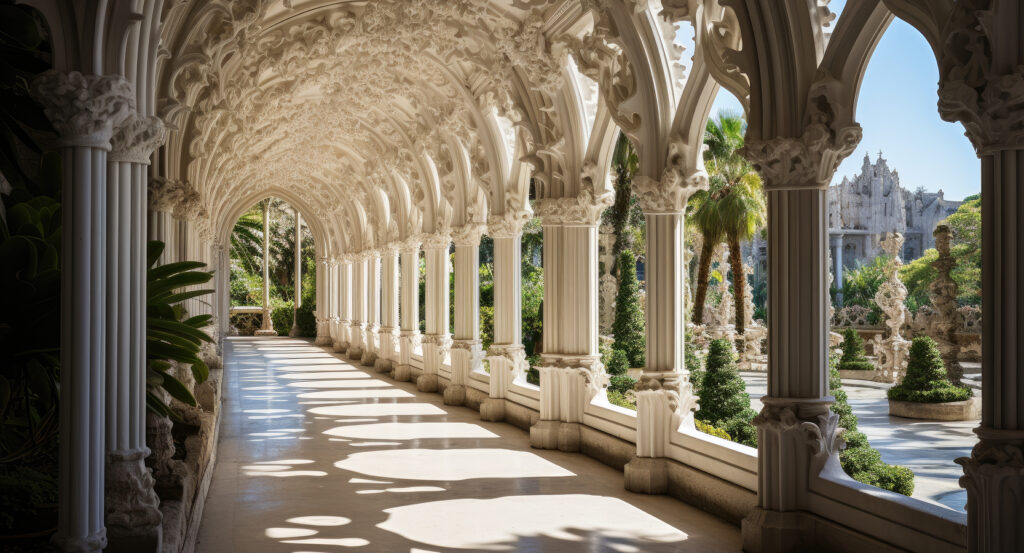
João de Castilho's architectural work gives the monastery's interior its distinctive structural and decorative character through the integration of complex vaulting, slender supports and exceptionally detailed stone carving. The Church of Santa Maria de Belém contains a broad nave organized beneath an elaborate ribbed vault whose intersecting patterns extend across the ceiling. Slender columns support the overhead structure, creating an unusually open interior for a late Gothic church. The vaulting distributes structural loads through carefully arranged ribs, allowing the central space to develop a sense of remarkable height and continuity. The south portal, associated with Castilho's workshop, incorporates an extensive sculptural program arranged around pointed arches, canopies and religious figures. Its vertical composition includes representations of saints and royal patrons, connecting the church's entrance with the devotional and political purposes of its foundation. The adjoining cloisters introduce a more intimate architectural arrangement through two levels of arcaded galleries surrounding a rectangular courtyard. Intricate tracery fills the openings, combining vegetal ornament, heraldic emblems and sculpted motifs associated with Portuguese royal authority. Armillary spheres appear among the decorative elements, recalling Manuel I's personal emblem and the navigational instruments associated with maritime exploration. The Cross of the Order of Christ contributes a further symbolic reference to the religious institutions connected with Portuguese overseas expansion. Sunlight passes through the carved stone openings, producing changing patterns of illumination across the galleries and courtyard. The cloisters' upper level provides a different perspective on the vaulting and ornamental detail, revealing the precision of the architectural composition. Within the church, the tombs of Vasco da Gama and Luís de Camões establish a commemorative connection between Portuguese navigation and literary achievement. Their funerary monuments place the explorer and the poet within the religious building most closely associated with the country's maritime expansion. Jerónimos Monastery unites structural innovation, royal symbolism and religious craftsmanship within an architectural complex whose individual details remain inseparable from the historical ambitions of its foundation.
How Jerónimos Monastery fits.
Jerónimos Monastery works as the architectural centerpiece for a Lisbon outing connecting Portugal's maritime exploration, its ceremonial waterfront monuments and the institutions that preserve the cultural history of Belém.
Begin at Belém Tower, the fortified structure completed in the early sixteenth century near the northern bank of the Tagus River. Commissioned during the reign of Manuel I, the tower formed part of Lisbon's defensive system protecting the river approaches to the capital. Architect Francisco de Arruda developed a composition incorporating a fortified bastion, an elevated tower and decorative elements associated with Manueline architecture. Its carved stonework includes royal heraldry, maritime ornament and distinctive sculptural details. The building's position beside the water preserves its historical relationship with navigation, defense and the movement of vessels entering Lisbon. Continue to Padrão dos Descobrimentos, the substantial monument commemorating Portuguese maritime exploration along the Belém waterfront. The original structure was created for the Portuguese World Exhibition of 1940, and the permanent monument was completed in 1960 to commemorate the five-hundredth anniversary of the death of Prince Henry the Navigator. Designed by architect Cottinelli Telmo and sculptor Leopoldo de Almeida, the monument takes the form of a stylized ship's prow. Sculpted figures representing explorers, navigators and other historical personalities extend along its sides. A large compass rose and world map embedded in the surrounding pavement demonstrate the geographical reach of Portuguese voyages. Conclude at Museu de Marinha, the maritime museum occupying part of the western monastery complex. Its collections examine Portuguese naval history through ship models, navigational instruments, historical paintings and objects associated with maritime expeditions. The museum preserves materials connected with the development of Portuguese seafaring from the Age of Discoveries through subsequent periods of naval expansion. Its exhibition spaces include ceremonial vessels and substantial collections devoted to the technologies of navigation. The institution provides a detailed historical counterpart to the monuments of Belém, connecting architectural commemoration with the practical instruments and vessels used in maritime exploration. The progression moves from Belém Tower's defensive architecture through Padrão dos Descobrimentos' commemorative sculpture and culminates at Museu de Marinha's maritime collections, connecting Jerónimos Monastery with the technological and political history of Portuguese navigation.
Where your story begins.
Foresyte Travel reveals places that feel extraordinary long before you arrive.
Enjoy editorial crafted for luxury travelers.
Foresyte may earn a commission when you book.














































































































