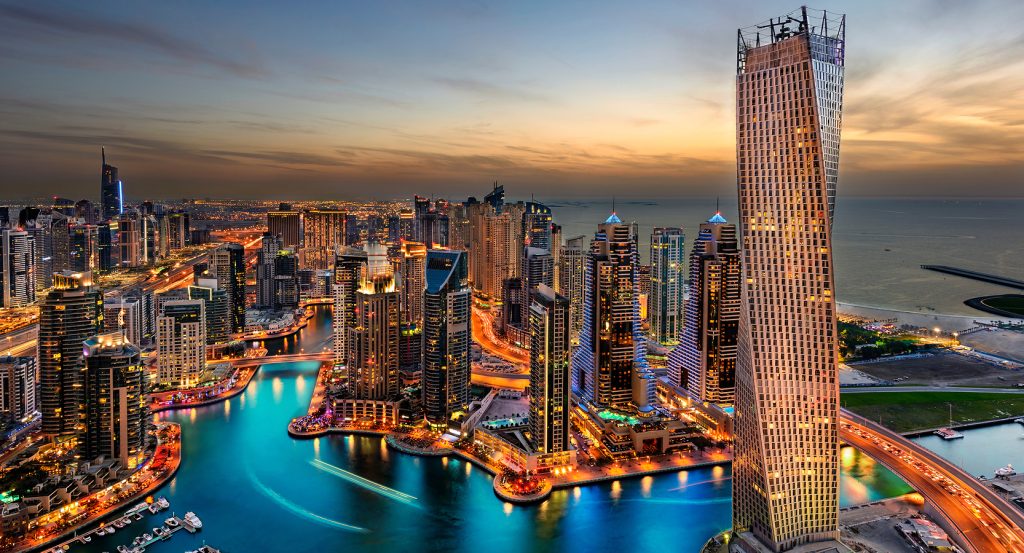
Perfect weekend in Dubai, United Arab Emirates.
Dubai's rise as a center of international commerce began along the sheltered waters of Dubai Creek, where maritime trade, pearl diving, and relationships with the Arabian Peninsula's interior supported the growth of a settlement that eventually became one of the Middle East's principal metropolitan centers. Archaeological discoveries across the surrounding emirate trace human activity to prehistoric communities that inhabited the region's desert plains, coastal environments, and seasonal waterways. During the early Islamic period, settlements along the southeastern Arabian coast participated in trading networks connecting Mesopotamia, Persia, India, and East Africa. Dubai developed as a fishing and pearling community before the Al Maktoum family established its rule in 1833, beginning the dynasty that continues to govern the emirate. Sheikh Maktoum bin Butti led members of the Bani Yas tribal confederation to Dubai, strengthening its political independence and commercial position along the Gulf. During the nineteenth century, merchants established trading relationships with ports throughout the Indian Ocean, and the settlement attracted commercial families from Persia and neighboring Arabian territories. Dubai became part of the British-protected Trucial States through agreements governing maritime security and foreign relations. The collapse of the natural pearl industry during the early twentieth century, accelerated by the Great Depression and the introduction of cultured pearls, brought severe economic difficulties to coastal communities. Sheikh Rashid bin Saeed Al Maktoum subsequently pursued major infrastructure investments, including the dredging of Dubai Creek in the late 1950s to accommodate larger commercial vessels. Petroleum was discovered offshore in 1966, providing financial resources for expanded transportation, public utilities, and port construction. Dubai joined six neighboring emirates in establishing the United Arab Emirates in 1971, with Ras Al Khaimah joining the federation the following year. The opening of Port Rashid in 1972 and Jebel Ali Port in 1979 strengthened Dubai's position as an international shipping center. Subsequent investment in aviation, finance, real estate, and tourism accelerated metropolitan growth, establishing a commercial economy closely connected to markets across Asia, Europe, and Africa.
Emirati maritime traditions developed through centuries of navigation across the Arabian Gulf, where shipbuilding, pearl diving, and commercial exchange shaped the cultural practices of coastal communities. Traditional wooden dhows carried dates, textiles, spices, and other commodities between Arabian ports and markets in India and East Africa, supporting the prosperity of merchant families throughout the region. Pearl diving became a principal occupation before the twentieth century, with crews undertaking seasonal expeditions governed by specialized maritime knowledge and longstanding social customs. Divers relied upon weighted ropes, nose clips, and the assistance of experienced crew members, and their voyages inspired nahma, a tradition of maritime singing performed to coordinate labor and sustain morale. The Al Shindagha Museum explores Dubai's commercial and social development through exhibitions devoted to maritime history, traditional crafts, and the lives of its early communities. Emirati poetry also preserves connections to the Arabian Peninsula's oral traditions, particularly nabati verse, which developed through Bedouin communities and became associated with hospitality, genealogy, historical events, and expressions of personal devotion. Traditional performing arts include al-ayyala, a ceremonial group performance incorporating poetry, percussion, and coordinated movement that holds an established place in national celebrations. The Etihad Museum examines the political formation of the United Arab Emirates through exhibitions devoted to the federation's founding leaders and the events surrounding independence. Dubai's culinary traditions developed through the interaction of Arabian desert cooking, Gulf fisheries, Persian trade, and South Asian migration. Emirati preparations include machboos, a spiced rice dish served with meat or fish; harees, a slow-cooked combination of wheat and meat; and thareed, a stew served over thin bread. Cardamom, saffron, dried lime, and cinnamon contribute to the aromatic character of regional cooking, reflecting centuries of trade across the Indian Ocean. Traditional hospitality centers upon Arabic coffee and dates, with coffee preparation and service retaining ceremonial importance during family gatherings and public occasions. Dubai's Indian, Pakistani, Iranian, and Levantine communities have contributed additional culinary traditions through restaurants, bakeries, and specialist markets established across the city. Contemporary chefs build upon these influences through regional ingredients, international techniques, and ambitious interpretations of Middle Eastern cuisine. A weekend in Dubai reveals the enduring influence of Arabian maritime culture amid the architectural ambition, international commerce, and culinary diversity of the modern Gulf metropolis.
Three day itinerary.
Day 1: Burj Khalifa
Burj Khalifa is best known for pushing the structural limits of the skyscraper to a height of 828 meters. Emaar Properties developed the tower as the centerpiece of Downtown Dubai, with Adrian Smith designing it at Skidmore, Owings & Merrill and William F. Baker leading its structural engineering. Its Y-shaped plan and buttressed-core system distribute structural loads through three wings arranged around a reinforced-concrete hexagonal core, allowing the building to narrow through successive setbacks as it rises. Construction began in 2004, and the completed tower opened in 2010 as the tallest building in the world. Burj Khalifa transformed Dubai's skyline into a global symbol of extreme vertical engineering and anchored the large-scale urban development of the surrounding Downtown district.
Day 1: Trèsind Studio
Trèsind Studio is best known for Himanshu Saini's transformation of Indian fine dining through a tasting menu that traverses the subcontinent's regional cuisines. Saini developed the restaurant from the broader Trèsind project before establishing Studio as an intimate culinary destination on Palm Jumeirah. Its cooking draws from regions across India, using fermentation, grilling, regional spice structures, vegetables, seafood, and reinterpretations of traditional preparations within meticulously constructed courses. A 15-seat dining room concentrates attention on the progression produced by Saini and his kitchen. Three MICHELIN stars place Trèsind Studio at the highest level of Dubai dining and establish it as one of the most internationally consequential Indian restaurants of its generation.
Day 2: Palm Jumeirah
Palm Jumeirah is best known for extending Dubai into the Persian Gulf through one of the largest artificial-island developments undertaken for urban use. Nakheel developed the palm-shaped archipelago through immense land-reclamation works beginning in 2001, using sand dredged from the Gulf and rock placed to form an encircling breakwater. A central trunk connects to 17 fronds, creating an extensive new shoreline for residences, hotels, and resort development. Satellite positioning guided the placement of reclaimed material across a geometry designed to remain legible at metropolitan scale. Subsequent development transformed the island into a major concentration of luxury hospitality and residential property, making engineered coastline a defining component of Dubai's twenty-first-century expansion.
Day 2: Il Ristorante-Niko Romito
Il Ristorante-Niko Romito is best known for translating Niko Romito's rigorous interpretation of Italian cuisine into the Bulgari Resort Dubai on Jumeirah Bay Island. Romito developed his international reputation from Reale in Abruzzo, where disciplined reduction and intensive examination of ingredients became central to his culinary approach. His Bulgari collaboration extended that philosophy through restaurants designed around a contemporary interpretation of Italian dining. Giacomo Amicucci leads the Dubai kitchen, building its menus around Italian ingredients, seafood, pasta, and compositions marked by exceptional technical restraint. Two MICHELIN stars place Il Ristorante among Dubai's highest-rated restaurants and connect the city's international dining culture to one of contemporary Italy's most influential chefs.
Day 2: Dubai Desert Conservation Reserve
Dubai Desert Conservation Reserve is best known for protecting a substantial expanse of desert ecosystem within an emirate transformed by rapid urban development. The protected area encompasses 225 square kilometers and grew from conservation initiatives associated with the reintroduction and management of native wildlife. Arabian oryx became central to restoration efforts after hunting and habitat pressures had devastated wild populations across the Arabian Peninsula. Gazelles, desert reptiles, birds, and native vegetation inhabit a landscape of dunes and gravel plains governed through conservation and controlled access. Its establishment placed ecological preservation within Dubai's broader development model, protecting a significant portion of the emirate as a permanent desert environment tied to Arabian natural history.
Day 2: Orfali Bros
Orfali Bros is best known for Mohamad, Wassim, and Omar Orfali's transformation of their Aleppan culinary inheritance into one of Dubai's most important homegrown restaurants. The brothers grew up in Aleppo before their careers carried them through kitchens and pastry programs across the Middle East, Europe, and Asia. Mohamad leads the savory kitchen, with Wassim and Omar bringing specialized pastry expertise to a menu built around Syrian memory, international technique, fermentation, and ingredients drawn from multiple culinary traditions. They opened Orfali Bros in Dubai in 2021 and progressively expanded the sophistication of the original bistro concept. Its promotion to two MICHELIN stars in 2026 established the brothers among the highest-ranked independent restaurateurs in a city historically dominated at the luxury level by imported international concepts.
Day 3: Al Khayma Heritage Restaurant
Al Khayma Heritage Restaurant is best known for concentrating Emirati cooking and hospitality within the historic fabric of Al Fahidi. The restaurant occupies a traditional-style courtyard setting whose architecture recalls the domestic environments that preceded Dubai's high-rise expansion. Its kitchen centers Emirati preparations including machboos, grilled meats, freshly baked breads, dates, and luqaimat, preserving culinary forms shaped by the Arabian Peninsula's historic relationships with trade, pastoral life, fishing, and maritime exchange. Cooking stations and traditional service practices place food production directly within the dining environment. MICHELIN's Bib Gourmand distinction gives Al Khayma unusual significance within Dubai's elite itinerary, grounding the city's extraordinary international restaurant culture in the cuisine of the Emirates themselves.
Day 3: Dubai Gold Souk
Dubai Gold Souk is best known for concentrating the city's historic precious-metals trade within the commercial fabric of Deira. Dubai's position between trading networks linking India, Persia, Arabia, East Africa, and Europe helped establish gold as an important commodity in the city's twentieth-century mercantile economy. Shops clustered through narrow covered streets near Dubai Creek, where maritime commerce had already created a dense district of merchants, warehouses, and markets. The souk developed particular prominence through the sale of high-purity gold jewelry, bullion, gemstones, and elaborate pieces shaped by South Asian and Middle Eastern traditions. Its continued presence in Deira preserves a direct connection between contemporary Dubai's enormous luxury economy and the trading culture that preceded the discovery-driven transformation of the emirate.
Day 3: Dubai Fountain
Dubai Fountain is best known for turning the artificial Burj Khalifa Lake into a grand stage for choreographed water, light, and music. WET Design created the system beside Burj Khalifa and Dubai Mall as part of the larger Downtown Dubai development. High-pressure mechanisms propel water through coordinated patterns across the lake, with illuminated jets synchronized to musical programs drawn from Arabic and international repertoires. The installation opened in 2009 during the rapid completion of the surrounding district, giving the newly constructed urban center a large-scale public performance at ground level. Its integration with Burj Khalifa and the surrounding architecture created a deliberately theatrical civic space at the center of Dubai's most ambitious vertical development.
Day 3: FZN by Björn Frantzén
FZN by Björn Frantzén is best known for extending Björn Frantzén's highly structured Scandinavian-Asian cooking into Dubai through an intimate restaurant at Atlantis The Royal. Frantzén built his international reputation in Stockholm, where his flagship became the first Swedish restaurant awarded three MICHELIN stars, before expanding his culinary organization into Singapore and the Middle East. FZN develops that lineage through a tasting sequence combining Scandinavian foundations with Japanese technique and ingredients drawn from wider Asian culinary traditions. The restaurant occupies an intimate two-level setting that organizes the meal through successive spaces and stages of service. Three MICHELIN stars place FZN beside Trèsind Studio at the summit of Dubai's 2026 MICHELIN hierarchy, giving the city two restaurants holding the guide's highest distinction.
Where your story begins.
Foresyte Travel reveals places that feel extraordinary long before you arrive.
Enjoy editorial crafted for luxury travelers.
Foresyte may earn a commission when you book.