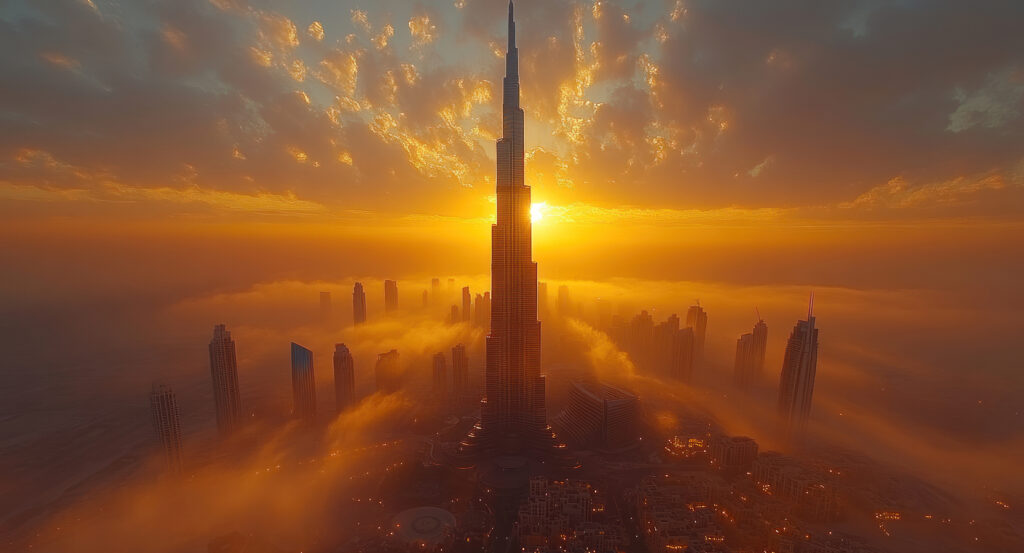
Why Burj Khalifa matters.
Burj Khalifa is a soaring skyscraper where Downtown Dubai's architectural ambition, engineering innovation, global vision, and modern urba character redefine the limits of vertical construction.
Set along Sheikh Mohammed bin Rashid Boulevard near Financial Centre Road and just steps from Dubai Mall, this elegant tower ascends through refined observation decks, luxurious interiors, corporate spaces, residences, and precisely engineered structural systems where sweeping views stretch across the Arabian Gulf, the Dubai skyline, and the surrounding desert. Stainless steel, reflective glass, sculpted setbacks, and graceful proportions create a silhouette inspired by the desert spider lily while expressing one of the most sophisticated feats of structural engineering ever achieved. Innovation, precision, and architectural excellence define every level of the ascent.
What defines Burj Khalifa.
Burj Khalifa is best known for opening in 2010 as the world's tallest building after construction began in 2004 under architect Adrian Smith of Skidmore, Owings & Merrill and structural engineer William F. Baker, rising 828 meters across 163 occupied floors through the pioneering buttressed-core structural system that fundamentally advanced the engineering of supertall skyscrapers while establishing a new benchmark for vertical construction. Developed by Emaar Properties as the centerpiece of Downtown Dubai, the tower required more than 330,000 cubic meters of reinforced concrete, 39,000 tonnes of structural steel reinforcement, and over 26,000 hand-cut glass panels covering its exterior curtain wall. The Y-shaped floor plan, inspired by the regional Hymenocallis flower, maximizes structural stability while increasing exterior window frontage for residences, offices, and hospitality spaces. More than 12,000 workers representing over one hundred nationalities participated in construction during peak activity, while specially formulated high-performance concrete was pumped to unprecedented heights exceeding 600 meters, establishing multiple world records during construction. The building incorporates one of the world's fastest elevator systems, advanced wind engineering validated through extensive wind tunnel testing, high-capacity mechanical systems, and carefully integrated sustainability measures including condensate recovery capable of collecting millions of liters of water annually for landscape irrigation. The tower contains At the Top observation experiences on levels 124, 125, and 148, residences designed with Armani, corporate offices, and the Armani Hotel Dubai occupying the lower floors. Since its inauguration on 4 January 2010, Burj Khalifa has continued serving as the centerpiece for internationally broadcast New Year's celebrations, architectural research, structural monitoring, and engineering innovation while remaining the tallest completed building ever constructed.
Advanced structural engineering, aerodynamic massing, sophisticated building systems, and precision construction demonstrate how architecture and engineering successfully overcame the challenges associated with extreme height. The buttressed-core system, carefully tapered setbacks, high-performance façade, advanced vertical transportation, tuned mechanical systems, and continuous structural monitoring demonstrate the collaborative achievements of architects, engineers, material scientists, and construction specialists working at an unprecedented scale. Ongoing façade maintenance, engineering assessment, sustainability initiatives, and operational refinements ensure the tower continues setting standards for supertall building performance. Architectural vision, engineering excellence, and technical innovation combine to create one of the world's most influential skyscrapers.
How Burj Khalifa fits.
Burj Khalifa works as the centerpiece of an exploration through Downtown Dubai's celebrated attractions.
Begin at Dubai Mall, where world-class shopping, dining, and cultural experiences establish the setting before ascending Burj Khalifa. Continue to Dubai Fountain, whose choreographed performances complement the tower's commanding presence beside Burj Lake. Conclude at Souk Al Bahar, where waterfront terraces and traditional-inspired architecture provide a memorable finale overlooking the illuminated skyline. The progression moves naturally from contemporary urban development to engineering achievement before concluding along the waterfront, revealing why Downtown Dubai stands among the world's foremost modern city centers.
Where your story begins.
Foresyte Travel reveals places that feel extraordinary long before you arrive.
Enjoy editorial crafted for luxury travelers.
Foresyte may earn a commission when you book.