Why Sheikh Mohammed bin Rashid Boulevard matters.
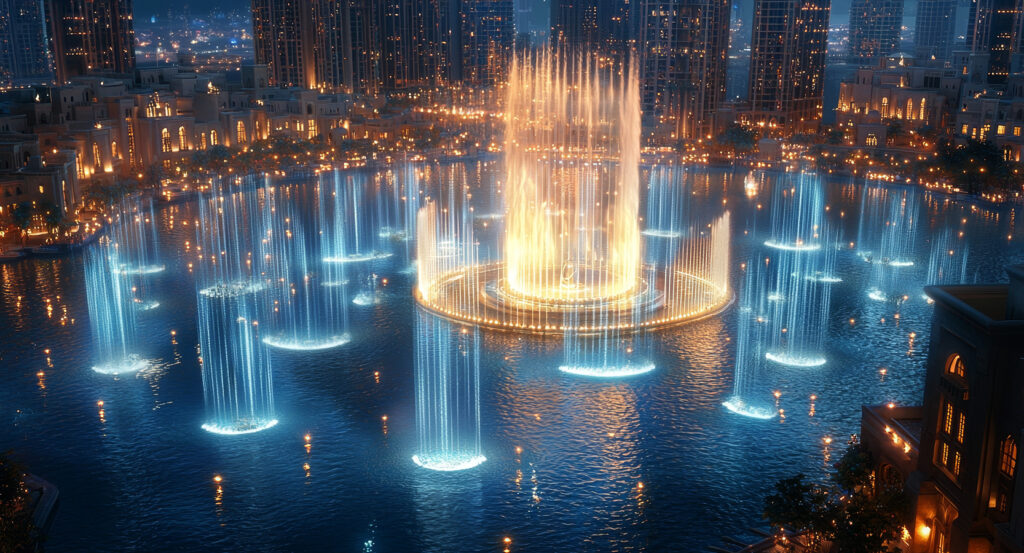
Sheikh Mohammed bin Rashid Boulevard is a grand urban corridor where Downtown Dubai's vertical ambition meets landscaped promenades, public art and the architectural concentration surrounding Burj Khalifa.
Running through Downtown Dubai between Financial Center Road and the districts approaching Business Bay, the curving boulevard follows a broad circuit around Burj Khalifa and Burj Lake, passing the district's tower clusters before bending through lower-rise residential and hospitality blocks. Generous pavements establish a continuous pedestrian edge beneath palms and shade trees. Building heights repeatedly change along the route, shifting from the extraordinary vertical emphasis surrounding Burj Khalifa to mid-rise perimeter blocks whose podiums maintain a closer relationship with the street. Sculptures and planted medians punctuate the roadway as the tower remains visible through changing angles across the district. The result is a deliberately composed urban circuit whose curves, landscaping and changing architectural scale turn the center of Downtown Dubai into a continuous street-level sequence.
What defines Sheikh Mohammed bin Rashid Boulevard.
Sheikh Mohammed bin Rashid Boulevard is best known for forming the principal street circuit through Downtown Dubai, the Emaar Properties development conceived as a new metropolitan center around Burj Khalifa. Emaar began assembling the Downtown project during the early 2000s as part of a vast redevelopment of land beside Sheikh Zayed Road. The district's centerpiece entered construction in 2004 as Burj Dubai, with Adrian Smith leading its design at Skidmore, Owings & Merrill and Bill Baker directing structural engineering. Dubai Mall opened in 2008, bringing an immense commercial anchor to the emerging district before the tower itself was completed. Burj Dubai reached 828 meters and opened on January 4, 2010 as Burj Khalifa, establishing the development around the tallest building ever constructed. The surrounding street was originally known as Emaar Boulevard, directly identifying the developer responsible for the district. In 2012 it was renamed Mohammed Bin Rashid Boulevard in honor of Sheikh Mohammed bin Rashid Al Maktoum, whose tenure as ruler coincided with Downtown Dubai's emergence as one of the emirate's principal urban centers. Emaar subsequently adopted Sheikh Mohammed bin Rashid Boulevard as the fuller form of the name, placing the corridor within the same civic nomenclature as several major Dubai institutions and infrastructure projects. The boulevard now functions as the connective urban element between the district's towers, residences, hotels, cultural buildings and major public spaces, giving Downtown Dubai a continuous street structure beneath architecture conceived at an unprecedented metropolitan scale.
Public art became one of the corridor's defining design programs as Emaar placed grand sculpture directly within the boulevard landscape. Fernando Botero's Horse 2007 brings the Colombian artist's characteristically swollen proportions into bronze, turning an animal form into a massive sculptural presence against the surrounding towers. Syrian artist Lutfi Romhein's Together, presents a standing Arab couple through contrasting stone, with the male figure carved from Carrara marble and the female figure formed from black Swedish granite. Donald Greig's Camels shifts toward an animal inseparable from Arabian history, translating a caravan into bronze forms positioned within the modern district. South African sculptor Vincent Da Silva contributed Wild Kong, combining a gorilla figure with a crown and geometric surface treatment. Xavier Corberó's Desert Sails uses abstract vertical forms whose curved profiles recall sails and desert movement. Those works place artists from Europe, Latin America, Africa and the Middle East into the same streetscape, creating a dispersed outdoor collection encountered through movement around the boulevard. Sheikh Mohammed bin Rashid Boulevard derives much of its street-level distinction from this integration of grand sculpture with architecture and landscape, giving the corridor an artistic layer independent of the towers surrounding it.
How Sheikh Mohammed bin Rashid Boulevard fits.
Sheikh Mohammed bin Rashid Boulevard works as the urban anchor for an outing connecting a purpose-built opera house shaped by Dubai's maritime history, a grand figurative sculpture and a pedestrian bridge conceived as a piece of calligraphic infrastructure.
Begin at Dubai Opera, designed by Atkins and opened in 2016 as the principal performing-arts venue within Downtown Dubai. Architect Janus Rostock developed the building around the profile of a traditional dhow, dividing its maritime reference between a glass-fronted bow containing the principal auditorium and a more solid stern containing supporting functions. The 2,000-seat interior incorporates mechanical systems that transform the auditorium among theatre, concert-hall and flat-floor configurations, allowing opera, orchestral music, theatre and large events to occupy the same room. Plácido Domingo inaugurated the venue with its opening performance on August 31, 2016, establishing an international classical program within a district developed primarily during the twenty-first century. Continue to Wings of Mexico, the grand bronze sculpture by Mexican artist Jorge Marín. The work places two enormous feathered wings on a pedestal designed for a human figure to stand between them, making the viewer's body part of the composition. Marín developed the project from a sculpture first installed in Mexico City in 2010, and subsequent versions traveled internationally as symbols associated with aspiration and freedom. Its Dubai installation frames Burj Khalifa between the wings from selected viewpoints, connecting Marín's figurative language with the extreme verticality of the surrounding skyline. Conclude at Bridge of Tolerance, designed by Dubai-based architect Wael Al Awar and opened across the Dubai Water Canal in 2017. Its sinuous structure rises above the canal without intermediate supports obstructing the waterway, creating a pedestrian connection whose profile recalls a sweeping stroke of Arabic calligraphy. The bridge received its name during the UAE's emphasis on tolerance as a national civic principle and joined a canal system opened in 2016 after the extension of Dubai Creek transformed part of the city into a continuous waterfront route. The progression moves from dhow-inspired architecture engineered for changing forms of performance through a participatory Mexican sculpture and culminates in a calligraphic bridge spanning Dubai's reconstructed waterway, connecting three expressions of contemporary design across the central city.
Where your story begins.
Foresyte Travel reveals places that feel extraordinary long before you arrive.
Enjoy editorial crafted for luxury travelers.
Foresyte may earn a commission when you book.