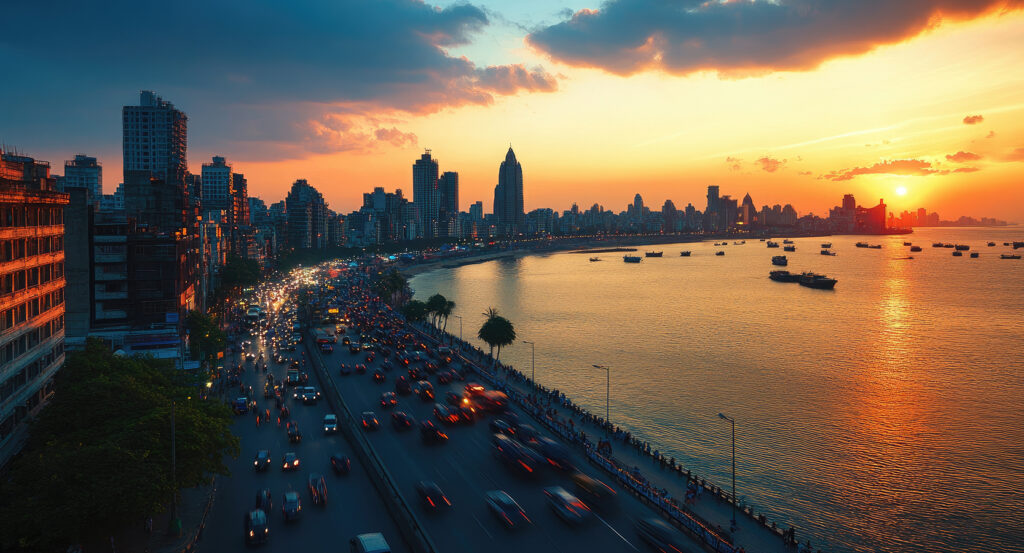
Top places to stay in Mumbai, India.
Mumbai carries a rich hospitality legacy shaped by the maritime wealth of Bombay Harbour, the commercial ambitions of British colonial rule, and the rise of Indian enterprise, with grand waterfront architecture, the influence of Bollywood, and the traditions of Indian service giving the city a commanding place in international luxury travel. The seven islands that formed Bombay passed from Portuguese to British control during the seventeenth century, and the East India Company developed the harbor into a major commercial center. Merchants, shipowners, and colonial officials initially relied on private residences, clubs, and modest lodging houses. The opening of the Great Western Hotel in the nineteenth century introduced a more formal style of accommodation for travelers arriving by sea. Bombay's commercial importance accelerated after the opening of the Suez Canal in 1869, which shortened shipping routes between India and Europe. Cotton exports, textile manufacturing, and mercantile finance generated fortunes that transformed the city's architecture and social institutions. The completion of Victoria Terminus in 1887 strengthened Bombay's railway connections with the Indian interior, bringing additional business travelers into its commercial districts. The city's most consequential hospitality landmark arrived in 1903, when industrialist Jamsetji Tata opened the Taj Mahal Palace overlooking the harbor. Its architectural composition united Indo-Saracenic influences with European design, introducing an unprecedented level of luxury to Indian-owned hotel accommodation. The property became a gathering place for international travelers, political leaders, and prominent figures in Bombay society. During the early twentieth century, the city's hotels served a growing professional class alongside merchants and visitors connected to the independence movement. India's independence in 1947 initiated a new chapter as Bombay consolidated its importance in national finance, manufacturing, and entertainment. The opening of the Oberoi Sheraton in 1973 marked the expansion of international-standard luxury accommodation along Marine Drive. Suburban development and the growth of commercial aviation subsequently shifted substantial hotel investment toward the airport and northern business districts. The establishment of the Bandra Kurla Complex as a major financial center created further demand for contemporary business hotels. The city officially adopted the name Mumbai in 1995, reflecting the Marathi name associated with the goddess Mumbadevi. The coordinated terrorist attacks of November 2008 struck several prominent locations, including two luxury hotels, leaving a profound mark on the city. Subsequent restoration and investment reinforced the significance of its historic hospitality institutions. Today, Mumbai's hotel industry captures the accumulated influence of maritime commerce, industrial wealth, Indian entrepreneurship, and the international ambitions of the country's financial capital.
Mumbai's accommodation landscape stretches across a narrow coastal peninsula and its expanding suburbs, creating distinct hotel environments shaped by the Arabian Sea, historic commercial districts, and the geography of a densely populated metropolis. Colaba occupies the southern tip of the original city, where prestigious waterfront hotels stand near the Gateway of India and the working harbor. Its streets combine Victorian commercial buildings, historic residential properties, and established cultural institutions, offering an intimate setting for exploring South Mumbai. Northward, the Fort district preserves an exceptional concentration of Gothic Revival and Indo-Saracenic architecture, with expansive civic buildings and former trading houses reflecting the city's colonial commercial importance. Boutique accommodation occupies restored properties near galleries, bookshops, and established business institutions. The neighboring Kala Ghoda precinct provides a particularly distinguished cultural setting through historic façades, museums, and pedestrian streets associated with contemporary art and design. West of the commercial core, Marine Drive curves along Back Bay beneath a succession of Art Deco apartment buildings and substantial hotels. The promenade offers expansive views across the Arabian Sea, with the surrounding architecture contributing to one of Mumbai's most recognizable urban landscapes. At its northern end, Chowpatty Beach introduces a lively public waterfront beneath the residential slopes of Malabar Hill. The adjoining neighborhoods contain elegant apartment buildings, established private residences, and smaller hospitality properties within reach of the city's southern cultural institutions. Farther north, Worli occupies a prominent coastal position where contemporary luxury towers rise above former industrial land and established residential neighborhoods. Hotels here emphasize expansive sea views, sophisticated contemporary interiors, and access to major corporate offices. The Bandra-Worli Sea Link provides a dramatic connection toward the western suburbs, where Bandra combines historic village streets, Portuguese-influenced houses, contemporary residential buildings, and fashionable commercial corridors. Boutique hotels and upscale accommodation serve visitors drawn to its restaurants, shopping, and creative community. Northward, Juhu introduces a contrasting coastal environment through its broad sandy beach, substantial residential properties, and longstanding association with India's film industry. Hotels overlook the Arabian Sea or occupy established streets near restaurants and entertainment venues. Inland, Andheri and the airport district contain a major concentration of international business hotels, supported by extensive commercial development and transportation connections. The neighboring Powai district offers a more planned metropolitan setting through contemporary towers, landscaped grounds, and accommodation overlooking its artificial lake. Eastward, the Bandra Kurla Complex presents a distinctly modern financial landscape of glass office buildings, broad roads, and prestigious hotels serving international commerce. Its proximity to the Mithi River and surrounding residential districts places it at an important junction between Mumbai's historic peninsula and expanding suburbs. Together, these settings offer a range of accommodation extending from expansive harbor hotels and elegant coastal properties to contemporary business towers and sophisticated suburban retreats. Foresyte may earn a commission when you book.
Foresyte Travel's top five choices.
5. The Leela Mumbai – Resort Style Business Hotel
The Leela Mumbai traces its origins to Captain C.P. Krishnan Nair, the textile entrepreneur who founded The Leela Palaces, Hotels and Resorts and named the company after his wife, Leela. The property opened in 1986 near Sahar International Airport, becoming the group's first hotel and the foundation for an Indian luxury portfolio that subsequently expanded across the country. Its landscaped grounds, water features, gardens, and low-rise resort composition established an unusually secluded environment within Mumbai's rapidly developing airport district. Nair drew inspiration from the international hotels he encountered through his textile business, translating that exposure into an Indian-owned hospitality company with increasingly ambitious properties. The Leela Mumbai remains fundamental to the history of the brand as the property from which Nair built one of India's major luxury hotel groups.
4. Four Seasons Hotel Mumbai
Four Seasons Hotel Mumbai opened in 2008 in Worli, placing the Toronto-founded hospitality company within a district undergoing extensive transformation from textile-mill territory into a high-rise commercial and residential center. The hotel occupies a purpose-built tower by architects Lohan Associates and Nair & Associates, using vertical scale to address the dense geography between Central Mumbai and the Arabian Sea. Its arrival coincided with the broader redevelopment of former industrial land across Worli and Lower Parel, where towers progressively replaced the physical dominance of the historic cotton mills. Four Seasons established its first Indian property here, making Mumbai the company's entry point into one of Asia's largest hospitality markets. The hotel captures the economic and architectural transformation that recast Central Mumbai's former industrial districts during the early twenty-first century.
3. The St. Regis Mumbai
The St. Regis Mumbai rises above Lower Parel, a district transformed by the decline of Mumbai's textile mills and the subsequent redevelopment of their enormous central-city landholdings. The property originated as the Palladium Hotel within the High Street Phoenix complex, itself developed from the former Phoenix Mills textile site established during Mumbai's nineteenth-century industrial expansion. St. Regis assumed the hotel in 2015, introducing the brand founded by John Jacob Astor IV in New York to the Indian market for the first time. Its tower forms part of a dense complex of retail, commercial, residential, and hospitality development that demonstrates Lower Parel's conversion from manufacturing center into a major business and luxury district. The St. Regis occupies both a physical and institutional position within one of Mumbai's most consequential episodes of urban reinvention.
2. The Oberoi, Mumbai
The Oberoi, Mumbai occupies the Nariman Point waterfront, where extensive land reclamation created a modern commercial district at the southern end of Marine Drive during the decades after Indian independence. Hotelier Mohan Singh Oberoi developed the property as part of the expansion of the Indian hospitality company he had built from beginnings in Shimla during the colonial period. The hotel opened in 1986 beside the earlier Oberoi Towers, placing the group at the center of Mumbai's emerging corporate and financial district. The complex became one of the targets of the November 2008 terrorist attacks in Mumbai, after which the hotel underwent extensive reconstruction and reopened in 2010. The Oberoi's history binds an Indian-founded hotel company to Nariman Point's post-independence development and one of the most consequential events in modern Mumbai.
1. The Taj Mahal Palace, Mumbai
The Taj Mahal Palace is best known for the role industrialist Jamsetji Tata played in creating a new standard of Indian-owned hospitality on Mumbai's waterfront at the beginning of the twentieth century. Architects Sitaram Khanderao Vaidya and D.N. Mirza shaped the original building, with W.A. Chambers completing the project before the hotel opened in 1903, decades before the Gateway of India rose beside it. Its immense dome, Indo-Saracenic composition, and position on Apollo Bunder established the property as a defining element of Mumbai Harbour during the final decades of British rule. The hotel became a target during the November 2008 terrorist attacks, suffering severe damage before an extensive restoration returned the historic Palace wing to operation. Taj Mahal Palace joins the industrial ambitions of the Tata family, Mumbai's colonial waterfront, Indian independence-era history, and the city's modern resilience within a single institution.
Where your story begins.
Foresyte Travel reveals places that feel extraordinary long before you arrive.
Enjoy editorial crafted for luxury travelers.
Foresyte may earn a commission when you book.