Why The St. Regis Mumbai matters.
The St. Regis Mumbai is a defining urban hotel where Lower Parel's industrial transformation meets Mumbai's financial power, textile history and enduring culture of luxury, commerce and social life.
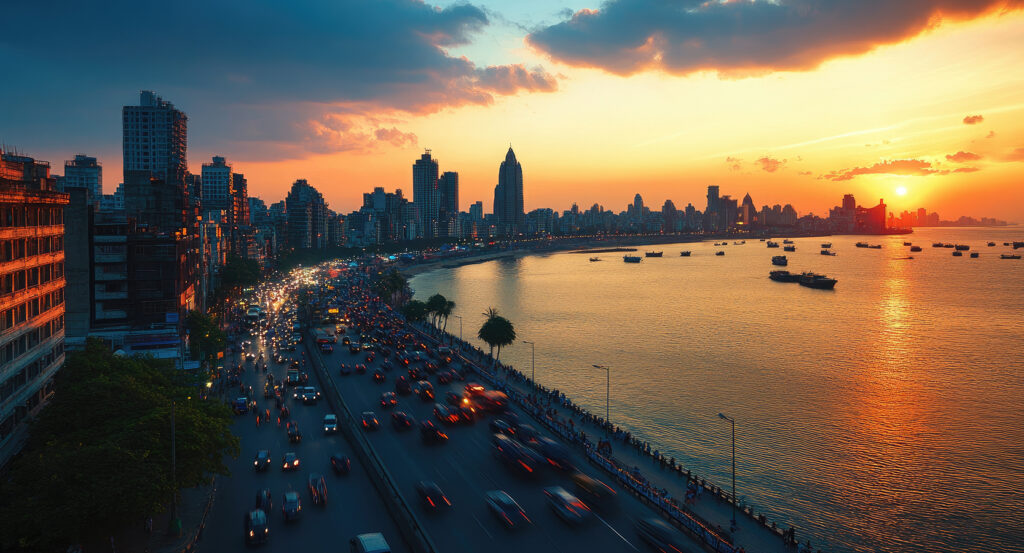
Set along Senapati Bapat Marg in Lower Parel, The St. Regis Mumbai occupies a position between High Street Phoenix, Palladium, Mahalaxmi Racecourse and the roads leading toward Haji Ali and the Arabian Sea, with Central Mumbai extending south through the dense metropolitan corridor. Its distinctive physical setting combines a contemporary luxury tower, former mill districts, high-end retail, racecourse grounds and the layered skyline of Central Mumbai. The city is encountered primarily through movement between the hotel, shopping complexes, offices, restaurants, racecourse roads and the routes connecting Lower Parel with Worli, Mahalaxmi and South Mumbai. A second atmosphere develops inside the property through restaurants, lounges, guest floors, wellness facilities, pools and event rooms that provide a polished refuge from traffic, heat and the intensity of the commercial district. The result is an exceptional urban hotel whose architecture and setting connect Mumbai's industrial past, luxury economy, financial center and maritime geography.
What defines The St. Regis Mumbai.
The St. Regis Mumbai is best known for introducing the St. Regis brand to India, transforming an established luxury hotel within the High Street Phoenix development into a flagship institution at the center of Mumbai's commercial and cultural reinvention. The property's origins trace to The Phoenix Mills Limited, whose transformation of a historic textile manufacturing complex into a major mixed-use destination became one of the defining redevelopment projects in Lower Parel. The former Phoenix Mills industrial estate belonged to Mumbai's extensive cotton-milling economy, which had supported the city's emergence as India's principal industrial and commercial center during the nineteenth and twentieth centuries. Under the leadership of Atul Ruia, Phoenix Mills expanded its commercial interests through luxury retail, hospitality, entertainment, and property development, establishing High Street Phoenix as a prominent destination within the former mill district. Its hospitality subsidiary, Pallazzio Hotels & Leisure Limited, developed a major hotel tower adjoining Palladium, the luxury shopping center that strengthened the district's appeal to international retailers and affluent consumers. The hotel originally opened in December 2012 under the management of Shangri-La Hotels and Resorts, introducing a substantial international hospitality establishment to an area undergoing rapid commercial transformation. The relationship ended in August 2013, prompting the property's transition to the independently operated Palladium Hotel. Phoenix Mills subsequently pursued a new international management partnership, negotiating with Starwood Hotels & Resorts Worldwide to introduce the St. Regis character to the Indian market. The companies entered into management and licensing agreements in September 2014, establishing the commercial foundation for an extensive refurbishment and rebranding program. Starwood announced the forthcoming transformation in May 2015, positioning the project as a major milestone in the international expansion of a luxury brand founded by John Jacob Astor IV in New York in 1904. The St. Regis Mumbai began operating under its new character on September 1, 2015, with an official launch ceremony following in November. Its introduction marked the first St. Regis property in India and South Asia, establishing Mumbai as the destination for the brand's entry into one of the world's largest emerging luxury hospitality markets. The hotel's arrival also reinforced Lower Parel's transformation from an industrial manufacturing district into a concentration of corporate headquarters, international retail, luxury residences, and cultural institutions. The property quickly became associated with Mumbai's entertainment industry and prominent social celebrations, hosting wedding festivities connected with cricketers Rohit Sharma and Dhawal Kulkarni, alongside Bollywood figures Bipasha Basu and Preity Zinta, during its first year under the St. Regis identity. These occasions strengthened its position within the city's established traditions of elaborate private celebrations and high-profile social gatherings. The St. Regis Mumbai captures the transformation of the city's historic textile economy into contemporary luxury commerce, connecting the redevelopment ambitions of Phoenix Mills with the international expansion of one of hospitality's most recognizable brands.
Pallazzio Hotels & Leisure's original architectural program established the property's distinctive character through an expansive tower rising above the former industrial landscape, connecting the vertical scale of contemporary Mumbai with the social traditions of the city's established luxury hotels. The thirty-eight-story structure integrates its principal hospitality spaces into an elevated metropolitan setting, introducing expansive perspectives across the surrounding commercial district and toward the Arabian Sea. Its interior conception combines polished stone, warm metallic finishes, decorative lighting, and contemporary Indian artistic references, establishing a sophisticated visual relationship between international luxury design and Mumbai's cosmopolitan character. The hotel's ceremonial spaces develop this architectural character through substantial gathering rooms and interconnected social environments, reflecting the importance of weddings, corporate celebrations, and formal entertaining within the city's cultural life. The St. Regis Bar introduces a direct connection with the brand's Manhattan origins through the Bloody Mary tradition associated with bartender Fernand Petiot and the King Cole Bar at The St. Regis New York. Mumbai's signature interpretation, the Mumbai Mary, adapts the established cocktail through spices and flavors associated with Indian culinary traditions, connecting an internationally recognized hospitality ritual with the city's distinctive gastronomic identity. The Drawing Room develops another dimension of this inheritance through afternoon tea, preserving a social custom deeply embedded in Mumbai's colonial-era hospitality culture. The hotel's culinary program extends the relationship between regional character and international influences through The Sahib Room & Kipling Bar, whose original conception drew upon the architectural and cultural atmosphere of British India. Its culinary direction emphasized the diverse regional traditions of Indian cooking, incorporating aromatic spice combinations, carefully developed sauces, and preparations associated with the subcontinent's established royal and domestic cuisines. By the Mekong introduced a complementary interpretation of Asian gastronomy, drawing upon the interconnected culinary cultures of China, Thailand, and Vietnam. Its elevated setting reinforced the hotel's relationship with Mumbai's metropolitan skyline, bringing the distinct flavors and cooking traditions of East and Southeast Asia into a sophisticated contemporary dining environment. Yuuka developed the property's original Japanese culinary character through an emphasis on precise preparation, ingredient quality, and the visual refinement associated with modern Japanese restaurant culture. The hotel's uppermost floors became particularly influential within Mumbai's nightlife through Asilo, an elevated open-air destination whose panoramic setting established a prominent gathering place for the city's entertainment and fashion communities. EXO and Li Bai contributed complementary social environments, extending the property's cultural importance into the late-night entertainment traditions of contemporary Mumbai. The original culinary and nightlife collection earned recognition across several categories at the Times Food & Nightlife Awards, reflecting its early influence within the city's competitive restaurant and entertainment landscape. Together, the hotel's elevated architectural composition, its adaptation of historic St. Regis rituals, and its ambitious culinary and social programming established a distinctive relationship between Mumbai's international cultural character and the luxury hospitality traditions of the original New York institution.
How The St. Regis Mumbai fits.
The St. Regis Mumbai works as the starting point for an exploration connecting the city's maritime religious traditions, its textile and industrial history and the cultural institutions that define Central Mumbai.
Begin at Haji Ali Dargah, the historic mosque and tomb complex standing on an islet reached by a causeway across the waters off Worli. The shrine's domes, minarets and waterfront setting create one of Mumbai's most recognizable religious landscapes, where tides, pilgrimage, architecture and the open sea meet. Its position reveals the city's long relationship with maritime routes, coastal devotion and the changing geography of the shoreline. Continue to Nehru Centre, the cultural complex where exhibitions, planetarium programs, galleries and public events present India's scientific, artistic and civic life within the Worli district. The institution occupies a prominent position near the Arabian Sea and Mahalaxmi Racecourse, connecting education, public culture and the modern development of Central Mumbai. Its exhibitions and programs broaden the city's character beyond finance, retail and high-rise development into science, history and national cultural expression. Continue to Dr. Bhau Daji Lad Mumbai City Museum, the historic institution where decorative arts, maps, photographs, models and objects present the development of Mumbai from island settlement to colonial port and modern metropolis. Its Victorian architecture and collections reveal the relationship between commerce, migration, industry, civic planning and the city's expanding population. The museum provides a direct connection between Mumbai's material history and the industrial landscape that later transformed Lower Parel and Worli. Conclude at Chhatrapati Shivaji Maharaj Vastu Sangrahalaya, the major museum where archaeology, Indian art, sculpture, decorative arts and natural history occupy a landmark Indo-Saracenic building in South Mumbai. The museum's collections connect the city to the civilizations, kingdoms, religious traditions and artistic practices that shaped the Indian subcontinent. Its gardens and galleries provide a cultural counterpoint to Lower Parel's towers and former mill districts, placing Mumbai within a much longer history of trade and artistic exchange. The progression moves from Haji Ali Dargah's maritime religious setting through Nehru Centre's civic and scientific culture, continues across Dr. Bhau Daji Lad Mumbai City Museum's urban history and concludes at Chhatrapati Shivaji Maharaj Vastu Sangrahalaya, where Mumbai's ocean, faith, industry, art and metropolita character meet.
Where your story begins.
Foresyte Travel reveals places that feel extraordinary long before you arrive.
Enjoy editorial crafted for luxury travelers.
Foresyte may earn a commission when you book.