Perfect weekend in Barcelona, Spain.
Barcelona's place in European history was forged through Mediterranean commerce, Catalan political institutions, industrial expansion, and an architectural movement that transformed the appearance of the modern city. Established as the Roman colony of Barcino during the reign of Augustus, the settlement developed into an important trading center along the northeastern coast of the Iberian Peninsula. During the Middle Ages, Barcelona became the political center of the County of Barcelona and a principal commercial port of the Crown of Aragon, whose maritime influence extended across the western Mediterranean. The city's medieval shipyards supported naval construction and commercial expansion, contributing to the prosperity of its merchant families and craft guilds. The War of the Spanish Succession culminated in the fall of Barcelona on September 11, 1714, followed by the suppression of important Catalan political institutions under Philip V. Industrialization during the nineteenth century transformed Barcelona into Spain's principal textile manufacturing center, generating the wealth that financed extensive residential construction and architectural experimentation. The demolition of the medieval walls and Ildefons Cerdà's ambitious Eixample plan of 1859 created an extensive grid of broad streets and chamfered intersections. Barcelona subsequently became the birthplace of Catalan Modernisme, an artistic movement whose architects, designers, and patrons fundamentally altered European approaches to architecture and decorative arts.
Barcelona's international artistic reputation extends through painting, sculpture, music, literature, and a culinary heritage grounded in Catalonia's Mediterranean agriculture. Pablo Picasso spent formative years in the city, studying at the Escola de la Llotja and developing relationships with artists and writers associated with the Els Quatre Gats café. The Museu Picasso houses an extensive collection of his early works, providing an important connection to the artistic experimentation of his youth. Joan Miró maintained deep connections with Catalonia throughout his career, developing an influential visual language associated with Surrealism and twentieth-century abstraction. The Fundació Joan Miró, designed by Josep Lluís Sert, became an important institution for modern art on Montjuïc. The Palau de la Música Catalana, designed by Lluís Domènech i Montaner, represents the architectural ambitions of Catalan Modernisme through its elaborate stained glass, sculptural decoration, and innovative concert hall. Barcelona's culinary traditions draw upon Mediterranean seafood, seasonal vegetables, olive oil, rice, and the agricultural production of Catalonia's surrounding countryside. Preparations including escalivada, suquet de peix, and crema catalana demonstrate the region's longstanding relationships with coastal fishing and rural cooking. Contemporary Catalan gastronomy has achieved international influence through experimental techniques and ambitious interpretations of regional ingredients. A perfect weekend in Barcelona brings together the maritime history, architectural achievements, artistic movements, and culinary traditions that have shaped Catalonia's capital across centuries.
Three day itinerary.
Day 1: La Rambla
La Rambla is best known for forming Barcelona's historic pedestrian spine between Plaça de Catalunya and the waterfront at Port Vell. Its course follows the line of a seasonal stream that once ran beyond the medieval city walls before urban expansion incorporated the corridor into Barcelona. Convents, markets, theaters, palaces, and civic buildings progressively established the avenue as a major social and commercial axis. The Gran Teatre del Liceu brought opera to the boulevard in the nineteenth century, and the Mercat de Sant Josep de la Boqueria developed beside it into one of the city's principal food markets. Plane trees, flower stalls, pavement mosaics, historic facades, and the continuous central promenade preserve a streetscape shaped by centuries of metropolitan growth.
Day 1: Disfrutar
Disfrutar is best known for Oriol Castro, Eduard Xatruch, and Mateu Casañas's expansion of the experimental culinary tradition they developed during their years at elBulli. The three chefs occupied senior creative positions within Ferran Adrià's kitchen, where dramatic work with texture, temperature, structure, and perception transformed international gastronomy. They opened Disfrutar in Barcelona in 2014 and built its tasting menus around technical invention, Mediterranean ingredients, unexpected physical forms, and tightly controlled sequences of flavor. Ceramics and other materials within the restaurant connect its contemporary interior to Mediterranean craft and Barcelona's artistic traditions. Three MICHELIN stars place Disfrutar within Barcelona's highest culinary tier, cementing its position as one of the most consequential descendants of the experimental movement that reshaped Spanish fine dining.
Day 2: Basílica de la Sagrada Família
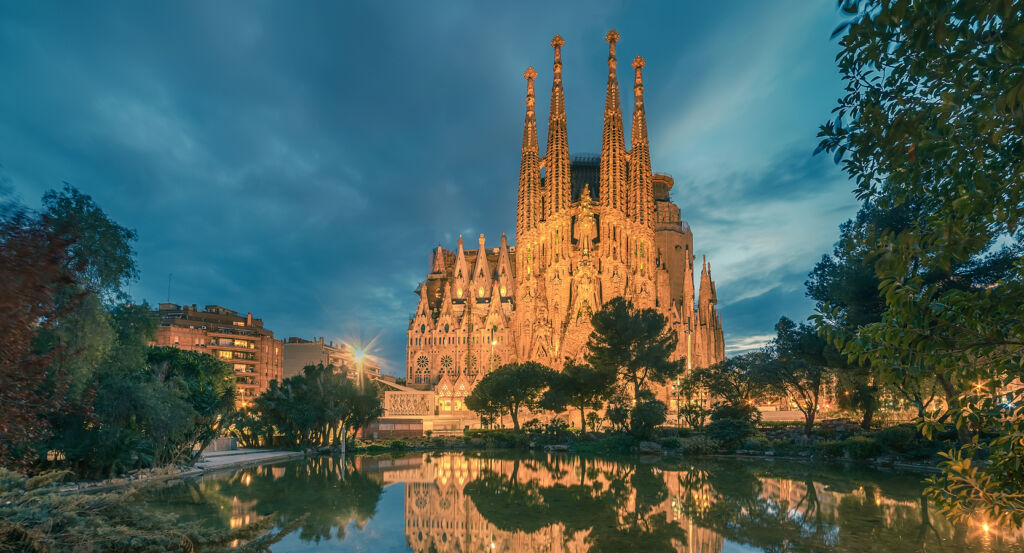
Basílica de la Sagrada Família is best known for Antoni Gaudí's transformation of Gothic church architecture through structural geometry, natural forms, sculpture, light, and religious symbolism. Construction began in 1882 under architect Francisco de Paula del Villar before Gaudí assumed control of the project the following year and radically reconceived it. Hyperboloids, helicoids, branching columns, ruled surfaces, and catenary-derived structures allowed architecture and engineering to operate as a unified system. Gaudí devoted the final phase of his life almost entirely to the basilica and was buried in its crypt after his death in 1926. The Nativity and Passion facades developed sharply different sculptural languages around the life and death of Christ. Generations of architects and craftspeople subsequently carried the unfinished project forward from Gaudí's models, drawings, surviving fabric, and geometric principles.
Day 2: Cocina Hermanos Torres
Cocina Hermanos Torres is best known for Sergio and Javier Torres's placement of the working kitchen at the physical and conceptual center of a three-star restaurant. The Barcelona-born twins developed their careers through European kitchens before building an independent culinary character grounded in Mediterranean ingredients, precise stocks, seasonal products, and close relationships with producers. Three cooking stations occupy the center of the dining room, dissolving the conventional architectural division between culinary production and service. An industrial building in Les Corts provides the expansive volume required for this arrangement, with diners positioned around the chefs as dishes move directly from preparation into service. Three MICHELIN stars place Cocina Hermanos Torres within Barcelona's highest culinary tier, establishing the brothers' open-kitchen model as one of the city's most accomplished expressions of contemporary gastronomy.
Day 2: Park Güell
Park Güell is best known for Antoni Gaudí's conversion of an unsuccessful residential development into one of the defining works of Catalan Modernisme. Industrialist Eusebi Güell commissioned the project as a garden suburb on the slopes above Barcelona, with Gaudí designing roads, viaducts, communal spaces, gatehouses, and infrastructure around the difficult terrain. Commercial failure prevented the planned residential community from developing at scale, leaving the architectural structure to assume a new civic role. The grand staircase, hypostyle hall, serpentine bench, and extensive trencadís mosaics combine structural invention with fragments of colored ceramic. Stone viaducts emerge from the hillside through inclined columns and irregular surfaces modeled on geological formations. The resulting complex became an extraordinary synthesis of landscape design, engineering, architecture, craft, and Gaudí's study of natural geometry.
Day 2: Enigma
Enigma is best known for Albert Adrià's continuation of Barcelona's experimental culinary tradition through a highly technical tasting menu structured around continual transformation. Adrià spent decades at elBulli, where his work in pastry and creative development helped produce techniques that profoundly altered international fine dining. Enigma became a vehicle for extending that research through seafood, vegetables, sauces, preservation, intricate preparations, and dishes completed directly before diners. Its futuristic interior reinforces the kitchen's focus on manipulation, surprise, and exacting technical control. MICHELIN elevated Enigma to two stars in the 2026 guide, strengthening Adrià's position as one of the principal figures connecting the elBulli revolution to Barcelona's contemporary restaurant culture.
Day 3: El Quim de la Boqueria
El Quim de la Boqueria is best known for bringing serious Catalan market cooking directly into the commercial life of Mercat de Sant Josep de la Boqueria. Quim Márquez established the counter within the market in 1987, building its character around ingredients moving through the surrounding fishmongers, butchers, produce vendors, and specialty stalls. Eggs, seafood, mushrooms, vegetables, offal, and other market products form the basis of preparations cooked within an unusually compact workspace. Counter seating places diners immediately beside the griddle and kitchen, preserving the direct relationship among market sourcing, preparation, and consumption that historically defined European food halls. El Quim represents Barcelona's market culture at its most concentrated, joining Catalan ingredients and professional cooking inside one of the city's oldest commercial institutions.
Day 3: Casa Batlló
Casa Batlló is best known for Antoni Gaudí's dramatic reconstruction of a conventional apartment building into a unified work of architecture, decorative art, structural invention, and organic form. Textile industrialist Josep Batlló commissioned Gaudí to remodel the existing Passeig de Gràcia property during the early twentieth century. Gaudí reshaped its facade with undulating stone, irregular balconies, colored glass, ceramic fragments, and a scaled roof whose profile has long evoked a dragon. A central light well distributes daylight through graded blue tiles whose changing tones regulate visual intensity across different floors. Curved woodwork, custom doors, ergonomic handles, ventilation systems, and flowing interior surfaces extend the architectural concept into minute functional details. Casa Batlló became one of the clearest demonstrations of Gaudí's ability to treat an existing urban building as a complete artistic organism.
Day 3: Gothic Quarter
Gothic Quarter is best known for preserving the historic core of Barcelona across layers of Roman, medieval, and later urban development. Roman Barcino occupied part of the district, and surviving walls, columns, street alignments, and archaeological remains preserve the physical foundations of the ancient settlement. Medieval Barcelona subsequently concentrated royal, religious, administrative, and commercial institutions within the same compact territory. Barcelona Cathedral, the Plaça del Rei complex, narrow streets, enclosed squares, and surviving civic buildings preserve major elements of that later city. Nineteenth- and twentieth-century interventions reshaped portions of the quarter and strengthened its Gothic architectural character as Barcelona constructed a modern understanding of its medieval past. The district compresses more than two millennia of urban history into the street network surrounding the city's ancient political center.
Day 3: Lasarte
Lasarte is best known for Martín Berasategui's culinary philosophy as interpreted in Barcelona through an exceptionally refined contemporary tasting-menu restaurant. Berasategui developed his career in the Basque Country and became one of Spain's most decorated chefs through an approach grounded in rigorous technique, concentrated sauces, immaculate seafood, precise temperature control, and disciplined presentation. Lasarte extended that culinary lineage into Barcelona under a kitchen shaped by Berasategui's methods and long-term collaborators. Catalan and Mediterranean products enter a technical system informed by the chef's Basque foundations, creating a direct connection between two of Spain's most influential gastronomic regions. Three MICHELIN stars place Lasarte within Barcelona's highest culinary tier and make it a formidable final expression of the city's position within modern Spanish gastronomy.
Where your story begins.
Foresyte Travel reveals places that feel extraordinary long before you arrive.
Enjoy editorial crafted for luxury travelers.
Foresyte may earn a commission when you book.