
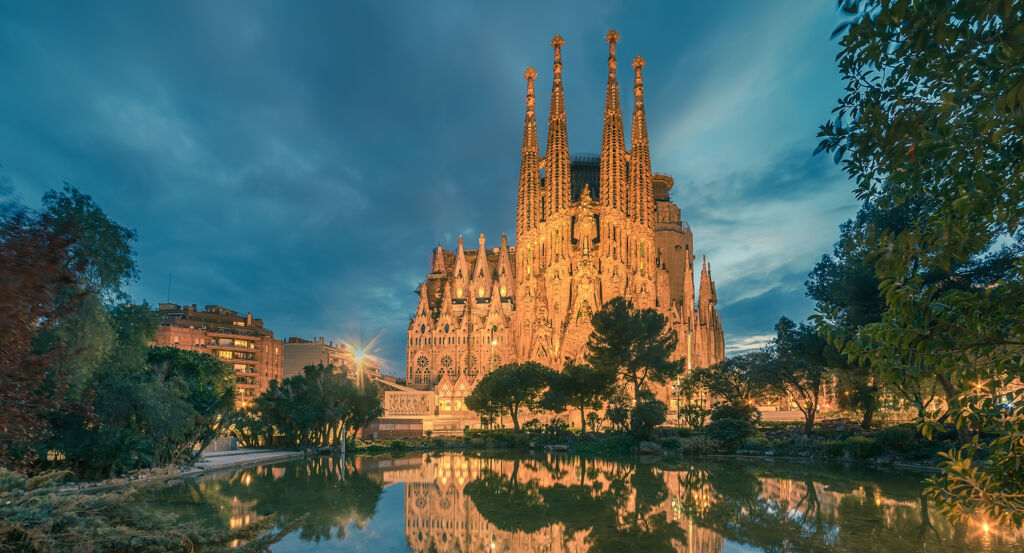
Why Casa Batlló matters.
Casa Batlló is a fantastical Modernista residence where Eixample's bourgeois architectural ambitions meet Antoni Gaudí's transformation of a conventional apartment building into an astonishing composition of sculpted stone, iridescent ceramics and structural forms inspired by the natural world.
Standing on Passeig de Gràcia between Carrer d'Aragó and Carrer del Consell de Cent, the celebrated residence occupies a narrow urban parcel within Barcelona's Quadrat d'Or, with its undulating facade rising among richly ornamented apartment buildings along one of the city's most prestigious nineteenth-century boulevards. Curved stone columns frame the lower windows, and delicate wrought-iron balconies project above an irregular surface of colored glass and ceramic fragments. The roofline rises in overlapping glazed tiles, culminating in a rounded turret crowned by a four-armed cross. Tall neighboring facades emphasize the building's unusual proportions, and the broad pavement provides a direct perspective on its sculptural exterior. The result is a distinctive architectural composition whose expressive craftsmanship and technical refinement establish a defining achievement of Catalan Modernisme.
What defines Casa Batlló.
Casa Batlló is best known for Antoni Gaudí's transformation of an existing residential building into one of the most inventive architectural works of the early twentieth century. The original apartment house was constructed in 1877 by architect Emili Sala Cortés, among Gaudí's former teachers. Textile industrialist Josep Batlló i Casanovas purchased the property in 1903 as Barcelona's expanding commercial elite invested heavily in prestigious urban residences. Batlló initially considered replacing the existing structure, but Gaudí developed a comprehensive renovation that retained its principal foundations and structural structure. Construction proceeded between 1904 and 1906, transforming the facade, circulation areas, residential interiors and roof. The commission occupied a particularly prominent position within the Manzana de la Discordia, a block containing ambitious works by competing Modernista architects. Gaudí collaborated with specialist craftsmen whose expertise in ceramics, stained glass, metalwork and woodworking enabled the realization of his complex designs. The renovation enlarged the principal residential floor and reorganized internal spaces to improve natural illumination and ventilation. Batlló and his family occupied the principal apartment, and other floors continued to accommodate residential tenants. The building received recognition in Barcelona's municipal architectural competition of 1906, although the principal award went to a different project. Following Josep Batlló's death in 1934, the property passed through successive ownership arrangements as its original residential functions changed. The Bernat family acquired the building in 1993 and subsequently undertook substantial restoration and conservation work. Public access expanded during the early twenty-first century, establishing the residence as an important institution devoted to Gaudí's architectural achievement. UNESCO incorporated Casa Batlló into the Works of Antoni Gaudí World Heritage designation in 2005, recognizing its contribution to the development of modern architecture.
How Casa Batlló fits.
Casa Batlló works as the architectural anchor for a Barcelona outing connecting the competing visions of Catalan Modernisme, the commercial prosperity of Passeig de Gràcia and the distinctive residential buildings that transformed the city's nineteenth-century expansion.
Begin at Casa Amatller, the adjoining residence redesigned by Josep Puig i Cadafalch between 1898 and 1900 for chocolate manufacturer Antoni Amatller. Its stepped Flemish-inspired gable, sculpted stone entrance and elaborate decorative program establish a striking contrast with the surrounding apartment buildings. The facade incorporates ceramic ornament, heraldic imagery and carved figures associated with the owner's interests and commercial standing. Interior rooms preserve original furnishings, decorative surfaces and architectural details that illuminate the domestic circumstances of Barcelona's industrial elite. The building also houses the Institut Amatller d'Art Hispànic, an institution dedicated to the study and preservation of Spanish art. Continue to Casa Lleó Morera, the residential building remodeled by Lluís Domènech i Montaner between 1902 and 1906. Its elaborate facade incorporates sculptural figures, floral ornament and carefully arranged architectural elements that demonstrate the decorative ambitions of Catalan Modernisme. Domènech i Montaner collaborated with prominent craftsmen, including sculptor Eusebi Arnau and mosaic artist Lluís Brú, to develop a coordinated artistic program. The building received the Barcelona City Council's annual award for artistic buildings in 1906, establishing its contemporary architectural significance. Its preserved exterior demonstrates the variety of materials and techniques employed by Barcelona's leading Modernista workshops. Conclude at Casa Milà, the residential building designed by Gaudí for Pere Milà and Roser Segimon between 1906 and 1912. Its undulating stone facade and wrought-iron balconies introduced a radically unconventional architectural composition along Passeig de Gràcia. The building's structural arrangement permits flexible apartment layouts, and internal courtyards distribute natural light throughout the residential floors. Its rooftop contains sculptural chimney stacks and ventilation towers whose geometric forms contribute to the building's distinctive silhouette. UNESCO recognition acknowledges the property's architectural importance within Gaudí's mature work. The progression moves from Casa Amatller's Gothic-inspired domestic architecture through Casa Lleó Morera's elaborate decorative craftsmanship and culminates at Casa Milà's structural innovations, connecting Casa Batlló with the competing architectural achievements that established Passeig de Gràcia as a principal center of Catalan Modernisme.
Where your story begins.
Foresyte Travel reveals places that feel extraordinary long before you arrive.
Enjoy editorial crafted for luxury travelers.














































































































