Perfect weekend in Prague, Czech Republic.
Prague's position at the crossroads of Central Europe shaped more than a millennium of royal government, religious reform, artistic patronage, and intellectual achievement, establishing the Czech capital as one of Europe's most historically significant cities. Situated along the Vltava River within the Bohemian Basin, Prague emerged as a political center during the ninth century under the Přemyslid dynasty, whose rulers consolidated authority over the surrounding territories of Bohemia. The establishment of the Bishopric of Prague in 973 strengthened the city's religious importance, encouraging the development of ecclesiastical institutions and commercial settlements along the river. During the reign of Charles IV, who became King of Bohemia in 1346 and Holy Roman Emperor in 1355, Prague entered an exceptional period of political and cultural prosperity. The foundation of Charles University in 1348 created the first university in Central Europe, attracting scholars and students from across the continent. Charles IV also commissioned extensive fortifications, religious buildings, and the planned expansion of Nové Město, transforming Prague into an imperial capital of considerable architectural ambition. The religious teachings of Jan Hus subsequently contributed to the Hussite movement, whose conflicts during the fifteenth century profoundly influenced European religious history. The Defenestration of Prague in 1618 helped precipitate the Thirty Years' War, followed by Habsburg consolidation and the expansion of Baroque architectural patronage. The establishment of Czechoslovakia in 1918 brought Prague into a new period of national independence, interrupted by Nazi occupation and four decades of Communist government. The Velvet Revolution of 1989 restored democratic government, and Prague became the capital of the independent Czech Republic in 1993.
Prague's artistic achievements extend through classical music, literature, theater, decorative arts, and a culinary heritage grounded in the agricultural traditions of Bohemia. The National Theatre, whose principal building opened in 1881, became an important institution of the Czech National Revival, supporting opera, drama, and ballet performed in the Czech language. Composers Bedřich Smetana and Antonín Dvořák contributed substantially to the development of Czech national music, incorporating regional musical traditions into works that achieved international recognition. The Rudolfinum, completed in 1885, became an important concert venue and subsequently the home of the Czech Philharmonic, founded in 1896. Prague's literary heritage includes Franz Kafka, whose fiction explored bureaucracy, alienation, and the uncertainties of modern existence, and Karel Čapek, whose 1920 play R.U.R. introduced the word robot to international literature. The Mucha Museum celebrates the work of Alfons Mucha, whose decorative compositions and theatrical posters became influential achievements of European Art Nouveau. The city's modern artistic heritage also encompasses Cubist architecture, with buildings such as the House of the Black Madonna demonstrating the adaptation of avant-garde artistic principles to architectural design. Traditional Czech cuisine draws upon regional agriculture, freshwater fish, game, root vegetables, and the longstanding brewing traditions of Bohemia. Preparations including svíčková, roast duck with dumplings, and traditional fruit-filled pastries occupy established places within local gastronomy, accompanied by Czech lagers and regional wines from Moravia. Contemporary Prague restaurants extend these culinary foundations through seasonal ingredients and innovative interpretations of Central European cooking. A perfect weekend in Prague brings together imperial history, architectural achievement, Czech artistic traditions, and the distinctive gastronomy of one of Central Europe's most influential capitals.
Three day itinerary.
Day 1: Old Town Square
Old Town Square is best known for concentrating nearly a millennium of Prague's mercantile, religious, and political history within the medieval core of Staré Město. The square developed beside major European trade routes as Prague expanded around the Vltava, drawing merchants into a marketplace surrounded by houses, churches, guild buildings, and civic institutions. The Gothic Church of Our Lady before Týn acquired its commanding twin-towered profile as Old Town accumulated wealth and political importance during the late Middle Ages. Baroque architecture subsequently transformed portions of the square after the upheavals of the seventeenth century. The execution of twenty-seven leaders of the Bohemian Revolt there in 1621 made the square a setting for one of the defining episodes of Habsburg consolidation in the Czech lands. Old Town Square preserves Prague as a physical accumulation of medieval commerce, religious conflict, royal power, and Bohemian civic identity.
Day 1: La Degustation
La Degustation is best known for Oldřich Sahajdák's reconstruction of Czech culinary traditions through seasonal ingredients and contemporary technique. The restaurant opened in 2006 with Czech cooking as its defining subject, developing dishes from the agricultural products, forests, ponds, farms, and culinary history of Bohemia. Sahajdák built the kitchen around regional sourcing, with vegetables, freshwater fish, game, meat, dairy, and preserved ingredients forming a distinctly Czech foundation. Its work reaches into historical domestic cooking and the recipes associated with nineteenth-century Czech culinary culture, transforming inherited preparations through the precision of a modern tasting menu. La Degustation became one of the restaurants responsible for establishing contemporary Czech cuisine as a serious fine-dining discipline in Prague. La Degustation
Day 2: Charles Bridge
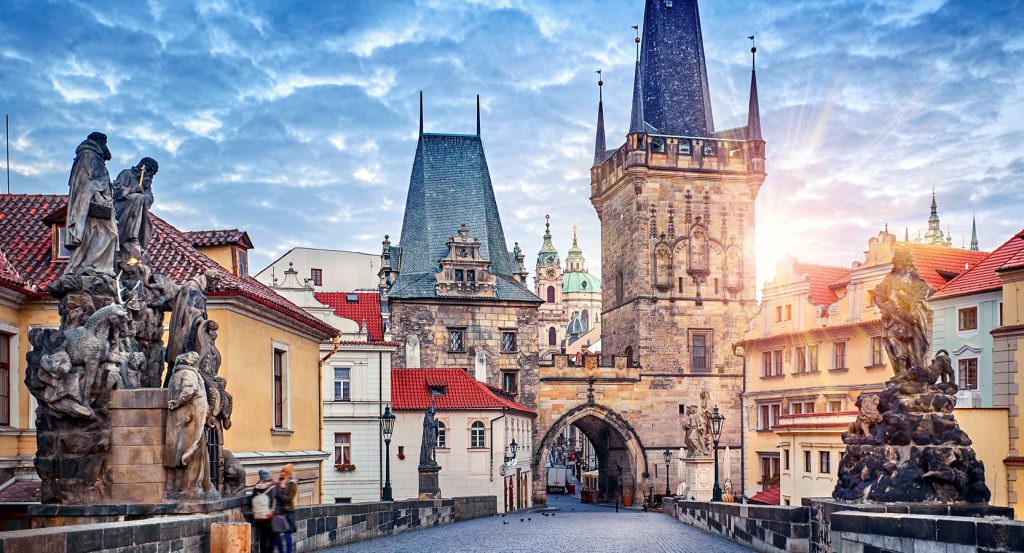
Charles Bridge is best known for carrying Prague's principal medieval crossing of the Vltava between Old Town and Malá Strana beneath the towers of Prague Castle. Emperor Charles IV commissioned the stone bridge after a flood destroyed its Romanesque predecessor, Judith Bridge, and construction began in 1357 under the direction associated with Peter Parler's workshop. Sixteen arches carried the crossing across the river, establishing a critical commercial and ceremonial connection through the royal capital. Baroque statues progressively transformed the bridge during the seventeenth and eighteenth centuries, creating an extraordinary sculptural corridor above the medieval engineering. The Battle of Prague in 1648 brought fighting directly to the bridge as Swedish forces attempted to penetrate Old Town. Charles Bridge became a physical expression of Prague's role as royal capital, trading center, fortified city, and artistic center within Central Europe.
Day 2: Field Restaurant
Field Restaurant is best known for Radek Kašpárek's transformation of Czech ingredients into exacting contemporary cuisine rooted in the country's agricultural landscape. Kašpárek built the restaurant around close relationships with seasonal products, placing vegetables, freshwater fish, meats, herbs, fermented ingredients, and regional produce at the center of technically disciplined compositions. The kitchen treats Czech terroir as its governing subject, extracting intensity from ingredients historically associated with farms, forests, fields, and inland waters. Restrained plating and concentrated sauces give the cooking a modern style without severing its connection to Central European products. Field established itself among Prague's leading restaurants by demonstrating the fine-dining potential of ingredients whose cultural meaning is inseparable from the Czech landscape. Field Restaurant
Day 2: Prague Astronomical Clock
Prague Astronomical Clock is best known for combining medieval astronomy, mechanical engineering, civic authority, and religious symbolism on the southern wall of Old Town Hall. The oldest portions date to 1410, when clockmaker Mikuláš of Kadaň and astronomer Jan Šindel created an astronomical mechanism capable of representing multiple systems of time and celestial movement. Its astrolabe displays the positions of the Sun and Moon against a complex astronomical dial, translating medieval conceptions of the cosmos into mechanical motion. A calendar dial and sculptural elements expanded the clock across subsequent centuries, and the procession of the Apostles became its most recognizable animated feature. Severe damage during the Prague uprising of May 1945 required major restoration after Old Town Hall burned under German attack. The clock survives as an exceptional union of medieval scientific knowledge, craftsmanship, civic architecture, and Prague's turbulent political history.
Day 2: Restaurant Mlýnec
Restaurant Mlýnec is best known for contemporary Czech cooking beside the Vltava at the Old Town end of Charles Bridge. The restaurant occupies Novotného lávka, a riverfront site historically associated with milling and the movement of water through Prague's urban economy. Czech ingredients and culinary traditions form the basis for modern preparations structured around seasonal produce, meat, freshwater fish, sauces, and Central European flavors. Its dining rooms establish an immediate architectural relationship with Charles Bridge and the Malá Strana riverbank across the water, placing the cuisine within Prague's defining historical geography. Mlýnec connects modern Czech restaurant culture with the river, bridge, mills, and commercial infrastructure that shaped the surrounding quarter for centuries. Restaurant Mlýnec
Day 3: Café Savoy
Café Savoy is best known for preserving Prague's grand café tradition through an ornate Neo-Renaissance interior and a serious commitment to Central European breakfast and pastry. The café occupies a late nineteenth-century building near the Vltava whose restored ceiling preserves an elaborate decorative program above the dining room. Viennoiserie, breads, cakes, eggs, open-faced preparations, and Czech pastry traditions give morning service the breadth historically associated with Central European coffeehouse culture. Its bakery reinforces that character through doughs and confectionery made as integral parts of the operation. Prague's cafés historically functioned as social spaces for writers, artists, professionals, and political discussion, making the form inseparable from the city's intellectual life. Café Savoy carries that institution into contemporary Prague through a morning meal grounded in the culinary traditions of Bohemia and the former Habsburg lands. Café Savoy
Day 3: Prague Castle
Prague Castle is best known for serving as the seat of Bohemian rulers, Holy Roman emperors, and Czech presidents across more than a thousand years of political history. Prince Bořivoj of the Přemyslid dynasty established a fortified seat on the ridge above the Vltava during the ninth century, beginning a complex that expanded with the power of the Bohemian state. Romanesque palaces and churches gave way to immense Gothic projects under Charles IV, whose imperial ambitions made Prague one of medieval Europe's principal political centers. Vladislav Hall later demonstrated the extraordinary engineering of late Gothic architecture through Benedikt Ried's sweeping ribbed vaults. Habsburg rulers added Renaissance and Baroque structures as the castle adapted to new dynasties and systems of government. The complex captures the continuity of Czech state power across monarchy, empire, occupation, communism, and the modern republic.
Day 3: St. Vitus Cathedral
St. Vitus Cathedral is best known for embodying the religious and dynastic ambitions of the Bohemian crown within the heart of Prague Castle. Charles IV founded the Gothic cathedral in 1344 as Prague became an archbishopric and his capital acquired growing imperial importance. Matthias of Arras initiated the design before Peter Parler transformed the project through daring vaulting, sculptural invention, and architectural solutions that helped define Central European Gothic design. The Chapel of St. Wenceslas surrounds the tomb of Bohemia's patron saint with semiprecious stones, frescoes, and extraordinary decorative richness. Coronations of Bohemian monarchs tied the cathedral directly to royal legitimacy, and the Crown Chamber became the repository of the Bohemian Crown Jewels. Construction continued intermittently for centuries before twentieth-century completion unified the immense structure, making St. Vitus a physical record of Czech religious, artistic, and political continuity.
Day 3: Terasa U Zlaté Studně
Terasa U Zlaté Studně is best known for refined dining immediately beneath Prague Castle within the historic fabric of Malá Strana. The restaurant occupies the Golden Well Hotel beside the castle gardens, giving its terraces exceptional proximity to the palaces, tiled roofs, domes, and towers descending toward the Vltava. Its culinary program draws from contemporary European technique through seasonal vegetables, seafood, meat, sauces, and carefully structured compositions. The surrounding quarter developed beneath the fortified royal seat as aristocratic palaces, ecclesiastical institutions, gardens, and residences transformed the left bank after medieval Prague expanded beyond its earliest settlements. Terasa U Zlaté studně joins serious contemporary cooking to one of Prague's most historically concentrated architectural environments.
Where your story begins.
Foresyte Travel reveals places that feel extraordinary long before you arrive.
Enjoy editorial crafted for luxury travelers.
Foresyte may earn a commission when you book.