
Why Old Town Square matters.
Old Town Square is a medieval civic square where Prague's historic commercial center meets the political institutions of the Bohemian kingdom, the religious conflicts of the Hussite era and the architectural development of Central Europe's urban marketplaces.
Positioned within Prague's Old Town between the former Jewish Quarter and the medieval commercial streets leading toward the Vltava, the square occupies a broad public space enclosed by Gothic, Renaissance, Baroque and Rococo buildings whose façades preserve successive phases of the city's development. Its irregular perimeter follows the boundaries of medieval properties and historic routes converging on the marketplace. The paved central area accommodates public gatherings, seasonal markets and commemorative events. Church towers, merchant houses and civic buildings define distinct architectural elevations around the enclosure. The result is a historic urban square whose surviving buildings preserve Prague's development as a commercial, religious and political center.
What defines Old Town Square.
Old Town Square is best known for its role as the principal marketplace and civic center of medieval Prague, particularly during the political and religious conflicts that shaped the Bohemian kingdom. Commercial activity developed around the square during the twelfth century as merchants gathered near routes connecting the Vltava crossings with settlements east of the river. The growing market attracted traders from German-speaking territories and other parts of Central Europe, strengthening Prague's position within regional commerce. King Wenceslaus I granted Prague's Old Town municipal privileges during the thirteenth century, supporting the development of independent civic institutions. In 1338, King John of Luxembourg authorized the municipality to acquire a building for its administrative headquarters, initiating the development of the Old Town Hall. Charles IV subsequently expanded Prague's political and commercial importance after becoming king of Bohemia in 1346 and Holy Roman emperor in 1355. His establishment of Charles University in 1348 reinforced the city's intellectual importance and contributed to the religious debates that preceded the Hussite movement. The execution of religious reformer Jan Hus at the Council of Constance in 1415 intensified opposition to ecclesiastical authority throughout Bohemia. The Hussite Wars transformed Prague into a principal center of religious and political conflict during the fifteenth century. In 1437, the execution of Hussite military commander Jan Roháč of Dubá demonstrated the continuing struggle over royal authority and religious allegiance. Following the defeat of the Bohemian Estates at the Battle of White Mountain in 1620, imperial authorities used the square for a public demonstration of Habsburg power. On 21 June 1621, twenty-seven leaders of the Bohemian revolt were executed outside the Old Town Hall, an event commemorated by crosses embedded in the pavement. The square continued to function as a public center through the Habsburg period, accommodating markets, ceremonies and political gatherings. During the Prague Uprising of May 1945, fighting and fire severely damaged the eastern wing of the Old Town Hall, leaving an altered architectural boundary that remains visible in the square's configuration.
Jan Hus's memorial occupies the center of the square, connecting its public space with the religious reform movement that shaped Czech political history. Sculptor Ladislav Šaloun designed the monument, which was unveiled in 1915 on the five-hundredth anniversary of Hus's execution. Its bronze figures represent the reformer and groups associated with the religious struggles of Bohemia, including Hussite warriors and Protestant exiles. The monument's substantial stone base creates a gathering point within the open marketplace. Across the square, the Church of Our Lady before Týn rises above the surrounding buildings through twin Gothic towers crowned with multiple spires. Construction of the church began during the fourteenth century, and its association with the Hussite movement made it an important center of Utraquist worship. The building's principal entrance is approached through the arcades of the Týn School, preserving the relationship between ecclesiastical architecture and the adjoining merchant properties. Its interior contains Baroque furnishings and the tomb of Danish astronomer Tycho Brahe, who worked at the court of Rudolf II. The Church of St. Nicholas occupies the northwestern side of the square, where architect Kilian Ignaz Dientzenhofer designed the surviving Baroque building during the eighteenth century. Its curved façade, dome and elaborate interior decoration distinguish the church from the surrounding Gothic architecture. The Kinský Palace contributes a Rococo frontage developed during the eighteenth century, incorporating a carefully ordered composition of pilasters, window surrounds and sculptural ornament. The building subsequently became associated with the National Gallery Prague, accommodating exhibitions within its historic rooms. The House at the Stone Bell preserves Gothic architectural elements associated with medieval residential construction, including pointed windows and substantial stone detailing. Old Town Square's architectural character develops through the physical proximity of these institutions, whose buildings preserve the religious, commercial and political functions of Prague's historic center.
How Old Town Square fits.
Old Town Square works as the medieval civic centerpiece for a Prague outing connecting the city's royal ceremonial route, historic Jewish institutions and the expansive architecture of the Vltava waterfront.
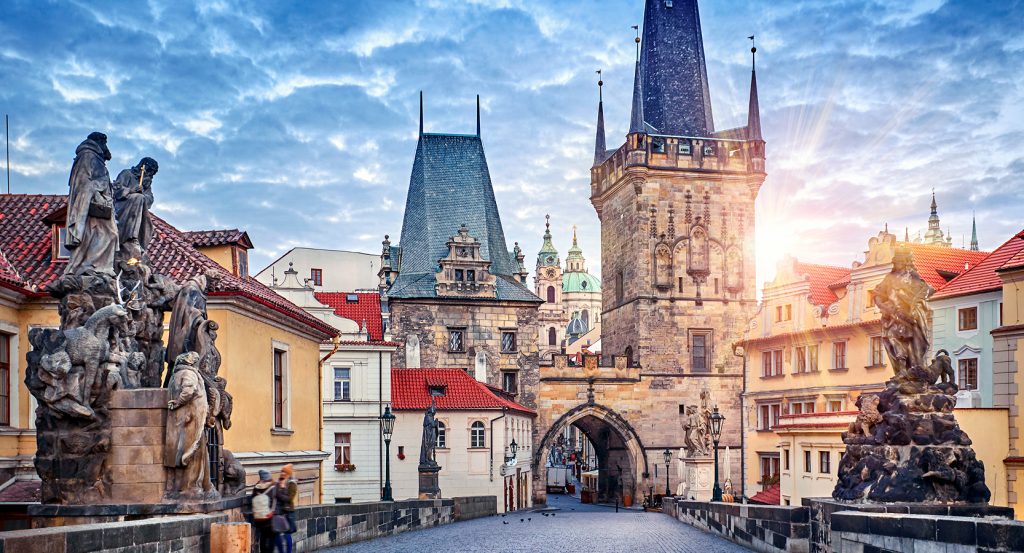
Begin at Powder Tower, the Gothic gateway constructed during the reign of Vladislaus II of Bohemia. Building began in 1475 under master mason Matěj Rejsek, who developed its elaborate sculptural decoration and pointed architectural forms. The tower originally marked an entrance to the Old Town and became associated with the Royal Route followed by Bohemian monarchs traveling toward their coronations. Its name developed from the storage of gunpowder within the structure during the seventeenth century. The surviving gateway preserves the relationship between medieval defensive architecture and the ceremonial geography of Prague's historic center. Continue to the Old Jewish Cemetery, the burial ground associated with Prague's Jewish community in Josefov. Established during the fifteenth century, the cemetery contains densely arranged gravestones accumulated through successive generations of burial. The oldest surviving gravestone belongs to Avigdor Kara, who died in 1439. The grave of Rabbi Judah Loew ben Bezalel, an influential sixteenth-century scholar associated with Prague's Jewish intellectual traditions, attracts particular historical interest. Restricted burial space contributed to the accumulation of successive layers of graves, producing the cemetery's distinctive arrangement of closely spaced monuments. Conclude at Charles Bridge, the stone crossing commissioned by Charles IV in 1357 to connect Prague's Old Town with Malá Strana. The bridge replaced the earlier Judith Bridge, which had been damaged by flooding in 1342. Its construction under master builder Peter Parler contributed to the development of Prague's principal medieval river crossing. Thirty Baroque statues and sculptural groups were installed along its parapets during subsequent centuries, incorporating religious subjects associated with the Catholic tradition. Fortified bridge towers frame its approaches and preserve elements of the city's medieval defensive infrastructure. The progression moves from royal ceremonial architecture through Prague's Jewish burial traditions and culminates at the Vltava crossing, connecting Old Town Square with the religious and political geography of the historic capital.
Where your story begins.
Foresyte Travel reveals places that feel extraordinary long before you arrive.
Enjoy editorial crafted for luxury travelers.
Foresyte may earn a commission when you book.





































































































